Remembering olden days
Elementary students travel back in time to learn Iowa ag history
-
-
-Submitted photo
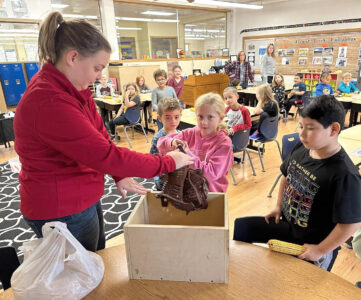
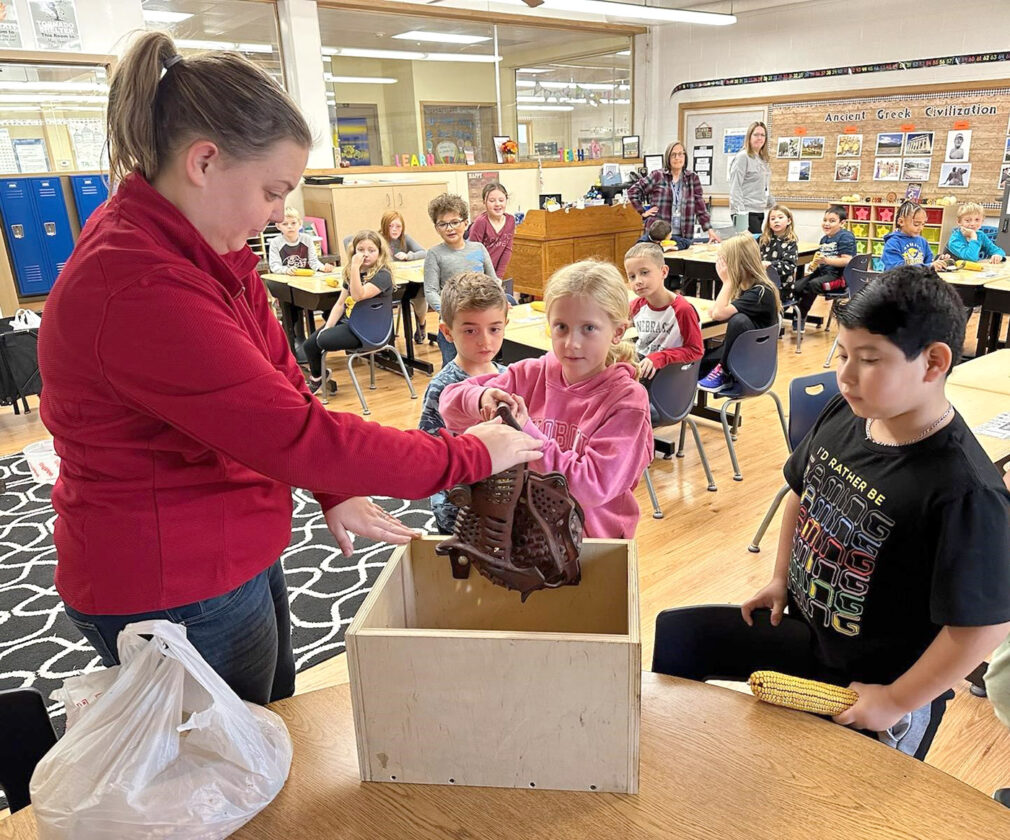
Kiersten Gatewood, youth coordinator for the Humboldt Iowa State University Extension and Outreach, holds a hand-cranked corn shelling machine as a student operates it. Students at Taft Elementary School and St. Mary’s Catholic School, both in Humboldt, recently completed classes on the history of farming that included hands-on experiences.
-
-
-Submitted photo
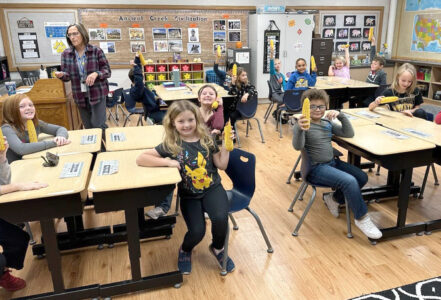
Students learned how to shell corn by hand.
-
-
-Submitted photo
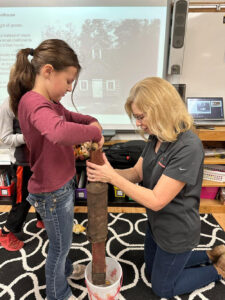
Kalene Berte, right, the tri-county ag in the classroom coordinator for Farm Bureau, steadies an old fashioned corn planter, while a student uses it to drop corn kernels into a bucket. Use of the old corn planter was part of an ag in the classroom program on the history of farming in North America. Students at Taft Elementary School and St. Mary’s Catholic School, both in Humboldt, completed the program.
-
-
-Submitted photo
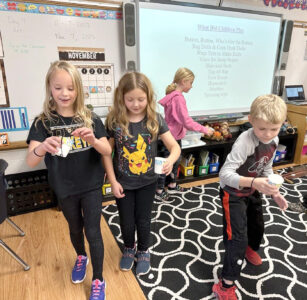
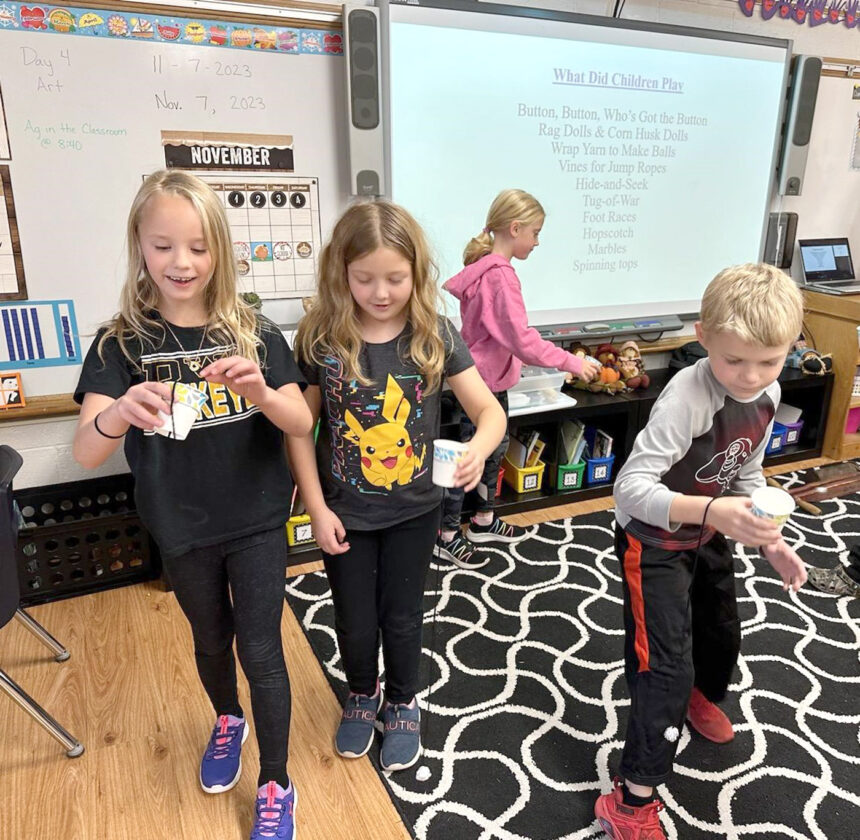
These students are playing an old fashioned game in which they must flip a ball attached to a string into the cup. The game was part of a lesson that showed how farm kids had fun decades ago.
-Submitted photo
Kiersten Gatewood, youth coordinator for the Humboldt Iowa State University Extension and Outreach, holds a hand-cranked corn shelling machine as a student operates it. Students at Taft Elementary School and St. Mary’s Catholic School, both in Humboldt, recently completed classes on the history of farming that included hands-on experiences.
HUMBOLDT — Second-grade students at Taft Elementary School and first-grade students at St. Mary Catholic School recently traveled back in time to discover the history of farming as part of their Ag in the Classroom lessons.
Kalene Berte, tri-county ag in the classroom coordinator for Farm Bureau, and Kiersten Gatewood, youth coordinator for Humboldt County ISU Extension and Outreach, used a PowerPoint presentation and hands-on learning to bring farming to life, from the first settlers to modern-day agriculture.
The lesson began with a brief history of North America and stories of the Native Americans, who started farming the land 10,000 plus years ago by growing maize (corn). Students learned that their ancestors moved to North America in hopes of a better life and were taught how to grow corn by the Native Americans by planting the seeds with a piece of fish.
The students discovered that the Homestead Act in the mid-1800s encouraged many settlers to move west. Photos of a covered wagon, log cabin, hand-powered corn planter, and a plow and planter pulled by horses helped students understand that farming demanded hard, physical work, with every member of the family helping.
Students learned that Iowa farms started out small, with only enough crops and livestock to feed the family and the livestock (subsistence farming). Presenters shared photos to show how advances in technology, including tractors, helped farmers grow more crops in less time. Farming has become so efficient that it’s possible for one farm today to feed 166 people a year.
-Submitted photo
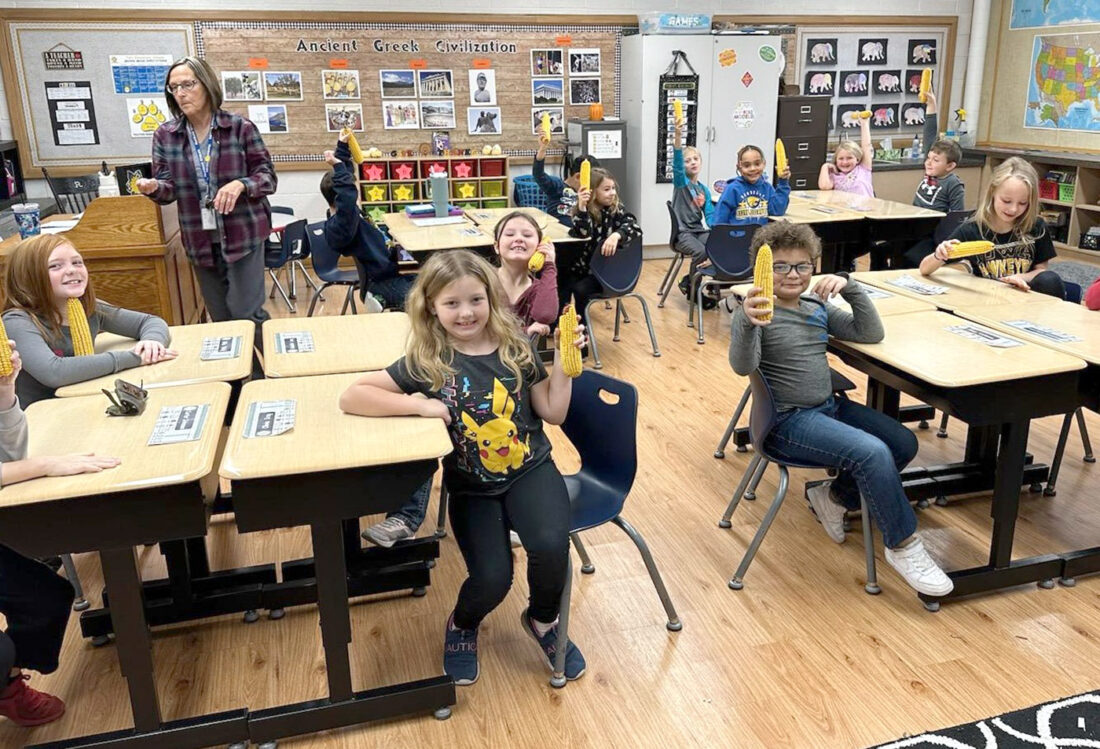
Students learned how to shell corn by hand.
While farmers use combines to harvest crops today, presenters explained how farmers in years past used to have to harvest corn by hand. They demonstrated this with a vintage corn-husking glove and a stalk of corn. They explained how each ear of corn would have been picked and husked by hand.
Students received an ear of corn and were encouraged to remove a few kernels, so they could learn how it felt to shell corn by hand. The students also had the opportunity to finish shelling their ear of corn with a vintage, hand-cranked corn sheller. They quickly learned that shelling the corn took time and was hard work. They also broke the cobs in half to see the inside.
“The students were extremely excited to take their shelled corn home,” Berte said.
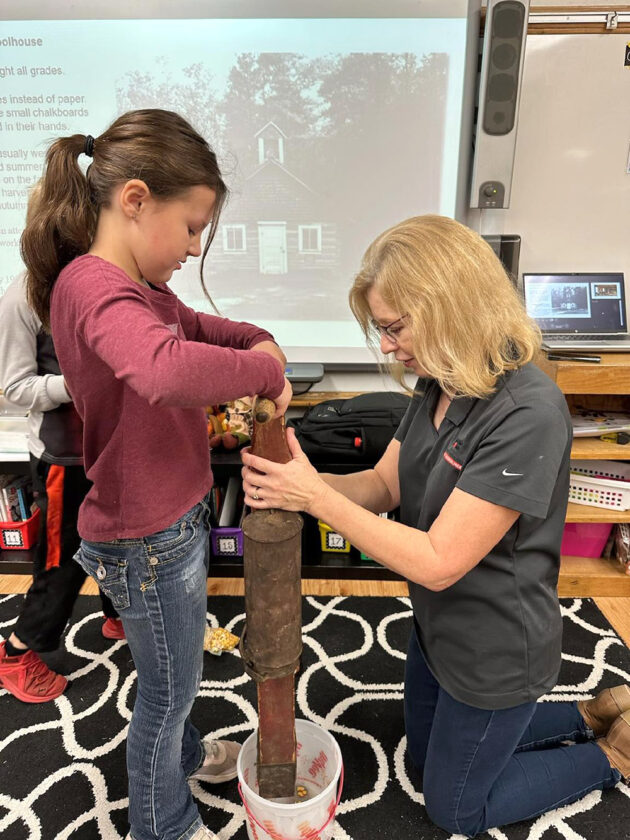
An antique, hand-held corn planter also offered a unique, hands-on learning experience for the students. The kids quickly learned how to open and close the wooden handle so the seeds would fall accurately from the planter box to a bucket, which was used in place of soil in this classroom lesson.
While farm children had plenty of chores on the farm, education was important to many families. In the early 1900s, Iowa had about 12,000 country schools, which were located every two miles. Presenters explained that children of the early settlers walked or rode their horse to a one-room schoolhouse, where all the grades were taught by one teacher. They also noted that many country schools did not have electricity. Students were surprised to learn that most farm children (especially boys) did not attend school after eighth grade, because they were needed to work on the farm.
-Submitted photo
Kalene Berte, right, the tri-county ag in the classroom coordinator for Farm Bureau, steadies an old fashioned corn planter, while a student uses it to drop corn kernels into a bucket. Use of the old corn planter was part of an ag in the classroom program on the history of farming in North America. Students at Taft Elementary School and St. Mary’s Catholic School, both in Humboldt, completed the program.
“I also felt it was important for the students to understand how farm families made simple toys and games from materials available on the farm,” Berte said. “A vine could be used as a jump rope, for example. Hiding the button was a great game any time of the year. ”
Berte made a family of corn-husk dolls to help show how something as simple — and common — as corn husks could be used for toys. She donated one of the dolls for the class to keep on display.
Presenters also showed the kids a replica of a vintage ball-and-cup game and explained how the father would have made this game from wood.
Before the lesson ended, every student received a ball-and-cup game that Gatewood made from supplies in her home, just like the early settlers used readily-available materials to make games and toys. The kids improved their eye-hand coordination as they played with the toys and learned how to flip the ball into the paper cup.
“This ag history lesson provided a great opportunity for students to gain an understanding of how difficult farm life was for early Americans, and how advancements in technology continually improve agriculture and all our lives,” Berte said.
-Submitted photo
These students are playing an old fashioned game in which they must flip a ball attached to a string into the cup. The game was part of a lesson that showed how farm kids had fun decades ago.
“Thank you to all the schools, students and educators for allowing us to visit your classrooms.” she added.
Berte also thanked Humboldt-area farmer, Mike Ludwig, for providing the ears of corn for the ag history lessons.
Local News
Iowa sunset
Community Clean Up Day in Fort Dodge
Experienced guide reveals wonders of Iowa
Supervisors approve settlement with City of Otho
The Webster County Board of Supervisors approved a settlement agreement and release on Tuesday between the county ...
St. Edmond students perform history at Fort Museum