
Experienced guide reveals wonders of Iowa
Stone addresses conservation fundraiser
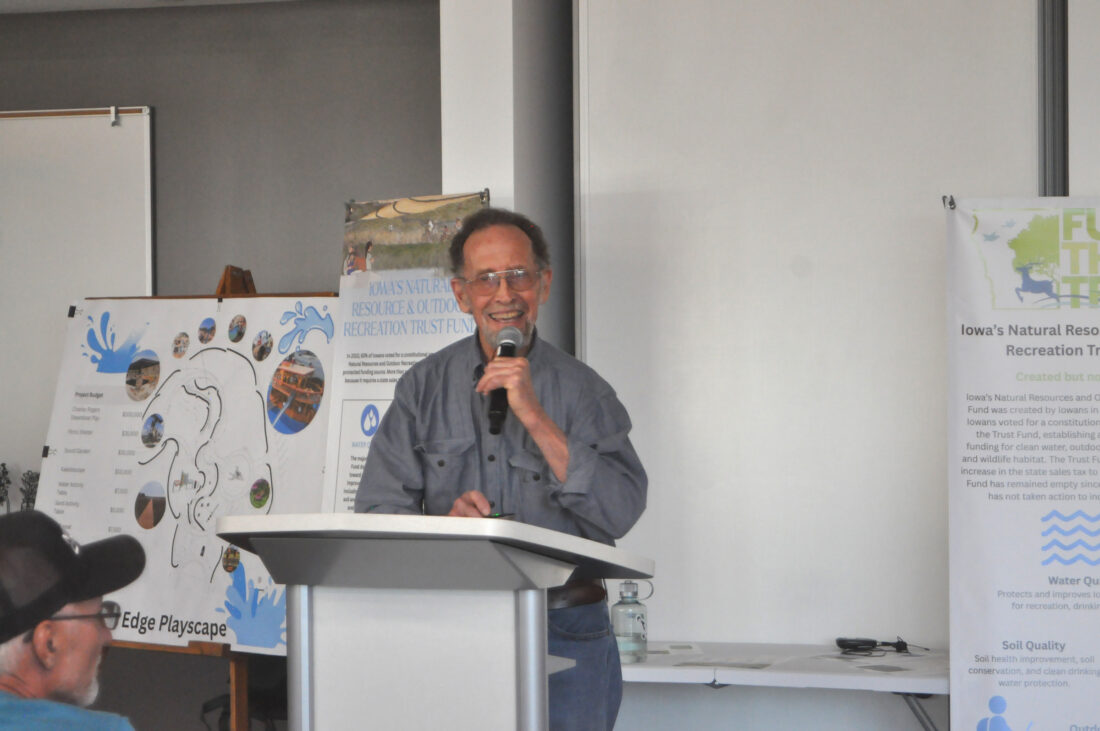
-Messenger photo by Bill Shea <br> Larry Stone, a writer, photographer, naturalist and explorer, speaks to the audience Wednesday evening at the Call of the Wild fundraiser for the Friends of Webster County Conservation. He spoke in the Matt Cosgrove River’s Edge Discovery Center about the natural and manmade features to be found along the rivers of Iowa.
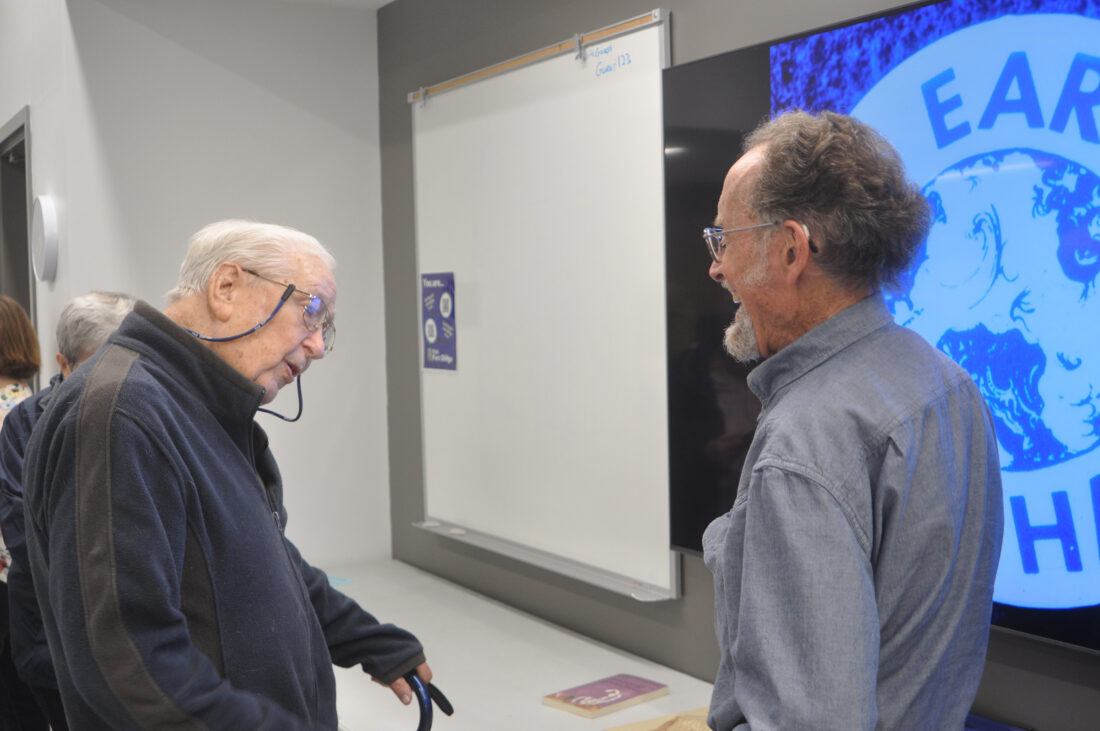
-Messenger photo by Bill Shea <br>Howard Jensen, left, of Fort Dodge, speaks to Larry Stone following his Wednesday evening presentation at the Call of the Wild fundraiser for the friends of Webster County Conservation.
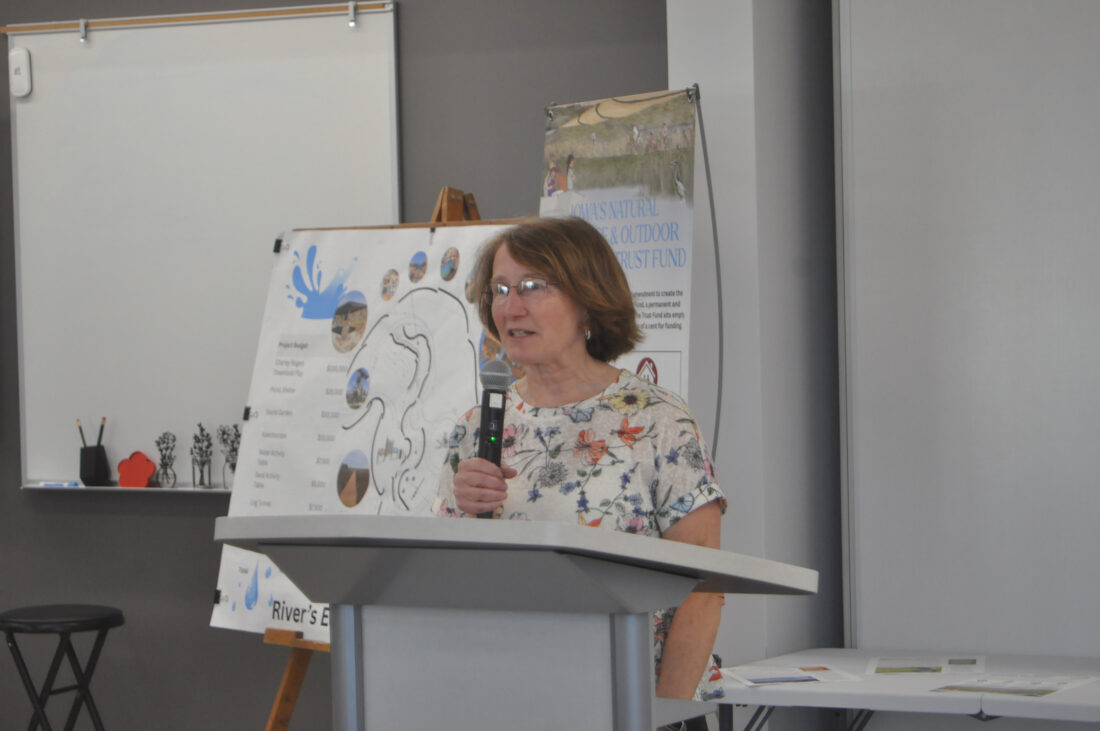
-Messenger photo by Bill Shea <br>Marie McLoughlin, the president of the Friends of Webster County Conservation, welcomes people to the group’s Call of the Wild fundraiser Wednesday evening.
-Messenger photo by Bill Shea <br> Larry Stone, a writer, photographer, naturalist and explorer, speaks to the audience Wednesday evening at the Call of the Wild fundraiser for the Friends of Webster County Conservation. He spoke in the Matt Cosgrove River’s Edge Discovery Center about the natural and manmade features to be found along the rivers of Iowa.
-Messenger photo by Bill Shea <br>Howard Jensen, left, of Fort Dodge, speaks to Larry Stone following his Wednesday evening presentation at the Call of the Wild fundraiser for the friends of Webster County Conservation.
-Messenger photo by Bill Shea <br>Marie McLoughlin, the president of the Friends of Webster County Conservation, welcomes people to the group’s Call of the Wild fundraiser Wednesday evening.
Trending
There are an estimated 50,000 miles of rivers and streams in Iowa.
Larry Stone, of Elkader, has experienced many of those miles from the vantage point of his canoe.
On Wednesday evening he described for a Fort Dodge audience the wonders to be found along those rivers and streams.
They include natural elements, such as animals and layers of sandstone that reveal the geological history of Iowa. And they include manmade elements, such as the largest stone arch bridge west of the Mississippi River.
"I like to be hopeful that we will take care of our rivers," he told his audience in the Matt Cosgrove River's Edge Discovery Center.
He was the main speaker at the Call of the Wild, which is the largest annual fundraiser for the Friends of Webster County Conservation.
Stone was an outdoor writer for the Des Moines Register. He is also a photographer, naturalist and explorer. He has authored or co-authored five books, including "Listen to the Land," "Gladys Black: The Legacy of Iowa's Bird Lady," "Sylvan T. Runkel: Citizen of the Natural World," and "Iowa: Portrait of the Land." He is a member of the Clayton County Conservation Board.
His presentation included a steady flow of photos, maps and other illustrations, with pictures of animals spotted along Iowa's rivers in the mix. He highlighted the animal photos by saying "Look out for the critters" every time one appeared on the screen.
The Des Moines River flows through Fort Dodge and Webster County, so Stone highlighted it early in his presentation.
He listed these interesting features, both natural and manmade, along the river:
• Layers of sandstone deposited by the water at Ledges State Park in Boone County
• An elk ranch in Kossuth County.
• Vegors Cemetery in Webster County near the junction of the Boone and Des Moines rivers.
• The Kate Shelley Bridge near Boone
• Pelicans at Lake Red Rock in Marion County.
At the river's southern end is the city of Croton, which Stone said is famous for getting hit by a couple of cannon balls during an 1861 battle of the Civil War. The actual fighting was in Missouri, but Confederate gunners missed their mark and sent a couple of rounds over the river into Croton.
Shifting to eastern Iowa, he said there are sections of the Yellow River where someone "can imagine being the first person ever seeing that river."
On a historical note, he said Jefferson Davis, who would later become the president of the Confederacy, went up the Yellow River as a young Army officer in 1833 to build a saw mill.
The upper Iowa River, he said, has some scenic limestone bluffs.
In Elkader, the largest stone arch bridge west of the Mississippi River spans the Turkey River, according to Stone.
In an interview after the presentation, Stone said he began canoeing when he was 15. He said he did a lot of canoeing when he was in college.
He said in 1971, he and his wife, Margaret, attempted to retrace a fur trade route along the border of Canada and Minnesota by canoe. He said they spent 109 days canoeing.
He recalled that their canoe was issued the registration number 1776 by the Iowa Department of Natural Resources so in the bicentennial year of 1976 they traveled on half a dozen rivers in Iowa.
Over the years, they also canoed in Michigan, Minnesota and Wisconsin.