
St. Edmond students perform history at Fort Museum
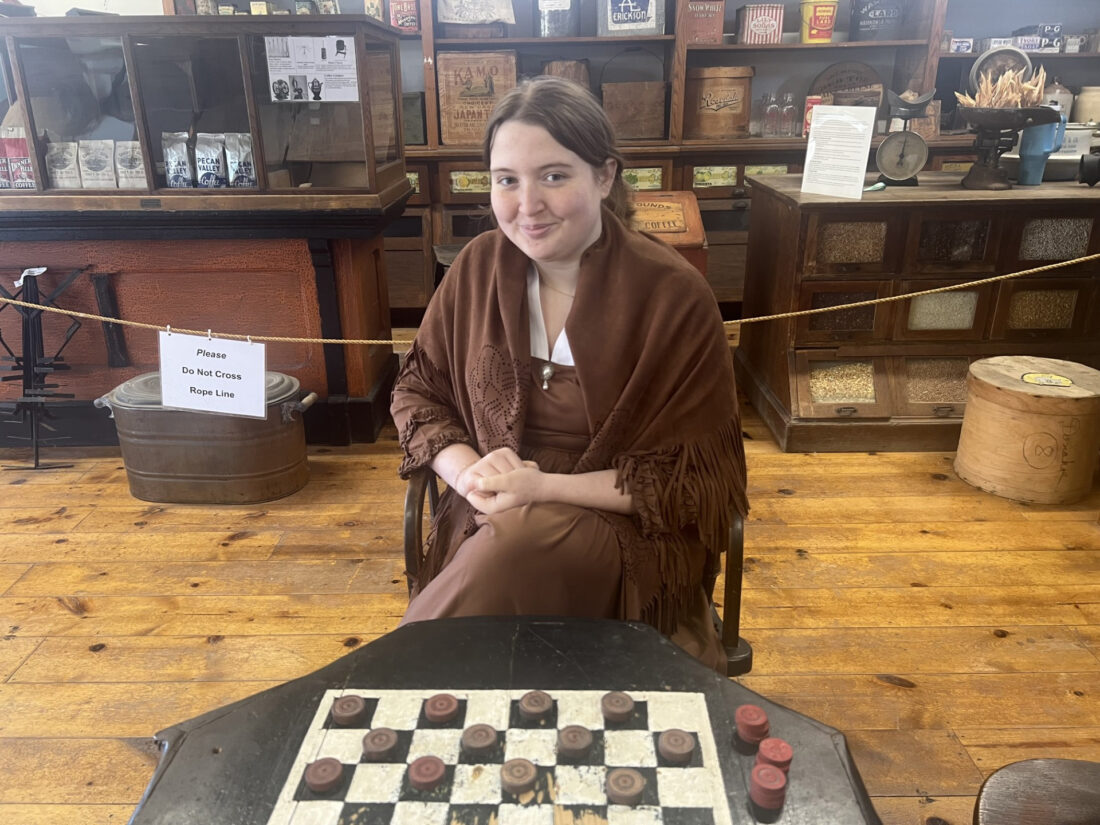
-Messenger photo by David Drissel <br> Azalya Hill portrayed Adeline Morrison Swain. a pioneering suffragist, educator, scientist, and writer.
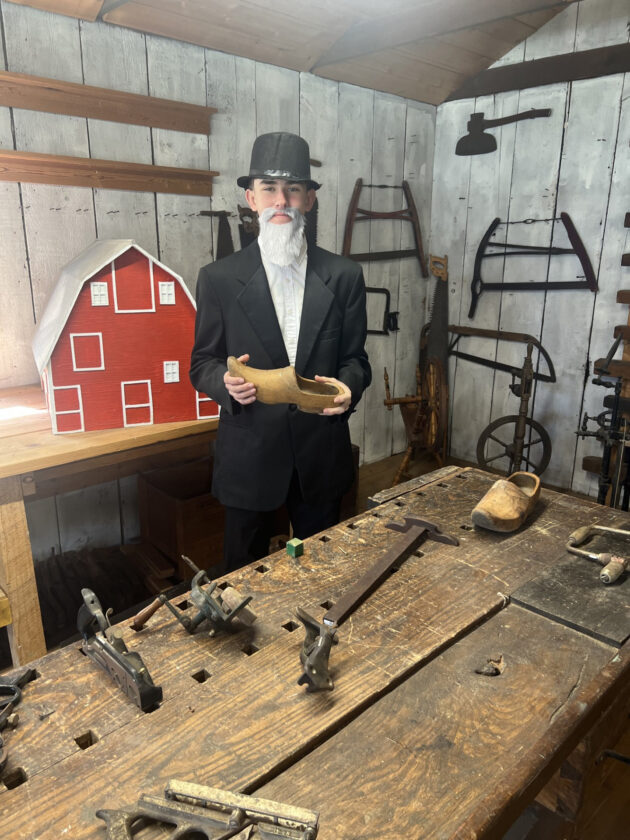
-Messenger photo by David Drissel <br> Griffin Laufersweiler portrayed his ancestor Conrad Laufersweiler — a Prussian immigrant who started the local funeral home business in 1856.
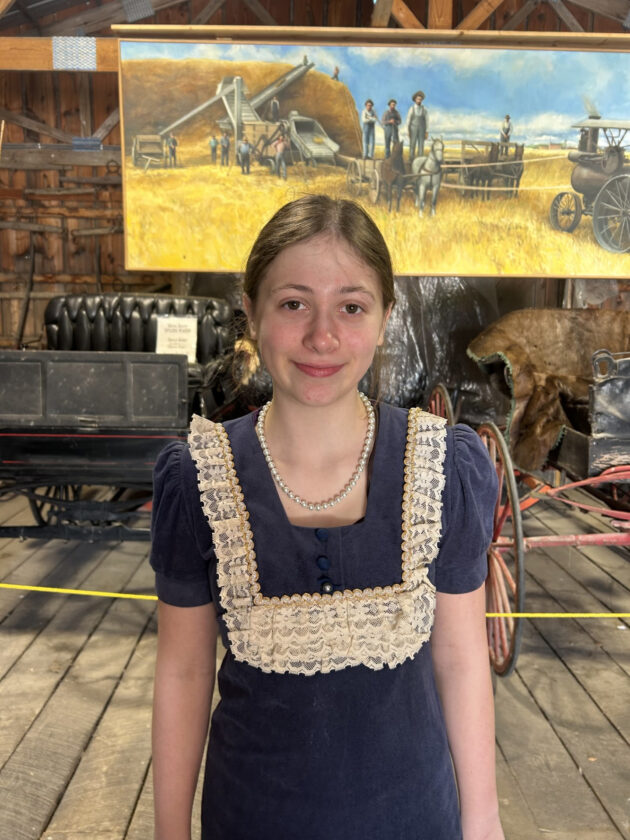
-Messenger photo by David Drissel <br>Jennifer Touney as Catherine Vincent Deardorf — a local journalist and philanthropist, who established a major charitable foundation bearing her name.
-Messenger photo by David Drissel <br> Azalya Hill portrayed Adeline Morrison Swain. a pioneering suffragist, educator, scientist, and writer.
-Messenger photo by David Drissel <br> Griffin Laufersweiler portrayed his ancestor Conrad Laufersweiler — a Prussian immigrant who started the local funeral home business in 1856.
-Messenger photo by David Drissel <br>Jennifer Touney as Catherine Vincent Deardorf — a local journalist and philanthropist, who established a major charitable foundation bearing her name.
Trending
From pharmacists to priests and politicians, 11th-graders from St. Edmond Catholic School recently portrayed a panorama of local historical figures at the Fort Museum and Frontier Village.
Known as a "Living Wax Museum," the project included approximately 60 juniors in an American Literature course, who were each required to select and research a historical figure from Webster County. Each student delivered an oral presentation, while wearing historically-appropriate attire, in various buildings of the Fort Museum complex on Monday.
This new project originated with students and staff from St. Edmond, in collaboration with the Fort Museum and Frontier Village and the Webster County Historical Society. More than 200 elementary school students, and dozens of other spectators, viewed the Living Wax Museum performances.
The historical figures selected by students lived in the area mainly during the first 100 years of Fort Dodge's existence -- from the mid-19th to mid-20th centuries.
Abram Ribbens, for example, decided to portray Cyrus Clay Carpenter (1829-1898) -- the eighth governor of Iowa. Lilah Reed assumed the role of Carpenter's wife, Susan C. Burkholder. Ribbens notes that his character was a Fort Dodge land surveyor who also served in the Civil War as a Union officer.
In contrast, Aiden Reel selected Lewis A. Armistead (1817-1863) as his historical figure. Armistead was a Confederate general who was killed at Pickett's Charge during the Battle of Gettysburg in 1863. Prior to that time, he served as a U.S. Army quartermaster and supervisor for the construction of the original fort located on the Des Moines River and Lizard Creek in 1850.
Flash forward in military history several decades later, Donald Eugene Fleetwood -- a U.S. Marine from Fort Dodge who died during the Japanese attack on Pearl Harbor in December 1941 -- was portrayed at the event by Sam Lemberg.
Hayden Harmon decided to portray Steven Berry Olney, the first physician in Fort Dodge. In a related occupation, Evan Christianson portrayed Homer Schwarz, and Liam Ellsbury played his brother, Art, who together opened the first successful drug store in Fort Dodge in the 1930s.
Caleb Moser played the role of the Rev. John Vahey -- the first resident Catholic pastor of Fort Dodge, who built the first church in the Corpus Christi parish in 1857. Assuming the role of a priest in the replica village church, Caleb led the visiting elementary school students in a prayer. He was accompanied by Emerson Peters, dressed as a nun, who portrayed Mother Mary Catherine Conway -- an early religious leader and teacher at Corpus Christi Church.
Another powerful woman in Fort Dodge history, Adeline Morrison Swain (1820-1899), was portrayed by Azalya Hill. Swain was a pioneering suffragist, educator, scientist, and writer. She was the first woman to run for statewide office in Iowa, and organized the first women's suffrage meeting in Fort Dodge in 1869.
The Swain family built a large Victorian home in Fort Dodge, which later became known as the Vincent House. This is the main reason why Hill selected Swain for her project.
"I'm from a long line of Vincents. My great-great-great-grandma was a Vincent," she said. "It was also nice to learn about how she helped women. She would bring women into her house and teach them all kinds of skills. She fought for women's rights in Iowa and across the country."
This connection to the Vincents was also evident in Jennifer Touney's project. She assumed the role of Catherine Vincent Deardorf (1907-1994) -- a local journalist and philanthropist, who established a major charitable foundation bearing her name.
Many students selected certain historical figures due to similar interests or ancestral connections. Eric Lawson, for example, portrayed the famous Fort Dodge municipal band conductor, Karl L. King (1891-1971), due to his own musical interests. As a member of the St. Edmond band, Lawson's love of music led him to select the internationally-known, prolific march-music composer and bandmaster.
"King advocated for the Iowa band law, which was passed in 1921. This law helped to create community bands all around Iowa," Lawson said. "Similar laws were adopted by other states and even other countries."
Griffin Laufersweiler decided to portray his ancestral patriarch from five generations ago, Conrad Laufersweiler -- a Prussian immigrant who started the local funeral home business in 1856. The Laufersweiler Funeral Home is still in operation in Fort Dodge today -- 170 years later.
Similarly, Vincent Driscoll portrayed his great-great-grandfather, Dennis Keleher (1872-1964), who was a prominent attorney in the Fort Dodge area.
"He helped defend the older brother of Al Capone in court. He was also on Al Capone's defense team for two weeks," Driscoll said. "He earned $500 per day while working for Al Capone's team, which is equivalent to around 12 grand today. He got a lot of money from that case."
Driscoll, who is the son of Webster County Attorney Darren Driscoll, notes that Keleher developed most of the income tax code when it was first introduced under President Woodrow Wilson.
"He helped write the tax code, which is why the Capone family wanted him on their team," he said. "I'm related to him directly, which is why I picked him."
Several students assumed the roles of relatively ordinary Webster County residents of the past. In such cases, students were advised to research the occupation, geographic locale, and time period in formulating a profile of their historic figure.
Breeanna Kalvig, for example, selected a 19th century German immigrant, Eva Marie Merten-Bratnober, who settled in Fort Dodge. Kalvig notes that Merton-Bratnober and her husband owned a lumber company in Fort Dodge.
Examples of other everyday Iowans in history include Henry Dimmler -- a cabinet maker in the 19th century, who was portrayed by Aaron Hindt. He picked the character because his occupation was simple and he likes simple things.
"I find furniture making somewhat interesting," he said.
Unlike a traditional research project, many students were unable to find much information about their historical figure on the Internet. As a result, students often received assistance from the Webster County Historical Society, which maintains a vast trove of local historical documents.
Fort Dodge's most noted local historian, Roger Natte, and his assistant, Meg Beshey, set aside time to help students with their projects.