
Preparing for an active shooter
Drill at St. Paul trains school staffs for the worst
-
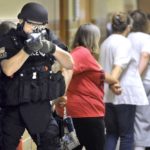
- -Messenger photo by Hans Madsen Fort Dodge Police officer Bryan Slama covers the hallway as a group of school staff leave a classroom at St. Paul Lutheran School during an active shooter drill.
-
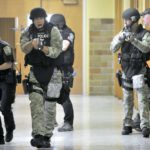
- -Messenger photo by Hans Madsen Responding officers begin the process of stopping the “active shooter” during an exercise Thursday morning at St. Paul Lutheran School. They are, from left, Fort Dodge Police School Resource Officer Joelyn Johnson and Lt. Dennis Quinn along with Webster County Sheriff’s deputy Derek Christie.
-
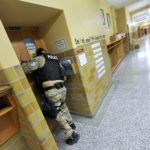
- -Messenger photo by Hans Madsen Fort Dodge Police Lt. Dennis Quinn, portraying the “active shooter,” attempts to gain entrance to classroom full of school staff during an active shooter drill at St. Paul Lutheran School Thursday morning.
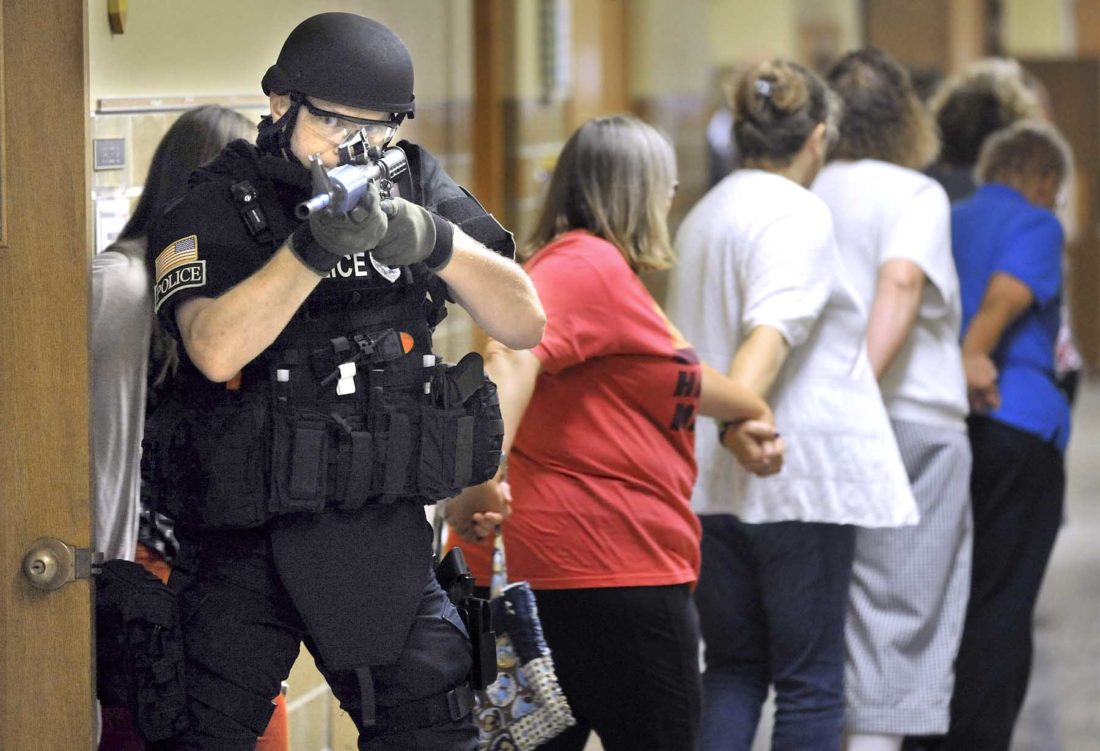
-Messenger photo by Hans Madsen Fort Dodge Police officer Bryan Slama covers the hallway as a group of school staff leave a classroom at St. Paul Lutheran School during an active shooter drill.
Something was heard and smelled Thursday morning in the hallway at St. Paul Lutheran School — something that it’s hoped, is never heard or smelled there for real.
The sound and odor were echoing booms from gunshots and the smell of freshly burned powder .
They followed a shooter who was looking to do one thing: kill.
He stopped at a classroom door, beating on it and screaming.
That was met with silence, darkness and a secured lock. The people inside followed protocol — they’re safe.
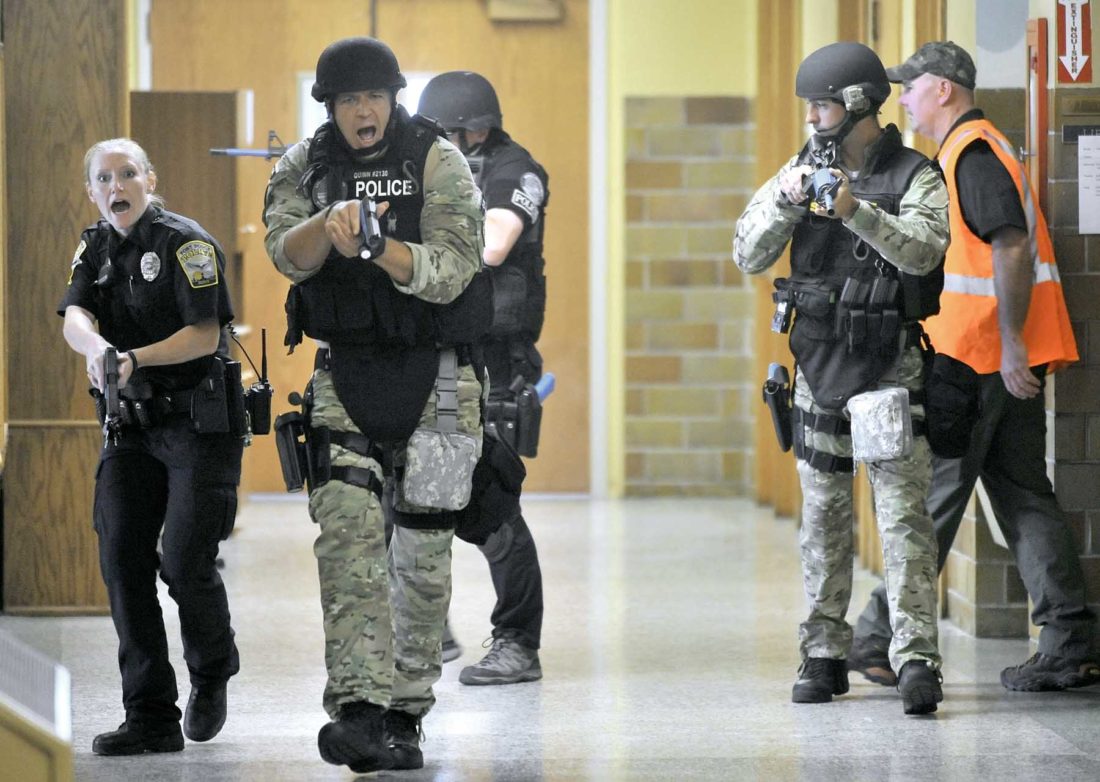
-Messenger photo by Hans Madsen Responding officers begin the process of stopping the "active shooter" during an exercise Thursday morning at St. Paul Lutheran School. They are, from left, Fort Dodge Police School Resource Officer Joelyn Johnson and Lt. Dennis Quinn along with Webster County Sheriff's deputy Derek Christie.
He moved down the hall, screaming, looking for someone. Enraged, he was on his way to the next classroom.
As he did, he passed under three posters hanging above the coat rack high on the wall. They bore The Lord’s Prayer, the Ten Commandments, the Apostles Creed.
He tried to beat down the next classroom’s door, but again was met with darkness, silence and a locked door.
Then the rampage ended the way it began, with echoing booms and the smell of burnt powder — this time from those who came to stop him.
According to Webster County Sheriff’s Sgt. Luke Fleener, who was timing the “rampage,” the entire episode lasted about a minute and a half.
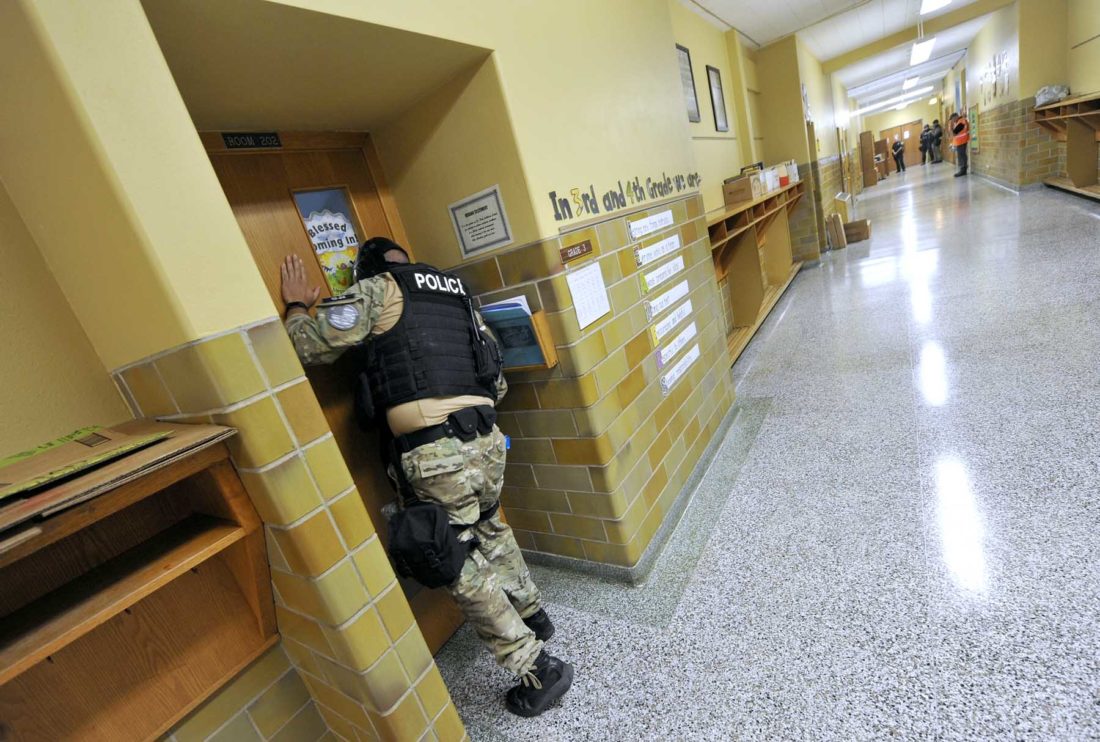
-Messenger photo by Hans Madsen Fort Dodge Police Lt. Dennis Quinn, portraying the "active shooter," attempts to gain entrance to classroom full of school staff during an active shooter drill at St. Paul Lutheran School Thursday morning.
The simulated active shooting scenario, conducted by members of the Sheriff’s Department and the Fort Dodge Police Department, was part of a training session for school staff, in this case staff from St. Paul’s, St. Edmond Catholic School and the Fort Dodge Community School District.
Fleener told them that chaos and confusion are an anticipated part of an active shooter situation. He showed a video from the April 20, 1999, Columbine High School shooting in Colorado that left 15 dead — including the shooters — and 24 injured.
“Everybody was running around going what do I do? What do I do?” he said. “Watch the chaos. Nobody knows where to go. That’s why we’ve changed what we do.”
The training is intended to give the school staff the best opportunity for survival during the time it takes for police to arrive. He said the national average response time is about three minutes.
“The goal is to give you information and a plan of what to do during that three minutes.” he said.
Columbine was the shooting that made law enforcement change its tactics. Officers now enter a building and attempt to stop the shooter immediately.
In the past, as it was at Columbine, they would wait for SWAT.
“They had an hour and half to do what we just saw,” Fleener said.
It’s a logical question, what drives someone to begin a shooting spree.
“Their goal is always the same,” Fleener said. “It’s driven by hate. They want to be remembered in history for how many people they killed that day.”
Fleener and the Fort Dodge Community School District use the Standard Response Protocol. He said it was developed after Columbine.
While Iowa has so far been free of any mass casualty school shootings, it’s not something that school districts can afford to ignore, he said.
“It’s the nature of the world we live in,” Fleener said. “We send our most valued treasure there for eight hours a day. We thought it was a safe place to be. It’s a hurdle we need to overcome because of the world we live in. We have tornado and fire drills to prepare too.”
Members of the Fort Dodge Fire Department were also on hand for the training. In an actual incident, they would play a critical role in giving medical aid to any shooting victims. The Fire Department trains with law enforcement so that if something happened, both can work together.
“We’re lucky here,” Fleener said. “Everyone works well together.”
Local News
Man gets 125-year prison sentence for sexual abuse
LIVERMORE — A Humboldt County man has been sentenced to 125 years in prison for sexually abusing three juveniles, ...

Ahead of the learning curve

New apartments touted as proof of progress
Go and Do: May 8, 2026
Around the area OTHO/COALVILLE — Citywide garage sales will be held from 8 a.m. to 2 p.m. on SATURDAY in Otho ...
Grassley pushes plan for rural hospitals
UnityPoint Health — Trinity Regional Medical Center is one of the hospitals benefitting from a Medicare plan ...