
In 2026, we’re losing the plot far too often
Trending
We celebrate winning all the time in sports.
Let's talk a little about losing.
The ultimate goal for every team or individual, of course, is to come out on top. No athlete or coach wants to settle for less than the best or fall short in their pursuit of victory.
Drake Ayala is the perfect lead into what needs to be a much more nuanced conversation. For all intents and purposes, the three-time Fort Dodge Dodger state champion just finished a remarkable wrestling career at the University of Iowa. He was a two-time national runner-up and a three-time All-American, placing fifth in his final NCAA Tournament earlier this month.
Ayala would be the first to admit that even though he reached an elite level of success very few competitors see, he's disappointed in his final podium finish. It's a frustration and a feeling that, while certainly countered by an overall sense of pride as time passes, Ayala has to face as a finality.
Ayala lost, but he's not a loser. Far from it. This is a line we keep blurring more and more in our sports fandom, where anything from social media to gambling continues to fuel vitriol that often spirals out of control as the vocal minority rears its ugly head.
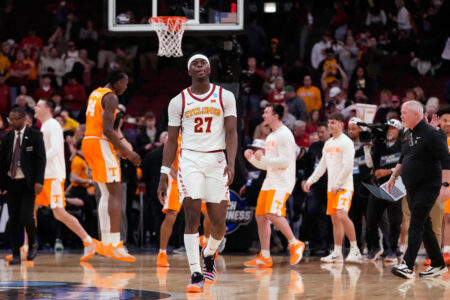
On the Cyclone side of the aisle, the Iowa State men's basketball team had a year to remember. T.J. Otzelberger's squad fell one win shy of 30 victories - tied for the second most in program history -- and earned a No. 2 seed in the NCAA Tournament. Hopes were high that this was the group destined to lead ISU to its first Final Four since 1944.
Instead, All-American Joshua Jefferson suffered an injury a few minutes into their opening-round game and the Cyclones simply ran out of firepower during a Sweet 16 setback to Tennessee.
I expected fans to be crestfallen, of course, given the season had so much promise. Most were. Others were downright upset, though, pointing to a supposed "trend" that Otzelberger has failed to get Iowa State past the Sweet 16 in three different trips now. Many scoffed at or downplayed Jefferson being out, trying to employ the no-excuses/next-man-up mentality.
Again, this is where we, as a society, have confused losing -- a part of the game at every sport and every level -- with losers. Just three letters separate the words, but there is a massive difference in the definition.
Losing comes with the territory. Athletes quietly fight through injury, adversity and criticism, yet still come up short every single day despite their absolute best efforts. The general public tends to have no idea what is truly happening behind the scenes, as well as the physical and mental toughness it takes just to be in a position to try and succeed.
Even at that point, there are so many variables and often-unpredictable paths that lead to an outcome. And sometimes -- especially on given days -- an athlete or a team just gets beat. We tend to gloss over -- or forget altogether -- the fact that the opponent is often just as driven to win, and might just be better.
To paraphrase former president Theodore Roosevelt in his famous and timeless 1910 speech, the real losers here aren't in the arena. They back-seat drive and second guess at every turn. They're quick to offer their "hot takes" -- often either exaggerated or unfounded -- without being realistic about the nuance of a situation. They cynically scoff at the outcome and have the freedom to then go about their day, showing little respect for the effort or understanding of what it took to get there in the first place. They're also the first to slap a negative label on an athlete or team in the process -- the same athletes and teams who are living with both the daily grind and the outcome of their performances every single day.
Social media has fueled this issue, of course. It's filled with faceless critics vomiting hyperbolic nonsense from the security and protection of their screens. The words spewed in the direction of Ayala, or Otzelberger's Cyclones, or Audi Crooks, or countless other athletes at all levels these days is obscene. No one is immune, because there are very few deterrents or repercussions to abusive online behavior -- especially in the world of sports.
What can we do about it? That's a difficult question. It's important to fight the good fight by supporting athletes and setting the record straight to counter derogatory posting -- despite the fact that many of the perpetrators don't have the conscience to care. Social media is a fascinating look at the human condition and our drive for attention -- both giving and receiving. It's best to not dwell on the negative, of course, but hard to simply be the bigger person and let the inflammatory comments go.
At the end of the day, I know we are only able to control ourselves. As fans, we all get justifiably upset from time to time. That comes with the territory. We may even occasionally make a comment out of frustration that we wish, in retrospect, we could take back.
Just remember there are human beings behind the jerseys and numbers. No one takes losses worse than they do. No one is more disappointed in defeat than they are. Words matter. Context matters. And your reactions matter.
Keep that in mind the next time the keyboard becomes your place to vent.
Eric Pratt is Sports Editor at The Messenger. Contact him via email at sports@messengernews.net, or on Twitter @ByEricPratt