
Court hears evidence supression motion for prison homicide
Defendant: I planned to kill at least five more
-
- -Messenger photo by Elijah Decious The court heard the defense’s motion on Friday to suppress a confession from Eric Hall, who’s charged with first-degree murder in the killing of inmate Thomas Daleske at the Fort Dodge Correctional Facility. Defense attorneys say the confession should be thrown out as improper since Hall secured a promise to release an impounded truck and cash to his brother in exchange for a statement.
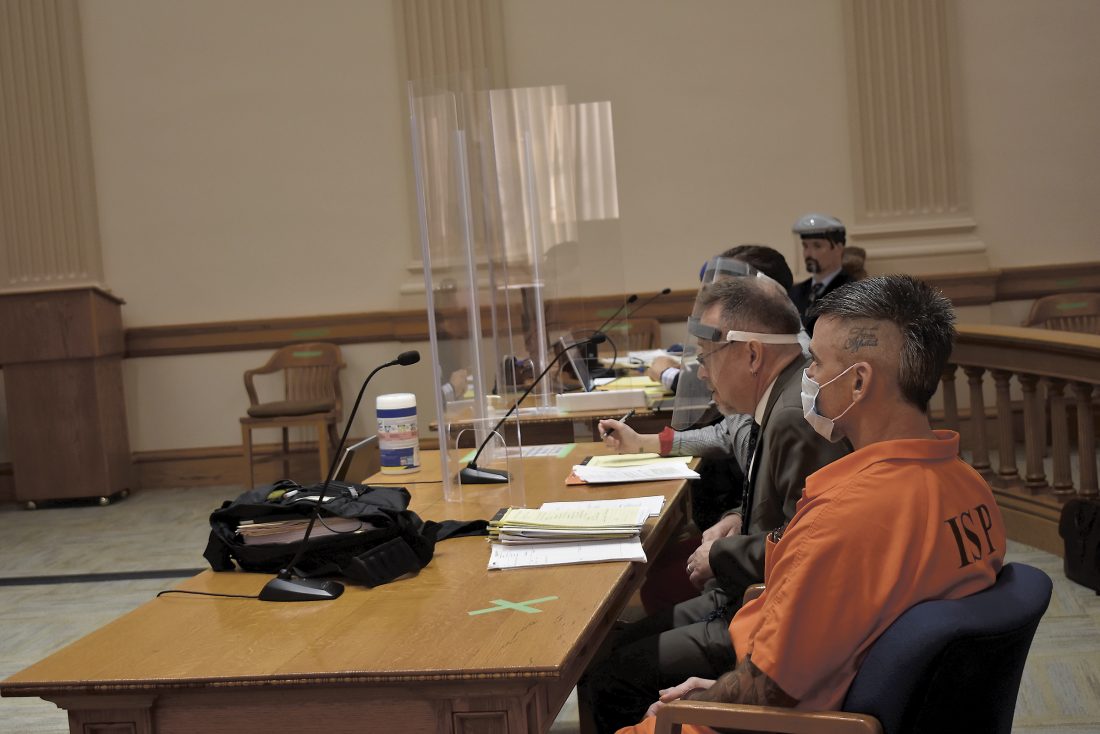
-Messenger photo by Elijah Decious The court heard the defense’s motion on Friday to suppress a confession from Eric Hall, who’s charged with first-degree murder in the killing of inmate Thomas Daleske at the Fort Dodge Correctional Facility. Defense attorneys say the confession should be thrown out as improper since Hall secured a promise to release an impounded truck and cash to his brother in exchange for a statement.
*Reader discretion advised: This story contains graphic content about a homicide and sexual abuse.
The court heard arguments Friday to decide whether the confession from a first-degree murder defendant should be tossed out after law enforcement and First Assistant Webster County Attorney Ryan Baldridge agreed to release an impounded vehicle and cash in exchange for a statement.
Hall, 44, faces the charge with a trial starting as soon as Nov. 3 for the June 14 killing of Thomas Daleske, 59, at the Fort Dodge Correctional Facility.
In a comprehensive confession, Daleske told Iowa Division of Criminal Investigation agents that he had been planning the killing since April and initially planned to kill five to 10 other inmates. Like Daleske, at least two of the others he planned to kill were serving sentences for sex crimes against children, according to an interview transcript and testimony.
Daleske was serving a 45-year sentence for multiple convictions out of Warren County, including sexual abuse and lascivious acts with a child. He had been incarcerated since October 2000.
“Ever since (the killing) happened, it’s like … I feel free,” Hall said to detectives, expressing a release from years of mental anguish after his abuse as a child. “I feel like I’ve done something and made something of myself.”
Motivating the killing, he said, was the fact that he was sexually assaulted as a baby.
“(You have) got to send a direct message. Look, the monster’s got to stop,” he said. “(You) kill ’em, or we’ll kill em.”
Photos of the crime scene and the transcript put into the record Friday painted a gruesome scene in which the victim was taken to the ground as he slept and killed through a series of stomps to his neck and chest.
Before confessing, Hall laid out three conditions: that he be permitted a conversation with the prison warden, and that about $1,500 in cash and a truck confiscated from an unrelated criminal case be returned to his brother.
Hall requested that a higher authority confirm that officials would meet those conditions before he confessed in interviews. To secure the statements, DCI special agents brought in Baldridge.
Resisting the motion, Baldridge said that Hall repeatedly waived his rights to an attorney and that there had been no promise of leniency in criminal charges or sentencing as a result of the confession. He also argued that the return of property to the defendant’s brother in Wisconsin had no direct incentive for him, saying Hall wouldn’t have confessed to first-degree murder, which carries a mandatory sentence of life in prison without the possibility of parole, for items “of such little value.”
The total value of the cash and truck was estimated to be shy of $5,000.
In closing, Rounds argued that offering anything of such monetary value in exchange for a confession ran afoul of Iowa common law precedent, cited as being much stricter than the “totality of circumstances” legal standard Baldridge used to support his argument.
The “clear, bright line” standard, Rounds said, makes clear that misconduct in securing confessions is not limited to offering lenient charges or sentencing, but does include “any hope of reward.”
“Any hope of reward — $4,500 falls squarely under ‘any hope of reward,'” he said. “They engaged in a negotiation they never should’ve engaged in.”
He asks the court to suppress all parts of the interview with law enforcement after Baldridge’s appearance.
Rounds also argued that the search warrant against Hall was unconstitutionally broad, pointing to a mention of narcotics in the warrant for evidence in a homicide. Baldridge said that Supreme Court rulings have noted that inmates have no expectation to privacy in their cell anyway, and that the warrant was only secured “out of an abundance of caution.”
A ruling on the matter is expected with the next two weeks.
Hall was serving a sentence for third-degree burglary that started in April 2019 after being convicted for a rash of break-ins at businesses across the state. His release was tentatively scheduled for November 2023.
Local News
Man gets 125-year prison sentence for sexual abuse
LIVERMORE — A Humboldt County man has been sentenced to 125 years in prison for sexually abusing three juveniles, ...

Ahead of the learning curve

New apartments touted as proof of progress
Go and Do: May 8, 2026
Around the area OTHO/COALVILLE — Citywide garage sales will be held from 8 a.m. to 2 p.m. on SATURDAY in Otho ...
Grassley pushes plan for rural hospitals
UnityPoint Health — Trinity Regional Medical Center is one of the hospitals benefitting from a Medicare plan ...