
Putting a face on budget cuts
In the Fort Dodge and Webster County area, here’s how a proposed federal budget could impact longstanding programs
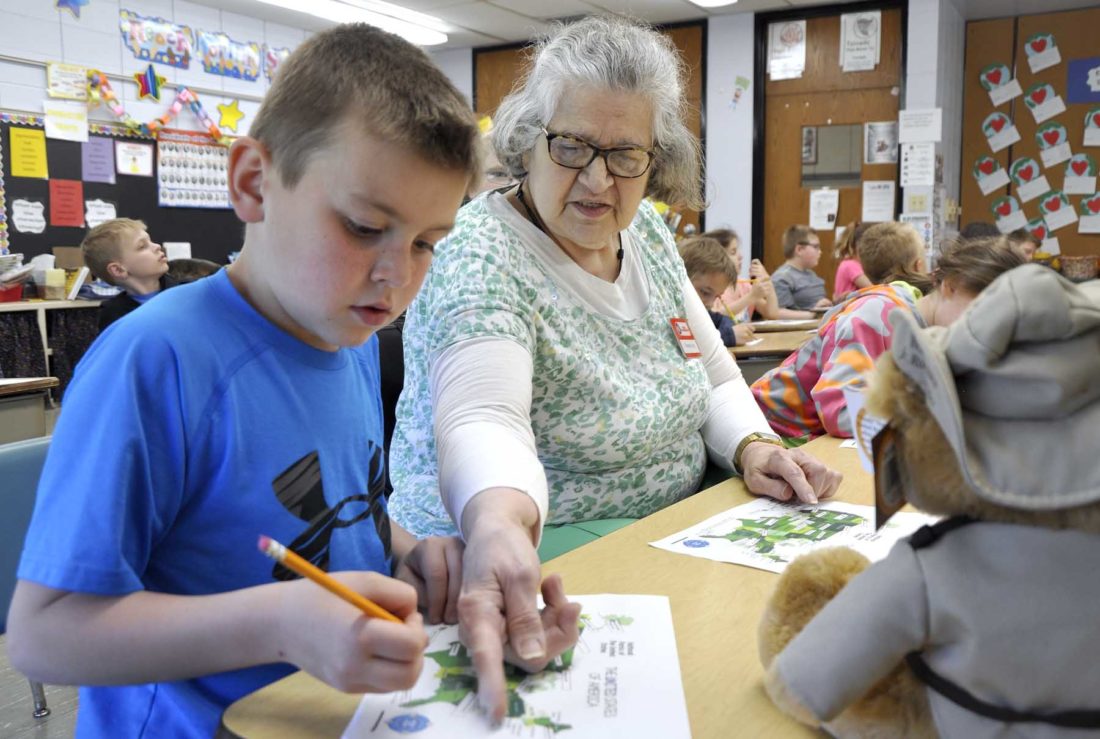
-Messenger photo by Joe Sutter Foster Grandma Vera Cerwick helps Aiden Armstrong and Haylee Scott, at right, with a geography exercise in Rita Engh's second grade class. Engh brings Cerwick into her class to help on a multitude of topics.
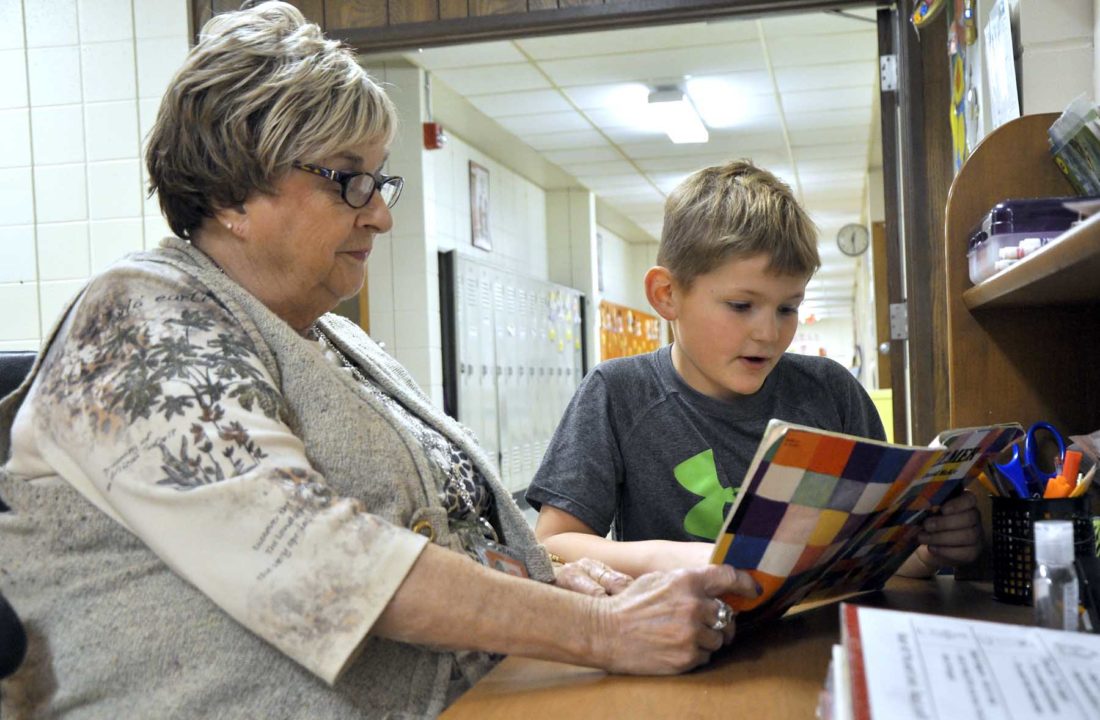
-Messenger photo by Joe Sutter Foster Grandma Bonnie Russell helps Patrick Clay, second grade, read a book at her desk in the hallway at Feelhaver Elementary. Russell was one of five Foster Grandmas a the school Tuesday, reading in the hallway and helping out within in the classrooms.
-Messenger photo by Joe Sutter Foster Grandma Vera Cerwick helps Aiden Armstrong and Haylee Scott, at right, with a geography exercise in Rita Engh's second grade class. Engh brings Cerwick into her class to help on a multitude of topics.
-Messenger photo by Joe Sutter Foster Grandma Bonnie Russell helps Patrick Clay, second grade, read a book at her desk in the hallway at Feelhaver Elementary. Russell was one of five Foster Grandmas a the school Tuesday, reading in the hallway and helping out within in the classrooms.
Trending
If a federal budget proposed by the Trump administration becomes a reality, it could mean an end to the local Foster Grandparents program.
But the Grandparents aren't the only ones who could be taking a hit.
Multiple service agencies in the Fort Dodge area could see decreases in their federal and state funding in the next year.
State lawmakers are trying to finalize a roughly $7.2 billion state budget that also cuts into some service programs, though it's not completely clear how any of these budget cuts would affect services being offered locally.
The White House's proposed budget includes billions of dollars in spending cuts, including decreases to the departments of State, Health and Human Services, Housing and Urban Development, and Transportation. That budget is used as a starting point for the bill that will eventually be written by the U.S. Congress.
Foster Grandparents
"The President's budget … right now is to eliminate the Corporation for National and Community Service," said Jeanine Nemitz, Foster Grandparent director in Fort Dodge.
The Foster Grandparents program is run through that corporation under the larger umbrella that includes Americorps, Nemitz said. But the program is older than that -- it was formed in 1965 as part of the war on poverty.
It was designed by Sargent Shriver, the brother-in-law of President John F. Kennedy, based on an observed need, Nemitz said.
"Sargent Shriver had been in Chicago and visited a children's hospital," Nemitz said. "This was when kids were institutionalized if they had special needs. The nurses said we can take care of all their needs, but we don't have time to hug them and love them and read them stories and such.
"On the same day he visited a senior center in Chicago that was in a lower income neighborhood. The people there said, we have so many people who can't afford to do the things that, if you retire with a healthy income, you have to do. They have so much love to give.
"His idea was if he could match those two populations up, what a great thing it would be."
Foster Grandparents has been in Fort Dodge since 1973, with the city serving as the local sponsor. Grandmas and grandpas serve in all the Fort Dodge public schools, at St. Edmond Catholic Schools, Community Christian, and elsewhere in the county, Nemitz said.
They served 40,000 hours last year, working primarily with kindergarten through third grade.
They're well-loved at Feelhaver Elementary School.
"They help us in so many ways," said second-grade teacher Rita Engh. Engh has been working with Vera Cerwick for years.
"She's like my right hand," Engh said. "I can just look at her and she knows what I need."
The five Grandmas at Feelhaver listen to students read, help out with math, and guide those who need a little helping hand with just about any subject.
Bonnie Russell was asked by one of the teachers to begin giving her time there, and has been in the program since 2009. Not only does she get a great chance to help the kids, it's good for her too.
"It keeps us busy," she said. "It keeps us young."
The bulk of the program's funding comes from a federal government grant, Nemitz said. Out of the $186,000 federal grant, $100,000 is returned to the grandparents in stipends.
"The Foster Grandparents earn a stipend of $2.65 an hour," she said. "It's a stipend, not a wage. It can't count against any other benefits they may get, like rent assistance or prescription assistance."
There's a 10 percent matching requirement, which can be in monetary assistance or in-kind donations. For instance, the city provides Nemitz's office at no cost and Dodger Area Rapid Transit provides half-price transportation.
"They have to be at 200 percent of poverty to qualify for the stipend," Nemitz said. "A lot of them don't drive.
"It doesn't cost anything to the schools to have the grandparents there, but they do provide a lunch to the grandparents every day they are serving," she added.
Nemitz talked to the Webster County Board of Supervisors about what the grandparents do, for the CNCS's mayor and county recognition day.
"It's very beneficial from personal experience, dealing with the schools and my kids in school," Supervisor Merrill Leffler said. "It's a very beneficial program for the kids, especially in reading. They help kids that are having some trouble do tremendous things."
Community and Family Resources
Community and Family Resources provides a number of services from multiple funding sources.
As budgets decline, there's a possibility fewer people could get help, said Executive Director Michelle De La Riva.
"If you don't have the funding, it is a potential that people would not be able to come in for treatment," she said. "That hasn't been the case in the past, but as they continue to cut, that's the potential."
CFR currently has two areas that are likely to be cut in the next year, De La Riva said.
"We've already been notified by the federal probation department, they are no longer going to be able to place federal inmates here locally in Fort Dodge at our regional correctional facility. We provided the treatment services," De La Riva said. "That will be about an $80,000 cut to our service program."
That would normally mean a staff member has to be cut, she said, but the agency had a staff opening, so was able to move a current staff member to another position.
Federal inmates who come through CFR often are convicted of distributing drugs, or producing meth.
"These kind of cuts are going to cut back on their treatment, which will certainly affect their ability to reintegrate into the community effectively," De La Riva said.
At the state level, cuts may be on the way for gambling treatment.
"The proposed cuts really are looking at gambling treatment and prevention," De La Riva said. "If those go through, there will be fewer dollars for people to come in for gambling treatment.
"As you know, we are increasing our casinos. As the casinos increase, you certainly see an increase of people with problem gambling disorders just due to the availability of the casinos."
CFR also gets funding through an Iowa Department of Public Health grant to provide services to people who aren't covered by health insurance.
So far, De La Riva doesn't know if that budget will be affected by any cuts in the coming year.
"We are watching closely," she said.
That grant has been vital as more people become unable to afford insurance, De La Riva said.
"Even with the new rollouts, what we found was last year there were more and more people who were unable to afford plans, so they were still going without coverage," she said. "One would think that would not happen, but the plans on the exchange were extremely expensive, and many families could not make it fit into their budget."
CFR provides substance abuse, gambling treatment and mental health services for 10 counties -- Boone, Calhoun, Franklin, Hamilton, Hardin, Humboldt, Pocahontas, Story, Webster and Wright. It has 83 employees.
In Fort Dodge it has an adult residential program, a crisis stabilization unit for mental health, an adolescent residential program for substance abuse treatment, and an outpatient clinic.
Upper Des Moines Opportunity
Foster Grandparents isn't the only program from the War on Poverty with concerns about its future funding.
Upper Des Moines Opportunity Inc. is a "community action agency," one of about 1,000 in the United States. These agencies were established under the Economic Opportunity Act of 1964.
"The president's budget zeroed all our programs out," said Jamie Whitney, UDMO executive director. "In other words, he didn't recommend any funding."
Of course, that budget is far from final.
"Talking with our senators and legislator, their feedback is they are really supportive of community action and poverty-focused programs," Whitney said. "The message to us is level funding is what they would most likely recommend, as we move forward in these tough times."
Funding at the same level would be far better than cuts, Whitney said, even though increases are needed.
There are many projects under UDMO funded from both federal and state dollars. At the state level, talks are still ongoing, Whitney said.
For the Shared Visions program, which provides early childhood development services, a 15 percent cut has been recommended, he said.
"It's a matter of keeping our fingers crossed so that does not happen," Whitney said. "We're hoping things will at least become status quo, which means they will fund us at the level previous. We understand you can't give increases, which we desperately need as well, but we're willing to accept status quo or very minimal cuts at the most."
Shared Visions already has had a 3.75 percent cut for the fourth quarter. And while that's a small amount which UDMO could probably make up from somewhere else, he said, small cuts can add up and lead to fewer services.
Funds for programs like this are also "braided" with other funds -- in this case with Head Start money. Head Start Development and Early Head Start is a program for prenatal women and women with infants, and children in preschool.
"So we could provide a lot more services for 32 at-risk kids throughout the counties. Without that funding it affects our Head Start program as well, and those children," Whitney said.
Weatherization is one of the federally funded programs that may be on the chopping block.
That's also one of the UDMO's programs that gets the most funding in Webster County. In the last year, the program weatherized more than 21 homes, saving each family about $400 annually in utility costs.
The program isn't always popular.
"One time the Congress is supportive, and other times people question it, and I don't understand because we can prove the impact they make," Whitney said. "It saves money for those who are low income as far as their energy bills, utility bills. Energy companies are really supportive of it."
Right now all the federally funded programs are only 60 percent funded, he said. UDMO is awaiting another continuing resolution in the Congress to keep things funded until September.
"That can be a real concern after the end of April here," he said. "If they don't, you're looking at a government shutdown, and that's not something we're hoping will happen again."
At the state level, Iowa is also looking closely at the funding for the Family Development Self-Sufficiency program.
"It works with them on getting jobs and education to move them out of poverty," Whitney said. "This was Iowa's answer to welfare reform and providing support to families that were on what used to be ADC and TANIF (Aid to Dependent Children and Temporary Assistance for Needy Families)."
Workers go into a family's home and help them identify goals to get out of poverty, Whitney said -- such as getting education or getting a job.
"We visit them weekly," Whitney said. "We work with them and help them remove the barriers so they can achieve those goals they set out to accomplish."
Whitney said the program has been very successful.
"To me, that's not a program I would cut," he said. "My opinion is, don't be cutting things you know are successful. Let's work with people that work in these to figure out a way to make them more effective."
Children and Families of Iowa
Children and Families of Iowa provides services including domestic violence intervention, mental health services, teen programs and family support, and has been in existence for almost 130 years.
Chief Executive Officer Janice Lane did not give specifics, but said shifts in government policy or budgeting always change CFI's ability to provide services.
"At times, the political climate can change at the federal and state levels. Consequently, any decrease in funding impacts CFI, including staff and the vulnerable individuals and families in our communities," Lane said in a written statement. "Unfortunately, vital programs helping Iowans achieve self-sufficiency are often impacted the most by budget decreases, therefore increasing our already significant need for donations.
"Our resiliency also comes from our countless donors, both individual and corporate, along with community members and volunteers that have faithfully supported our mission for decades," she added.
Intertwined
Social service agencies are all interconnected, De La Riva said.
"We're all intertwined because we serve the same people," De La Riva said. "Whenever a service is cut , it dramatically affects the other service providers. … How do you manage these things when the other providers no longer have that ability to do so?"
Cuts to one organization affects all the organizations, Whitney said.
"I hope when we try to resolve these budgets at the federal and state level, we do not always put it on the backs of the less fortunate," Whitney said.
"Taking away these safety net programs like we provide doesn't relieve problems. It's going to create a whole new set of ones -- because somebody has to take care of the poor, help feed the poor, help house the poor, help do all the things that we do. If we aren't there to do it, someone will have to."