
New EMS coordinator ready to make an impact
Richard was inspired by paramedics he saw as a child
Trending
When he was growing up, Scott Richard repeatedly saw the ways that paramedics can quickly make a vital difference for someone who is critically ill.
Richard, who is the Webster County emergency medical service coordinator, recalled that his mother, who was an insulin dependent diabetic, sometimes had problems that required the help of paramedics.
"She would have these terrible hypoglycemic emergencies, diabetic emergencies," he said.
After the ambulance arrived, he watched as the paramedics helped his mother recover, often by starting an IV.
"As a child, I saw them just absolutely save the day," he said.
His memories of the impressive work done by those paramedics eventually launched him into a career in emergency medicine.
"I like the fact that almost on a daily basis you can impact someone's life in a positive way," he said.
He is now putting his decades of experience to use serving Webster County in a new position created as a result of the March 2025 voter approval of a tax levy to support emergency medical service as an essential service.
May 4 was his first day on the job.
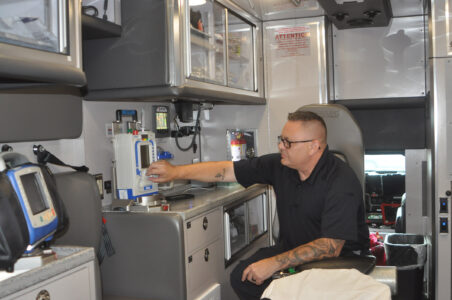
Richard is not the boss of all the agencies providing emergency medical care in the county. His role is to serve as an adviser on training, medical supplies and equipment, and compliance with rules and regulations. He will also respond to emergency calls in areas of the county that do not have paramedic level service.
"This is an amazing opportunity to be at the ground level of a new county-supported system," he said.
"We already have a fine EMS system in the county with talented people and very dedicated people," he added. "They are very skilled. They do a great job."
He said his job is to work with those people to create an EMS system that will be sustainable for the next 50 years and beyond.
Richard grew up in northern Minnesota and graduated from Bemidji High School.
Although the paramedics who cared for his mother left a deep impression on him, it took a little bit of time for him to realize that EMS was the right career for him. After graduating from high school he earned an associate degree in theology. He followed that up with an associate degree in general education.
Later, he earned an associate degree in paramedic technology from Century College in Minnesota.
"This is what I found to be my calling," he said.
After being certified as a paramedic, he worked for Lakes Region Emergency Medical Service in an area north of St. Paul, Minnesota. He also became a volunteer firefighter in Chisago City, Minnesota.
He went on to become a fulltime firefighter/paramedic with the Virginia Fire Department in Minnesota. He became that department's EMS coordinator. He was also a tactical medic working with the St. Louis County Sheriff's Office SWAT team.
After his family moved to Iowa, he became a paramedic for Mary Greeley Medical Center in Ames and Franklin General Hospital in Hampton.
Richard later took a job working in the emergency room at Iowa Methodist Medical Center in Des Moines. There, he met and worked with LifeFlight helicopter crews, He became a LifeFlight paramedic in 2010.
Throughout his career, he has taught EMS classes, first at Missabee Range Community College in Minnesota and more recently at Des Moines Area Community College in Ankeny.
Currently, he is working out of the Webster County Courthouse. This fall, he plans to move his base of operations to the southern half of the county. He said there he will be positioned to respond to emergencies and provide paramedic level care. The Dayton Rescue Squad and Southwest Webster Emergency Medical Service provide basic life support care in the southern part of the county, and Richard will support those units with advanced life support care.
Richard said the end result of the system that's being developed will be "emergency care at the highest and most efficient level with the most up-to-date equipment."
"That translates to lives saved and reduced disabilities," he said.