
THE PERFECT SEASON
92-year-old Eide shares his stories from Fort Dodge’s last unbeaten football campaign in 1945
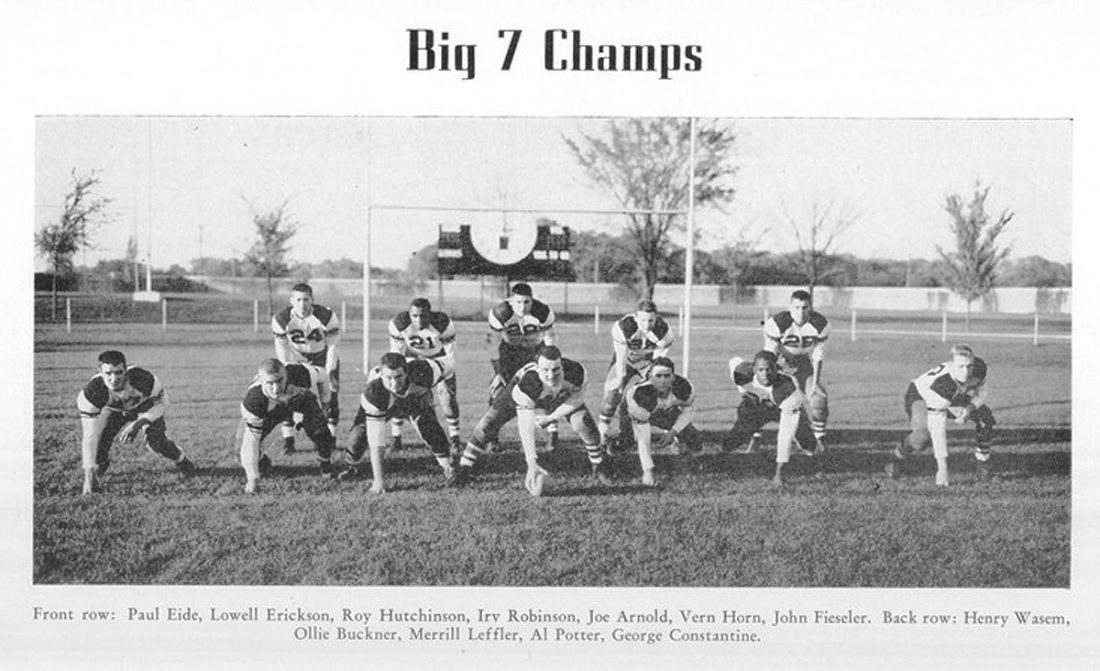
Submitted photo Starters for the 1945 Fort Dodge football team included, front row (left to right): Paul Eide, Lowell Erickson, Roy Hutchinson, Irv Robinson, Joe Arnold, Vern Horn and John Fieseler. Back: Henry Wassem, Ollie Buckner, Merrill Leffler, Al Potter and George Constantine.
-
- Submitted photo Starters for the 1945 Fort Dodge football team included, front row (left to right): Paul Eide, Lowell Erickson, Roy Hutchinson, Irv Robinson, Joe Arnold, Vern Horn and John Fieseler. Back: Henry Wassem, Ollie Buckner, Merrill Leffler, Al Potter and George Constantine.
-

- Submitted photo Rosemary and Paul Eide are pictured here in Colorado, where they are retired. The Eides previously lived in Fort Dodge and raised five children — all St. Edmond graduates.
-
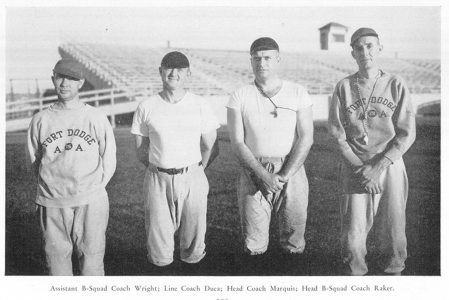
- Submitted photo The 1945 Fort Dodge coaching staff, shown here at Dodger Stadium, included (left to right): Coach Wright, Coach Duea, head coach Forrest Marquis and Coach Raker.
-
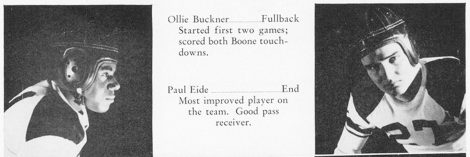
- Paul Eide was a senior and a starting end for the Dodgers in 1945.
World War II had just ended. Harry Truman was in the early stages of his presidency after the sudden death of Franklin D. Roosevelt a few months prior. And Dodger Stadium, a freshly-minted central Iowa gem erected as a major Works Progress Administration (WPA) project in Fort Dodge, was just five seasons into use.
Eide was a 170-pound senior end for head coach Forrest Marquis’ Dodgers that fall. It was 75 years and a lifetime of memories ago, but the 1946 Fort Dodge High School graduate is still sharp with his details and quick with his wit when he recalls the specifics of the school’s last state championship on the gridiron.
“Truth be told, we weren’t really expected to be very good that season,” Eide said. “We only had one regular back from the year before (when Fort Dodge had posted a 7-2 record). But Coach Marquis really had an ability to whip a team into shape. He was kind of an imposing figure; he wasn’t necessarily intimidating physically, but he had very piercing eyes. He just commanded your attention and respect. Away from the football field, he was relatively quiet. But he was a dominant individual in practices and in games.
“It was very hot that summer. We had 30 days of practices before the season started, and Coach Marquis had us practicing hard at 11 (a.m.) and 5 (p.m.) every day. He was a stickler for conditioning, and it certainly paid off in the end, but it was intense. I lost 14 pounds during that (one month) period of time.”

Submitted photo Rosemary and Paul Eide are pictured here in Colorado, where they are retired. The Eides previously lived in Fort Dodge and raised five children — all St. Edmond graduates.
The Dodgers had gone 5-4, 8-1 and 7-2 under Marquis during his first three seasons at the helm. When World War II began in 1941, the local junior college discontinued its football program and Marquis — its head coach — took over at the high school instead.
“I remember The Messenger didn’t really think much of our group (in the preseason),” said Eide, who attended Corpus Christi through seventh grade before moving into the public school system for his final two years of junior high and three in high school. “Coach Marquis had two really good teams before ours, and none of (the 1945 seniors) had really played much (at the varsity level) up to that point. So we were kind of an unknown. But once the season started, things fell into place for us and we showed we were going to play really well together. Coach Marquis’ conditioning program made sure we were ready and in better shape than (the opponent).”
Fort Dodge opened its campaign with three consecutive shutouts, defeating Albert Lea (Minn.), 47-0; Boone, 13-0; and Central Sioux City, 20-0.
“I think the defense quickly became the hallmark of the team,” said Eide, who was also a three-year track standout in high school. “The offense was good, but the defense was outstanding. Coach Marquis was a stickler for tackling — especially doing it the right way in the open field.
“We weren’t really supposed to beat Central Sioux City, so when we won comfortably, I think that turned some heads and made us a contender in the Big 7 Conference.”
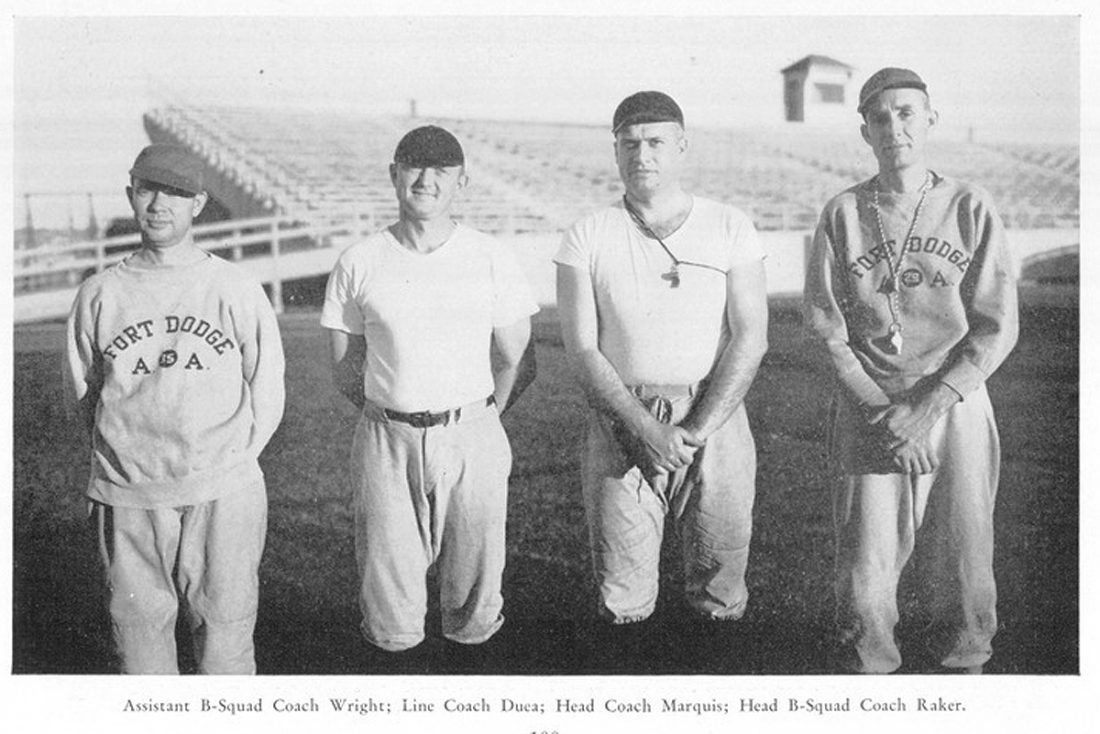
Submitted photo The 1945 Fort Dodge coaching staff, shown here at Dodger Stadium, included (left to right): Coach Wright, Coach Duea, head coach Forrest Marquis and Coach Raker.
The Dodgers took care of West Waterloo in their league opener, 13-7, to set up a showdown at home against fellow unbeaten East Waterloo.
“Dodger Stadium held 5,000 people, but they added an extra 1,500 (temporary seats) due to the anticipation surrounding the game with East,” Eide said. “They were 5-0 and ranked No. 1 in the state by the (Des Moines) Register.
“It was a gorgeous night. That crowd was something else. Fort Dodge has always been a football town. The fans packed the Stadium, and it was supposed to be our toughest game, but we won rather easily.”
The Dodgers rolled to a 26-6 win. Victories over East Des Moines (19-13), Des Moines Roosevelt (41-0) and Mason City (21-0) followed, setting up a home finale against Shattuck Military Academy. Fort Dodge posted its sixth and final shutout of the season, cruising to a 27-0 triumph to cap a 9-0 campaign.
Center Irv Robinson and end John Fieseler were first team all-staters from the Dodger squad. Henry Wasem made the second team, and George Constantine landed on the third. It was Fort Dodge’s first undefeated season since 1919, and there hasn’t been one since.
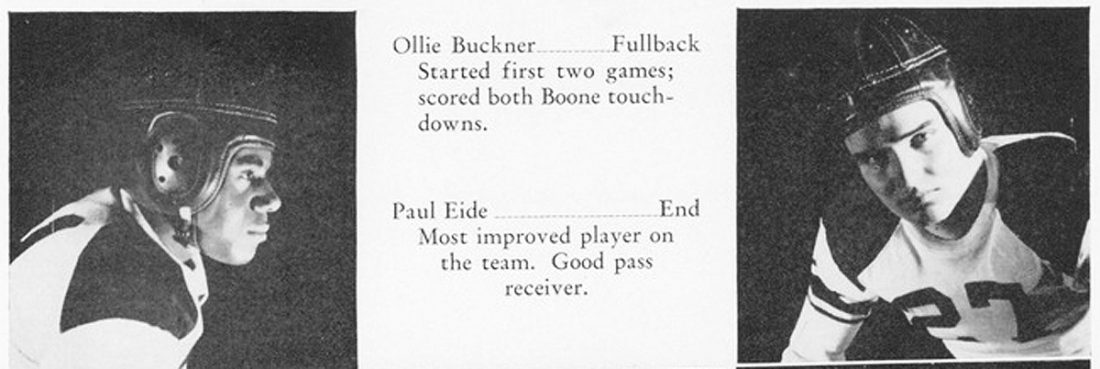
Paul Eide was a senior and a starting end for the Dodgers in 1945.
“The community really rallied around us,” Eide said. “There was tremendous energy and it made the year that much more memorable. The Messenger played a big role in that. Every week, we had a story and a few photos in the paper. It was just wonderful.”
The Dodgers celebrated an unofficial state championship when the Register named them Iowa’s top team at the end of the season.
“There were no playoffs at the time, so that had to be good enough,” Eide said. “We played in a very tough conference; we knew there was one on the east side of the state, too, but the Register had decided we were the best and that was just fine by us.”
Eide also remembered having two African-American players on the squad: Ollie Buckner and Vern Horn. It was “pretty rare” to have a racially integrated high school team in Iowa at the time, but Eide added, “none of us even gave it a second thought.”
“Ollie and Vern were outstanding players and even better people,” Eide said. “There were only three black students in our high school at that point, but they were all our friends and we had a terrific relationship with them. I don’t remember any problems, including with (opposing) coaches, fans or players. I know that wasn’t common yet at the college or pro level, but in Fort Dodge, it was normal and we were proud to call them teammates and classmates.”
Jackie Robinson would break the color barrier in Major League Baseball two years later in 1947.
Eide enlisted in the Army after graduation in 1946, then enrolled as a freshman at the University of Notre Dame in the fall of 1948. After obtaining a finance degree, Eide went to work in the insurance industry with his uncle in Des Moines.
With his wife, Rosemary, and four children — Clark, Jed, Nancy and Eric — the Eide family moved to Fort Dodge in 1965. A fourth son, Matt, was the youngest and the only sibling born here. Clark, Jed, Nancy, Eric and Matt all graduated from St. Edmond High School.
After starting a leasing company and later working for First Federal Savings Bank in Fort Dodge, the Eides retired to Colorado.
“I lost touch with most of the guys from high school after I enlisted; we all kind of went our separate ways,” Eide said. “(Long-time Messenger sports editor) Bob Brown, who was a great guy and good friend of mine, was on the team. He put together a 50th reunion (in 1995).
“Fort Dodge has always been so supportive of its athletics and activities. It was then and it still is to this day. The school district, the fans, the newspaper — it’s something I’ll always remember about the community, something our kids got to experience, and something everyone there should appreciate.”
Local Sports
Dodgers, Gaels both start in Top-10
Both the Fort Dodge and St. Edmond softball teams find themselves in the preseason rankings to begin the year ...
Mericle’s season finishes with 78 at district golf
St. Edmond junior Ty Mericle placed 10th in a Class 1A district boys golf meet, hosted by the Gaels at Lakeside on ...

Tritons bring home hardware from NJCAA national meet

Successful run for FDMX Spring Classic

STRENGTH IN NUMBERS