
Walking on the Dragoon Trail
Author speaks in Fort Dodge about Iowa’s environmental changes
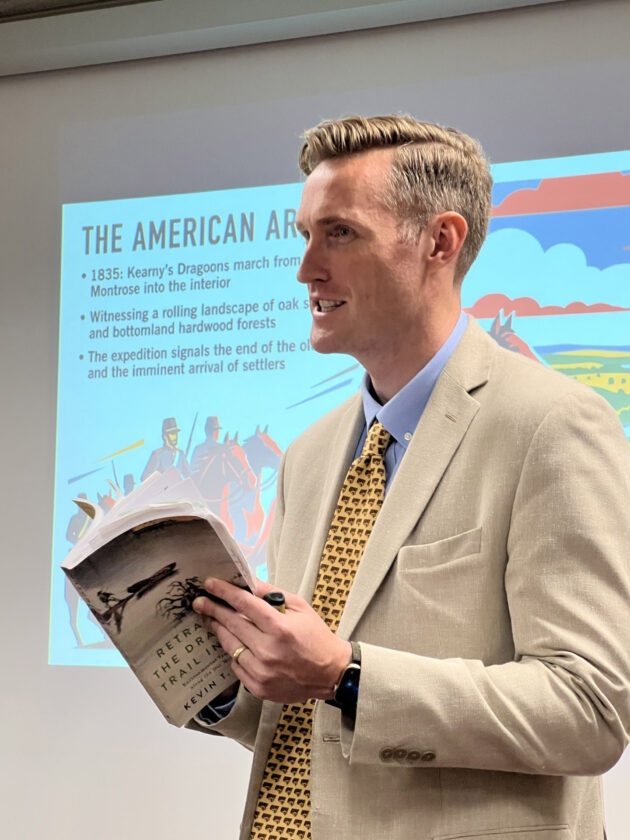
-Messenger photo by David Drissel <br> Kevin T. Mason, a history professor at the University of Northern Iowa in Cedar Falls, talks about his journey to retrace the path of the U.S. Dragoons, a military unit that explored northern Iowa before the first settlers arrived. For 21 days, he walked on their route along the Des Moines River. He made a presentation at the Fort Dodge Public Library Tuesday.
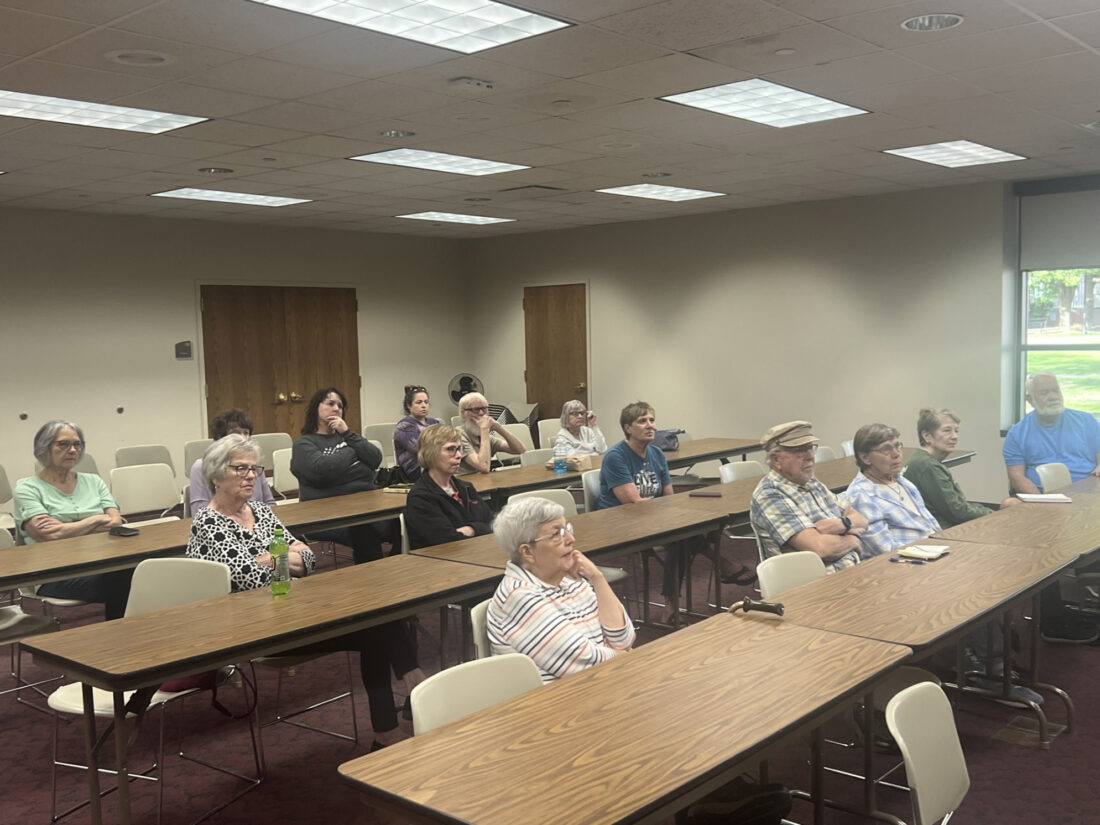
-Messenger photo by David Drissel <br>The audience listens to the presentation about how Iowa’s landscape has changed since the U.S. Dragoons explored the area in 1835.
-Messenger photo by David Drissel <br> Kevin T. Mason, a history professor at the University of Northern Iowa in Cedar Falls, talks about his journey to retrace the path of the U.S. Dragoons, a military unit that explored northern Iowa before the first settlers arrived. For 21 days, he walked on their route along the Des Moines River. He made a presentation at the Fort Dodge Public Library Tuesday.
-Messenger photo by David Drissel <br>The audience listens to the presentation about how Iowa’s landscape has changed since the U.S. Dragoons explored the area in 1835.
Trending
Following in the footsteps of a famous military battalion of U.S. Dragoons that rode through Iowa in the summer of 1835, historian Kevin T. Mason recalls how he was able to retrace this expedition almost two centuries later by walking 371 miles on the Dragoon Trail.
A University of Northern Iowa history professor, Mason is the author of the book, "Retracing the Dragoon Trail in Iowa: Environmental Transformation along the Des Moines River," published last month. He discussed his findings Tuesday evening at the Fort Dodge Public Library.
Mason's book includes firsthand observations from his lengthy trek, blending traditional historical scholarship with modern storytelling. It focuses on how Iowa's prairies, wetlands, and hardwood forests were largely transformed into agricultural landscapes and urban networks.
The official Dragoon Trail is a roughly 200-mile scenic and historic driving route in Iowa along the Des Moines River, established in 1933 to commemorate the 1835 march of the first official regiment of U.S. Dragoons - soldiers on horseback.
The driving route is marked by special signs that encourage tourists to visit sites that are key to Iowa's territorial development in the 19th century. The trail is designed to call attention to Iowa's early military history and natural landscapes.
Born and raised in Iowa, Mason recalls seeing road signs of the Dragoon Trail as a child. As he grew older, however, he became more curious about the Trail's historical significance.
The trail follows the path of the U.S. Dragoons that surveyed Iowa in the aftermath of the Black Hawk War and the related U.S. territorial purchase of Iowa territory in 1832, he said. These events opened up Iowa to thousands of white settlers, beginning the following year.
The official Dragoon Trail includes two northern trails originating in Fort Dodge and Webster City, joining near Stratford, then traversing through Boone and Des Moines before ending at Red Rock Dam near Pella and Knoxville.
However, Mason completed a longer and slightly different Dragoon Trail route on foot in the summer of 2021. He walked for 21 days in a row, averaging 15 to 18 miles each day.
Mason said that he sought to chart a more historically accurate Dragoon Trail on which to walk, rather than simply following the driving route. His journey was based on original maps and other archival records from the 1835 expedition.
He followed the Des Moines River, starting in Old Fort Des Moines in Montrose and ending in the Mini-Wakan State Park.
"I tried to stay as close to the river as possible," he said.
Mason didn't originally plan on retracing the Dragoon trail on foot; it actually started as a joke among friends. However, his idea was leaked to the media after it came up at an Iowa Historical Society meeting. He was contacted by a producer for Iowa Public Radio to talk about his project.
"That's when it kind of became a real thing," he said.
Mason notes that the first dragoons originated in late 16th century France, named after the "dragon" - a short musket or carbine they carried, which emitted fire from the muzzle, mimicking a dragon.
He said that dragoons played an important military role in the early history of the United States, during both the American Revolution and War of 1812, but subsequently disappeared for several years.
"In the 1830s, they reappear as this kind of frontier force in America," he said.
The U.S Dragoons who explored Iowa were the first mounted infantry unit in the new western frontier of the U.S. They were armed with rifles, pistols, and swords, but traveled on horseback to move quickly across the new territory.
Led by Capt. Stephen Watts Kearny, the U.S. Dragoon unit sought to explore, map, and secure the new frontier in Iowa between Native American tribes and incoming U.S. settlers.
"Along the way, the dragoons made their presence known among the indigenous peoples they encountered," Mason said. "A show of force meant to deter attacks on American settlers encroaching on lands, they had no legal claim to occupy under existing treaties."
The Dragoon expedition led to the establishment of new military outposts in Iowa, including present-day Fort Dodge, Webster City, Des Moines, and other cities.
"They pass through the site of all the major American military forts that are going to unfold along this new frontier," he said.
In addition to Kearney, Mason emphasized the important role of two other officers serving in the dragoon expedition – Capt. Nathan Boone and Lt. Albert Lea. The son of the famous frontiersman, Daniel Boone, Nathan Boone served as Kearney's "right hand man."
"Boone also leaves his name all over our map in Iowa," Mason said. "He's the namesake of Boone County, and Boone, Iowa, among other places."
Lea, who had a background in topographical engineering and mapping, documents the trip in a short book, "Notes on the Wisconsin Territory." His account provides an early description of the Iowa landscape, Mason said.
Lea's book is what first sparked Mason's interest in the Dragoon Trail, while in graduate school at Iowa State University.
"His book is a great snapshot of what Iowa looks like in this moment right before things start to shift," he said. "That's why Lea is very important to us."
Using Lea's work and other documents as a baseline, Mason was able to detail many of the environmental and historical changes to Iowa's landscape that have occurred over the past two centuries. He notes, for example, that the dragoons encounter 5,000 buffalo at one point on their journey - the largest herd ever seen in Iowa.
Mason explains that his book references Native American histories and ecological data to explore the impact of displacement and erasure of native peoples from Iowa.
"The landscape in Iowa has changed more than anywhere on Earth," he said. "We've lost 99.8 percent of our prairies. We have also seen complete human change through the dispossession of indigenous peoples."
Mason's walk became a central part of his broader project, "Notes on Iowa," which endeavors to make Iowa's history more accessible to the public. Throughout the trek, Mason recorded video essays and took photographs, sharing his findings on social media platforms and his website.
"As a result, I was able to reach a lot of people about Iowa history in different ways than I ever anticipated," he said. "Notes on Iowa now reaches over 3 million people a week across platforms, such as Facebook, Twitter, and Google."
While on his walking expedition, he visited many museums and other historic sites in nearby towns, often talking to local people about the history of their communities.
"While I was working on this project, one of the things that I became very committed to was talking to people about their local history," he said.
Mason said that people often ask him why he did not simply drive the route. He explains that he chose to walk the route in order to have a fuller experience.
"Walking around, I saw things I wouldn't have seen in my car," he said.
He recalls, for example, how a bald eagle suddenly dove in his direction and flew right over his head while he was walking in Fort Dodge's Loomis Park.
Mason claims that he wants to write history from a more down-to-earth perspective, and spark new interest in Iowa history. He notes that one of his students said that Mason's book makes Iowa history seem interesting and relevant.
"This book is a gateway drug to Iowa history," the student told him. "I'm going to keep reading Iowa history."
Mason explains that his book is really more about historic changes in Iowa's natural environment rather than a detailed history of the Dragoons.
"It's a broad Iowa history with an environmental focus within a Trojan horse of the Dragoon Expedition of 1835," he said. "In each chapter, we start with an observation from the dragoons," and then proceed to discuss environmental transformations in Iowa."
He notes that there is a great deal of Fort Dodge history in the book.
"Fort Dodge is really useful to tell a lot of Iowa stories," he said.
"One chapter focuses on how meat production has changed in Iowa over time from ancient history to the early 2000s," he said.
This chapter includes a former Fort Dodge meatpacking plant. Another chapter highlights the development of diverse agriculture in Iowa, including community orchards such as the one in Fort Dodge.
Mason said that his Notes on Iowa social media page focuses on a wide gamut of historical topics. The interactive responses he receives to his online essays are sometimes critical but nonetheless valuable to the process.
"People tell me how wrong I am every day, but you get a thick skin for it," he said. "I really want people to talk to me about history. I'm convinced that history's only real when it's shared."