
Fort Dodge, Homer were rivals for county seat
Webster County had colorful early history
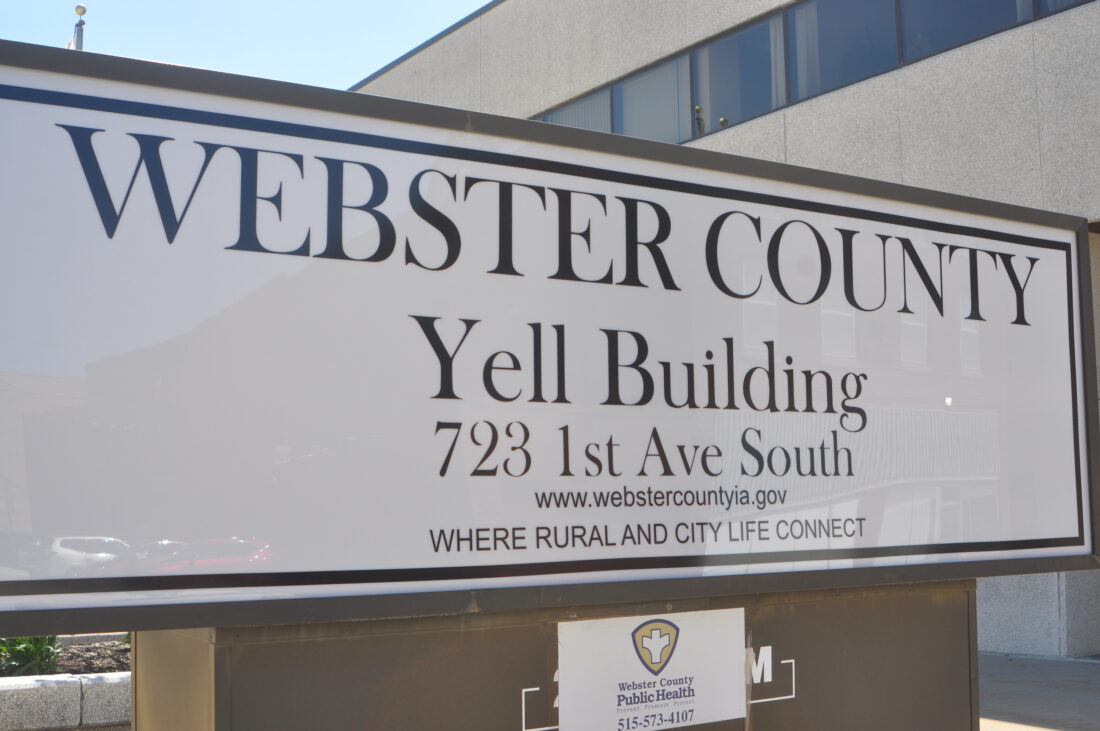
-Messenger photo by Bill Shea <br> The Webster County office building at the corner of First Avenue South and Eighth Street in Fort Dodge is named the Yell Building, a tribute to the original county name for this area.

-Messenger file photo<br>The Webster County Courthouse was built in 1902 on the site of the original courthouse.

-Messenger file photo<br> The interior of the Webster County Courthouse is shown.
-Messenger photo by Bill Shea <br> The Webster County office building at the corner of First Avenue South and Eighth Street in Fort Dodge is named the Yell Building, a tribute to the original county name for this area.
-Messenger file photo<br>The Webster County Courthouse was built in 1902 on the site of the original courthouse.
-Messenger file photo<br> The interior of the Webster County Courthouse is shown.
Trending
Fort Dodge was still an active Army post when it and all the land around it became part of an official Iowa county.
But it wasn't named Webster County. And the process of eventually getting the county seat moved to the town of Fort Dodge after the Army left got a little bit nasty.
The Army post, which was at the northwest end of what is today's downtown Fort Dodge, was established on Aug. 2, 1850. It was initially named Fort Clarke. The name was changed to Fort Dodge in 1851.
During its 1850-1851 session, the Iowa legislature named the area around the fort Yell County in honor of an Army officer killed in the Mexican-American War.
The Yell County name did not last very long, however. During the 1852-1853 session, the legislature combined Yell County with Risling County to the east to form a new large county named Webster County. It was named after Daniel Webster, a congressman, senator and secretary of state.
Webster County was officially established in April 1853. At that time Fort Dodge was still an Army post, but it would be closed two months later.
Homer, a town 19 miles southeast of Fort Dodge, near the Boone River, was the first county seat.
In 1854, William Williams, who had been the civilian merchant serving the Army post, laid out the town of Fort Dodge. He had bought the land from the state government after the Army left.
The town had a growth spurt in 1855, after a federal land office was opened there.
In the fall of 1855, Williams and other Fort Dodge leaders, notably John Duncombe, one of the first attorneys in town, learned that the people of Homer planned to build a courthouse there. In his history of early Fort Dodge, Williams wrote that he learned of the plan from a man who rode a train into eastern Iowa and then came to Fort Dodge. That individual told Williams that another passenger on the train told him about the courthouse plan and encouraged him to settle in Homer.
Williams, Duncombe and some of their associates circulated petitions calling for a referendum election on moving the county seat to Fort Dodge. Learning of that development, people in Homer circulated a petition intended to thwart it.
The Fort Dodge and Homer petitions were delivered to the county judge in Homer on the same day.
Duncombe expected trouble and wrote in his diary that he went to Homer "armed with a huge Bowie knife."
When the judge reviewed the petitions, he found the Fort Dodge one had more signatures and he had no choice but to call a referendum vote on moving the county seat.
After presenting their petition, six men from Fort Dodge went to the hotel in Homer to take a break before returning home. There, things got ugly.
"The Homerites had resorted to whiskey pretty freely, twenty or more of their bullies attacked us and were for mobbing us," Williams wrote.
"They abused us very much and I suppose all that saved us was taking a pretty stubborn and silent stand, which caused them to believe we were armed," he added.
Here is how Duncombe described the scene in his diary:
"A ruffian begins to abuse Major Williams, a man of over 60 years. The most shameful abuse is perpetuated. Oaths and low vulgar slang constitutes the order. I resolve if a blow is struck, to split open the man's head who does it. I was the only one in our crowd armed. I stay in the house until all my friends are in their sleigh, then I get into mine and we drive home, safe and sound and on my own part, not the least scared."
The referendum on the county seat was held on April 8, 1856. The voters favored the move to Fort Dodge.
"In April 1856, after a very exciting canvas, the election was held and the removal of the county seat to Fort Dodge carried by a large majority," Williams wrote.
In late 1856, the legislature approved a plan to make the eastern part of Webster County a new county to be called Hamilton.
In April 1858, Webster County voters approved the construction of a courthouse in Fort Dodge. In August of that year, H.D. Merritt and Israel Jenkins were hired to build the courthouse at a cost of $39,450.
The chosen site was where the current courthouse stands at the corner of Central Avenue and Seventh Street. But in 1858, those streets were called Market and Sixth.
By 1898, that first courthouse had outlived its usefulness. So on Nov. 7, 1899, the voters of Webster County approved the construction of a new courthouse. The result was the current structure, which was completed in 1902.
Historian: Townships were major focus in 1800s
Many of today's Webster County residents probably have forgotten that rural areas of the county are divided into townships.
But people who lived here in the late 1800s thought more about their local township than they thought about their county, according to Fort Dodge historian Roger Natte.
"People identified with townships," he said.
"Counties did not amount to much," he added. "The work was done by townships."
It was the townships, he said, that took care of what roads existed. And it was the townships that assessed properties and maintained the tax records, he added.
The township system found in Iowa is a refinement of the setup found in the original 13 colonies that was revised by president Thomas Jefferson.
"He apparently is the person who really put together the township system we have," Natte said.
Jefferson's system, he said, called for acquiring land via treaty with the Native Americans. Then the land was surveyed in a process that included dividing it into townships. Then finally the land would be put up for sale.
Webster County, he said, is in the last area of Iowa in which land was transferred by a treaty.
Natte said each township had a section of land reserved for a school, creating the system of country schools that would last into the 20th century. Each township also had a polling place.
Over time, counties and cities assumed many of the responsibilities of the townships.
Today, townships are mainly responsible for maintaining rural cemeteries and providing some funding to volunteer fire departments.