
Sheriff answers parents’ school safety questions
-

-
-Photo by Hans Madsen
Cooper Elementary School special education teacher Dana Recker, along with her husband Tony Recker listen to a School Safety Session for Families in the Middle School Auditorium Tuesday evening.
-
-
-Photo by Hans Madsen
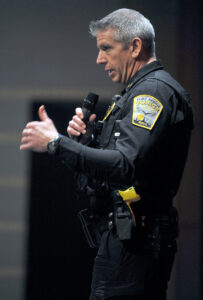
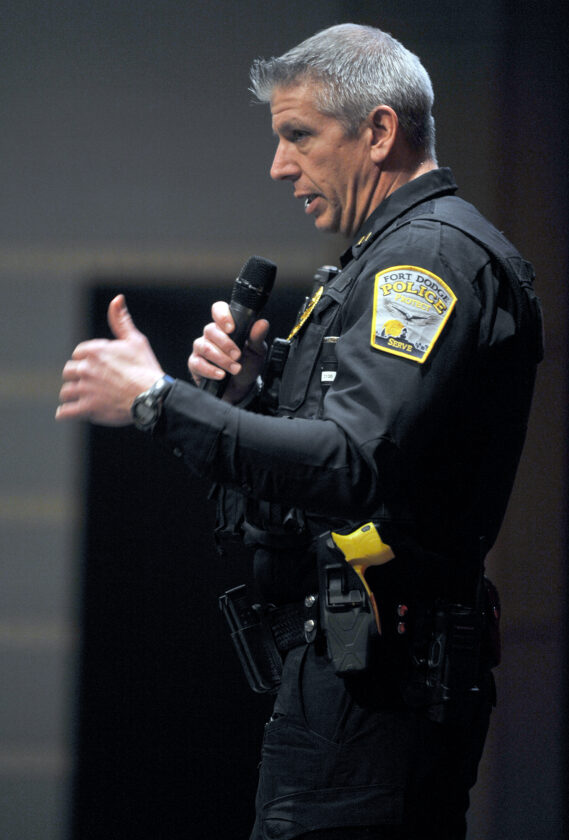
Fort Dodge Police Lt. Dennis Quinn talks about how an incident in September at the Fort Dodge Middle School was handled by staff and law enforcement to ensure a safe ending.
-

-
-Photo by Hans Madsen
Members of the audience, including parents, staff and students, listen Tuesday evening to a School Safety Session for Families in the Middle School Auditorium.
-
-
-Photo by Hans Madsen
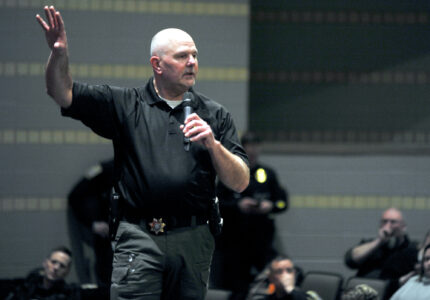
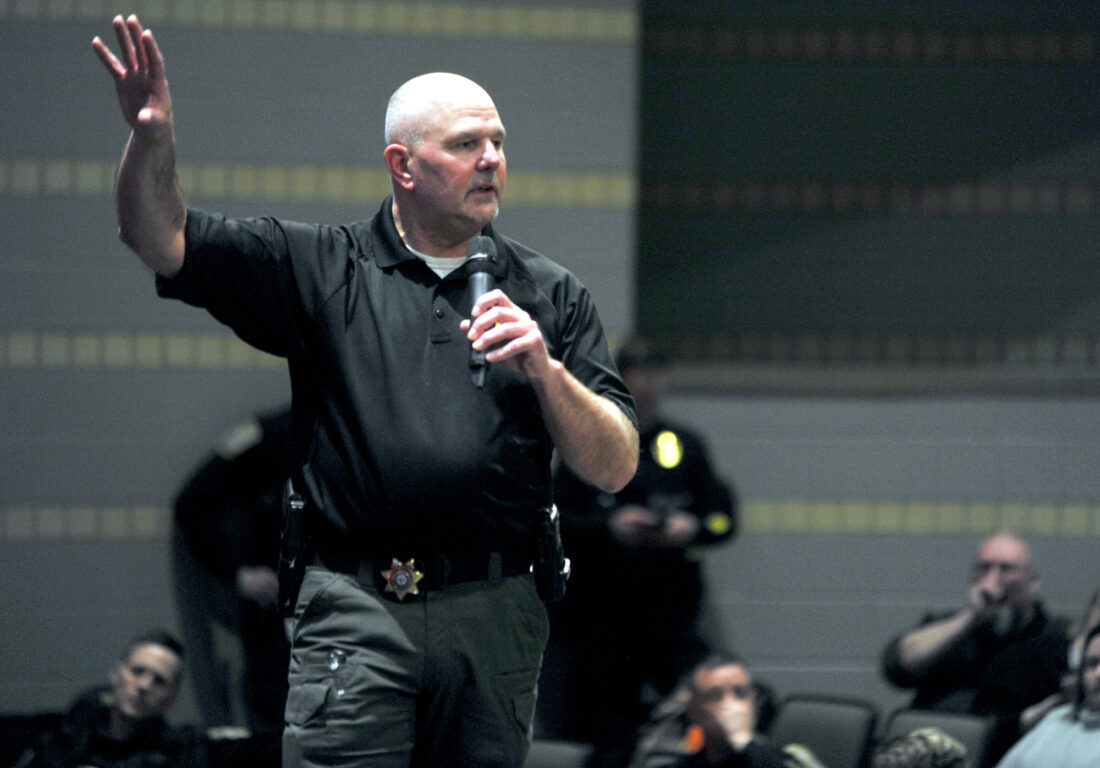
Webster County Sheriff Luke Fleener speaks about various aspects of keeping students and staff safe Tuesday evening during a School Safety Session for Families in the Middle School Auditorium.

-Photo by Hans Madsen
Cooper Elementary School special education teacher Dana Recker, along with her husband Tony Recker listen to a School Safety Session for Families in the Middle School Auditorium Tuesday evening.
The school safety meeting Tuesday night at the Fort Dodge Middle School auditorium was more than just a lecture from law enforcement — it was a conversation with concerned parents as well.
The goal of the meeting was to hear concerns from district parents and inform them of the upcoming lockdown drills the district will be doing at all of the schools.
During the meeting, Webster County Sheriff Luke Fleener introduced the parents to the Standard Response Protocol from the I love U Guys Foundation that the school district and local law enforcement use for emergencies.
In particular, the protocol for a lockdown is to secure individual classrooms and other rooms in the school building by locking the door and turning out the lights as students and staff hide quietly in the locked room until released by a member of law enforcement or school administrator.
The goal of the lockdown is to keep students and staff safe and to create a “time barrier” for the attacker until law enforcement can arrive.
-Photo by Hans Madsen
Fort Dodge Police Lt. Dennis Quinn talks about how an incident in September at the Fort Dodge Middle School was handled by staff and law enforcement to ensure a safe ending.
“The national average time of an attack is five minutes,” Fleener said. “We’re going to be there in less than three, and time barriers buy us time to get on scene.”
The most basic time barriers in an attack, Fleener said, are locked doors because history has shown that attackers don’t take the time to try to get through a locked door.
“Rarely has anyone ever shot through a locked door,” he said.
One mother shared her concerns about the “quiet” part of the lockdown procedure.
“What about the special needs kids that don’t have the ability to calm down in the middle of a lockdown and are screaming and crying and are panicked and scared?” she asked. “What if they can’t keep quiet?”

-Photo by Hans Madsen
Members of the audience, including parents, staff and students, listen Tuesday evening to a School Safety Session for Families in the Middle School Auditorium.
First and foremost, Fleener said, there is no “perfect” protocol that will fit every situation. There are many variables, but the SRP has proven to be a best practice in response to school emergencies like an attack.
“I assume somebody in that classroom knows that student very well and it would fall upon them to do the best they can to keep that student safe,” he said. “And if it means being loud to deal with the stress of this, so be it.”
Again, Fleener emphasized locking the classroom doors during this kind of situation.
“[An attacker is] not going to take time, historically, to fight their way through that door just because they hear noises,” he said.
One parent asked about the possibility of arming school staff in the event of an active shooter-type situation.
-Photo by Hans Madsen
Webster County Sheriff Luke Fleener speaks about various aspects of keeping students and staff safe Tuesday evening during a School Safety Session for Families in the Middle School Auditorium.
In 2022, the Spirit Lake Community School District School Board unanimously approved a plan to arm up to 10 staff members in district buildings.
At Tuesday’s meeting, Fleener explained that it’s not as simple as just allowing a handful of school administrators to carry a concealed weapon on campus.
“There are some states that are talking about that and there’s some school districts that have ventured down that road, but here’s the thing — when we do our training to possess and carry this 24/7, everywhere we go, there’s a lot of things that go with it,” he said. “One of those rules is know your target and what’s beyond.”
An armed individual trying to stop an attack in a crowded place needs to be “really, really proficient” at shooting so the target they’re aiming at is hit, but none of the people around are harmed.
“I’d also probably need to know the ballistics of the ammunition that I carry,” Fleener said. “Would this bullet go through that brick wall? Would this bullet go through that wooden door?”
These are things law enforcement officers train for on a regular basis to be proficient in a crowded room of innocent people that are running for their lives and depending on them to stop the attack, he said.
“If we can provide that amount of training and quality to a person in the school, then maybe,” Fleener said about arming school staff.
If armed school staff aren’t trained to that level and lack a knowledge of weapons and ammunition caliber, they could end up harming or even killing an innocent bystander in a chaotic situation, he said.
An armed civilian also creates problems for the responding law enforcement, the sheriff said.
“A civilian holding a weapon in a highly-charged, highly-emotional situation, standing over a bad guy holding cover, as officers make entry into that classroom, in our scenario training, guess what happens to that person standing there with that weapon?” he said.
The school resource officers on campus are trained for these kinds of scenarios, Fleener said.
Another parent asked if there were any plans to have a full-time school resource officer at every school building in the district.
“In a perfect world, I would say absolutely,” Fleener answered.
Currently two SROs from the Fort Dodge Police Department — officers Matt Meyer and Matt Weir — serve as full-time SROs at the middle school and high school. They also visit the elementary schools.
“It’s a great program,” Fleener said.
But the idea to add more SROs comes down to money — “Can we afford it?” Fleener said.
“The school board works diligently with the Police Department to help fund those two SRO positions to keep them here, so it’s a great program,” he said. “It does add a great sense of security.”
At the end of the meeting, Jen Lane, director of information for the school district, informed parents that in the next month, all the district’s schools will be conducting lockdown drills with the students.
“The next natural step is getting our students involved,” Lane said. “As parents, we want you to be comfortable with it so that you can help your kids be comfortable with it.”
Lockdown drills, Fleener explained, aren’t “scary” life-like scenarios — it’s a teacher closing and locking the classroom door and the class huddling up together in a corner for a short period of time.
“It’s not SWAT dudes all geared up roaming the hallways,” he said. “It’s not blank guns going off, screaming, yelling. It’s not that, and that’s a common misconception.”
The purpose of the drills are to be educational, not fear-based, he said.
Local News
Grassley pushes plan for rural hospitals
UnityPoint Health — Trinity Regional Medical Center is one of the hospitals benefitting from a Medicare plan ...

Ag Days
Area youth learn about Iowa agriculture
By KELLI BLOOMQUIST WEBSTER CITY — More than 600 students from three area counties - Hamilton, Humboldt, and ...

Paivarinta pleads guilty to non-forcible felony charge

Firefighters battle blaze in ravine