
Reserve Unit seeks recruits
Volunteer officers needed to serve Fort Dodge, Webster County
-
-
-Messenger photo
by Elijah Decious
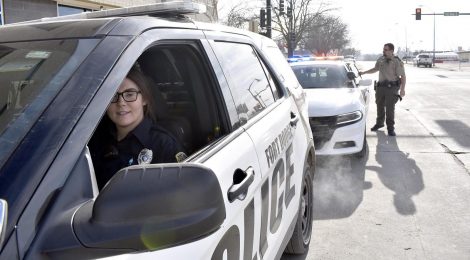
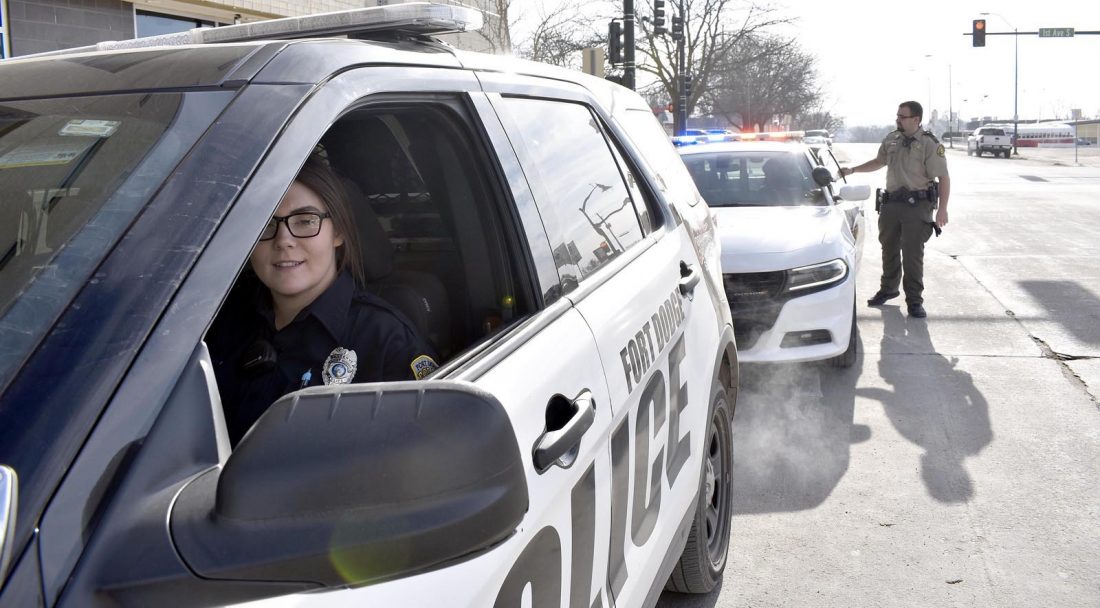
Fort Dodge Police Reserves Officer Brittni Nelson gets “pulled over” outside the Law Enforcement Center by fellow Webster County Reserves Deputy Dylan Hagen. Officer Nelson was reportedly released with a warning.
-
-
-Messenger photo by Elijah Decious
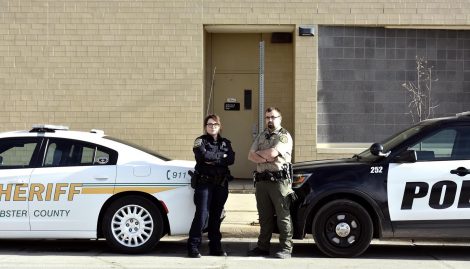
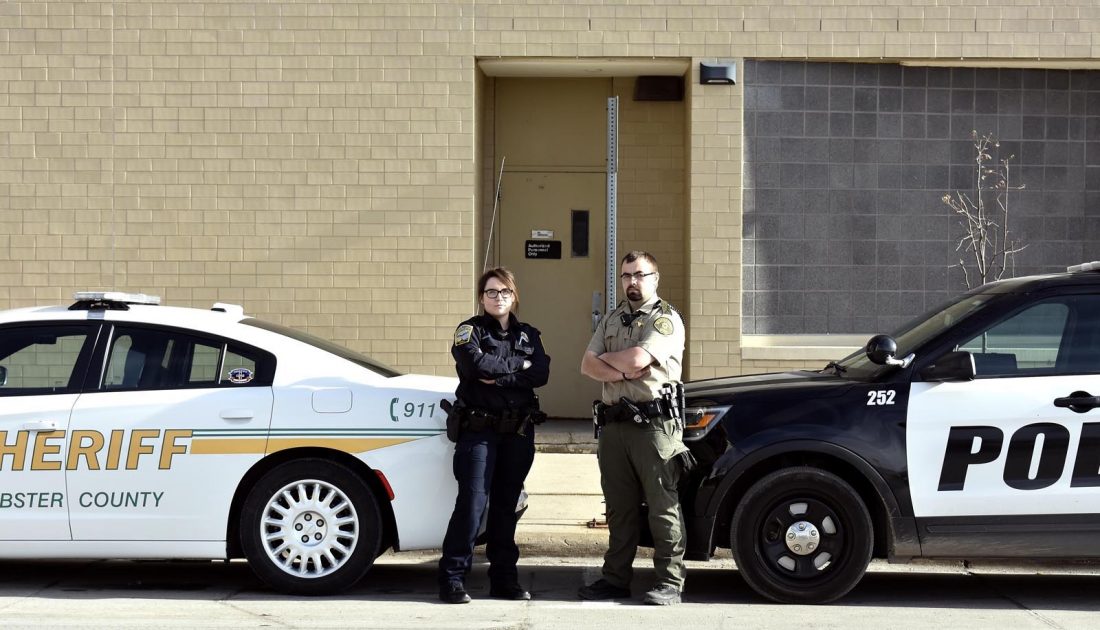
Fort Dodge/Webster County Reserves officers Brittni Nelson, left, and Dylan Hagen can wear either Fort Dodge Police Department or Webster County Sheriff’s Office uniforms in the state’s only joint program.
-Messenger photo
by Elijah Decious
Fort Dodge Police Reserves Officer Brittni Nelson gets “pulled over” outside the Law Enforcement Center by fellow Webster County Reserves Deputy Dylan Hagen. Officer Nelson was reportedly released with a warning.
The only joint volunteer law enforcement program in Iowa is seeking more members to serve with Fort Dodge and Webster County’s finest at the Fort Dodge Police Department and Webster County Sheriff’s Office.
You won’t get paid — in fact, you have to buy some of your own equipment. It requires a substantial time commitment — 200-some hours in your first year-and-a-half. You’ll need to make sacrifices to fulfill your duties.
And the Reserves doesn’t have any “I Want YOU” inspirational recruitment posters with Uncle Sam’s index finger aiming patriotic conviction squarely at prospects.
But for those called, it offers a way to connect to the community and serve alongside officers with a type of satisfaction unmatched by other opportunities, volunteers say.
The program, which currently has seven volunteers, is looking to bulk up the force as much as possible, up to 17 Reserves members.
-Messenger photo by Elijah Decious
Fort Dodge/Webster County Reserves officers Brittni Nelson, left, and Dylan Hagen can wear either Fort Dodge Police Department or Webster County Sheriff’s Office uniforms in the state’s only joint program.
“It’s a great way to be a part of the community and give a path to a career,” said Sheriff Jim Stubbs.
While some in Iowa use the reserves as a training ground and stepping stone into full-time law enforcement, many volunteers choose to give their time not for a career payoff, but simply to give back.
“I wanted to help more in my community than I was,” said Reserves Officer Brittni Nelson, who works full-time as an emergency dispatcher in addition to volunteering. “I’ve always been interested in that kind of thing. I thought I could offer more help to my community.”
For people like her, the thanks from a grateful force in need of the help and the county — which saves thousands of taxpayer dollars in tight budgets — is more than enough.
Plus, there are perks: you get to be tased as part of your law enforcement training, the same training all paid officers go through.
“So there’s that,” FDPD Chief Roger Porter joked after Nelson played the video of her electrifying experience.
“It’s rewarding to know I’m helping the community and supporting full-time officers,” Nelson said.
The program, which started out in the ’80s as the “Sheriff’s Posse,” became a joint program with the FDPD in 2008, prompted by the city’s need for extra resources to cover more ground. For 11 years, they’ve maintained their status as the only joint program in the state.
“It was just the logical next step, to make it a joint Reserves since they were coming out and helping (the police department,)” Porter said.
That means on any given day, volunteers could be wearing either the Police Department’s black uniform or the tan and green one worn by the deputies, depending on the needs and activities of the day.
FDPD service involves dealing with a higher call volume, whereas working for the Sheriff’s Office means covering more ground on your own in a larger jurisdiction, explained Dylan Hagen, emergency management coordinator for Webster County and a Reserve volunteer.
As the program has evolved, so have the stringent requirements to make the volunteers equal partners in enforcing the law and serving their communities. Applicants must pass rigorous physical tests and psychological assessments to apply.
“Before, if you could breathe and walk, you could be a Reserve,” Porter joked. All law enforcement personnel today have been through the proper, extensive training.
Reserve officers help out at about 15 to 20 events per year, providing extra security and assistance as needed for anything from a concert to a crime scene.
The nature of the program’s interaction with the public has evolved over the decades Porter has served on the Police Department.
“You didn’t (used to) see a lot of community-type interaction,” he observed, noting that Reserve presence has made law enforcement’s community relations efforts more cohesive. “They’re another voice out there for law enforcement.”
They’re an invaluable organization whose involvement has only increased over his tenure, he added.
As law enforcement departments across the country face a decline in applications for both paid and volunteer work due to a variety of factors, Fort Dodge and Webster County have started to look at the program as a hiring tool.
Anti-police sentiments, portrayals in the media and general changes in career patterns with younger members of the work force are potential reasons for the decline.
Porter estimates that the department only receives a handful of Reserve applications each year — something the program would like to see change.
“It takes a lot of commitment,” he said. “You’re not making wages, you’re not getting benefits. You’re doing it because you want to help. It’s a huge commitment.”
With all the occupational hazards, too, Hagen noted.
But for the right person, the personal sacrifice is a worthy endeavor, rewarding a mentality of public service that no amount of cash can compensate.
Those wishing to apply to be a Reserve officer/deputy can find an application online at fortdodgeiowa.org/police. Once there, click on “Employment” in the right side bar.
Requirements
Those wishing to be a volunteer in the joint Reserve Unit for the Fort Dodge Police Department/Webster County Sheriff’s Office must meet the following requirements:
• 21 years of age or older.
• A U.S. Citizen and resident of the state of Iowa.
• A resident of Webster County or a bordering county.
• Have a high school diploma or equivalent GED certificate.
• Have a valid Iowa drivers licence with good driving record.
• Not be addicted to drugs or alcohol.
• Not have prior felony convictions or convictions of crimes of moral turpitude.
• Be of good moral character, as determined by a thorough background check.
• Pass minimum physical agility, vision and hearing standards set by the Iowa Law Enforcement Academy. Physical agility tests include a 1.5 mile run, push-ups, sit-ups and sit-and-reach. Standards vary by age and sex.
• Pass a psychological assessment.
• Not be opposed to the use of force when necessary in the course of performing duties.
Those selected to become a member of the Reserve Unit will be required to complete mandatory training prescribed through the Iowa Law Enforcement Academy. Training modules include a wide range of topics including basic law, reporting, precision driving, court testimony and report writing.
“Your first year will be very busy and consist of approximately 200 hours of training,” the application states. Quarterly hour requirements must be met and monthly meetings must be attended. Members are expected to contribute a minimum of 30 volunteer hours per calendar quarter.
Local News

America at 250: Chaos in the run-up to Civil War
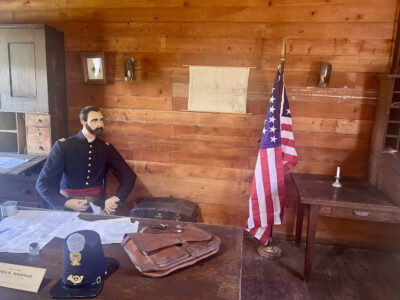
Armistead served from Fort Dodge to Gettysburg
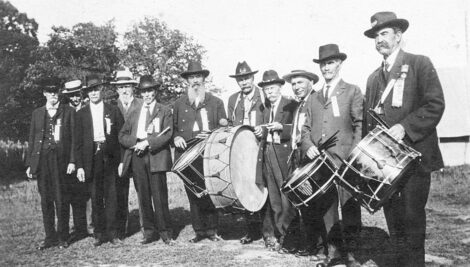
GAR had local presence
Two Civil War units came from Fort Dodge

Primary election is Tuesday
Boost for rural hospitals OK’d by Senate
The U.S. Senate unanimously passed a plan championed by U.S. Sen. Charles Grassley that will help hospitals like ...