
Armistead served from Fort Dodge to Gettysburg
Trending
One of the Army officers who oversaw the construction of the original Fort Dodge would later lead Confederate soldiers before being killed in the battle of Gettysburg.
Lewis Armistead was born on Feb. 8, 1817, in New Bern, North Carolina, and grew up in Virginia.
Many of the men in his family were soldiers, and Armistead followed them into a military career.
He was enrolled in the United States Military Academy, at West Point, New York, but dropped out. That did not stop him from becoming an Army officer, however. On July 10, 1839, he was commissioned as a second lieutenant and assigned to the 6th U.S. Infantry. One of that regiment's components, Company E, established Fort Dodge on Aug. 2, 1850.
But before he came to Fort Dodge, Armistead served at several posts in the Midwest and fought in the Mexican-American War.
The Fort Dodge military post was at the northwest end of today's downtown, on a high point overlooking the Des Moines River and Lizard Creek. The old Wahkonsa School sits on the site today.
Armistead directed the soldiers in setting up a steam-powered saw mill used to cut the wood needed to build the fort's buildings. The fort consisted of a couple of rows of buildings, and was never an enclosed stockade.
In October 1852, Armistead left Fort Dodge and returned home to Virginia, on leave to help his family after their house burned down.
The Fort Dodge Army base was abandoned several months later, in June 1853.
While it's unclear if Armistead ever returned to Fort Dodge before it closed, he did return to Army duty and served at several more posts in the West.
He was in San Diego, California, when the Civil War began in 1861. He resigned from the Army on May 26, 1861, and headed to Virginia to join the Confederate Army.
He commanded various brigades and regiments in fighting throughout Virginia. He was promoted to brigadier general.
Armistead and his men were among the thousands of Confederate soldiers who advanced on the small Pennsylvania town of Gettysburg in July 1863.
On July 3, 1863, Confederate Gen. Robert E. Lee ordered a massive frontal attack on Union forces atop Cemetery Ridge south of Gettysburg. The Confederate soldiers had to advance across a mile of open ground to get at their enemies. The attack became known as Pickett's Charge, after the Confederate general who commanded a division leading the assault
As the Confederates advanced, Union troops shredded their ranks with musket and cannon fire.
Armistead, unlike many other generals, was on foot. He walked at the head of his brigade. Wanting to make sure his men could always see him, he put his hat on the tip of his sword and held it above his head as he marched.
Miraculously, Armistead and about 200 Confederate soldiers made it all the way to the top of the ridge, jumped a low stone wall and plunged into the Union position. The Union troops briefly scattered. Numerous histories report that Armistead placed his hand on a Union cannon and was apparently about to tell his men to turn it around when regrouping Union troops fired a big musket volley. Armistead was shot three times. All of the Confederate troops with him were killed or wounded.
Armistead died July 5, 1863, in a Union field hospital near Gettysburg. He was initially buried there. His remains were later placed in the family plot in Virginia.
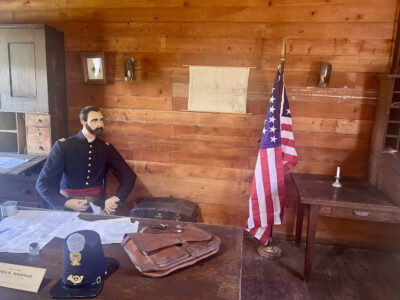
Armistead is remembered today with a display in a cabin at the Fort Museum and Frontier Village. That cabin is the last remaining structure from the Fort Dodge military post.