
America at 250: Chaos in the run-up to Civil War
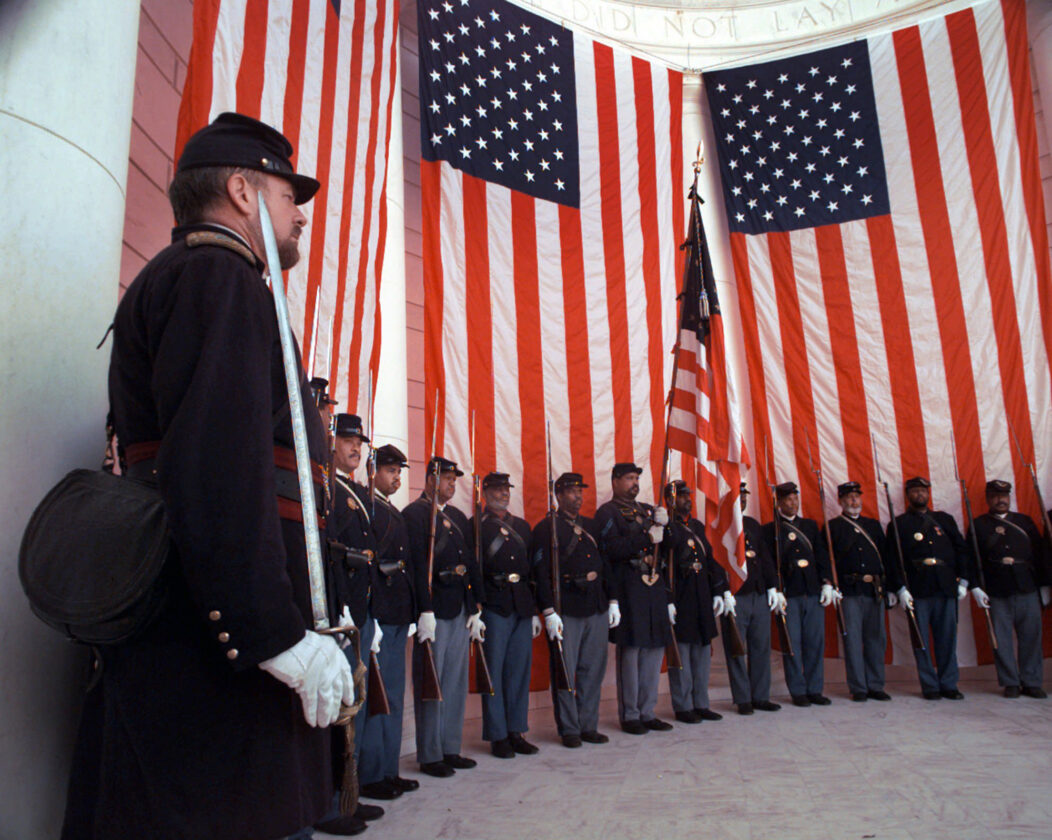
-AP Photo/Ruth Fremson <br> Re-enactors of the 54th Massachusetts Infantry Regiment stand at attention in the Amphitheater at Arlington National Cemetery in Arlington, Virginia, on Sept. 10, 1996, during a ceremony to celebrate the African-American Civil War Memorial.
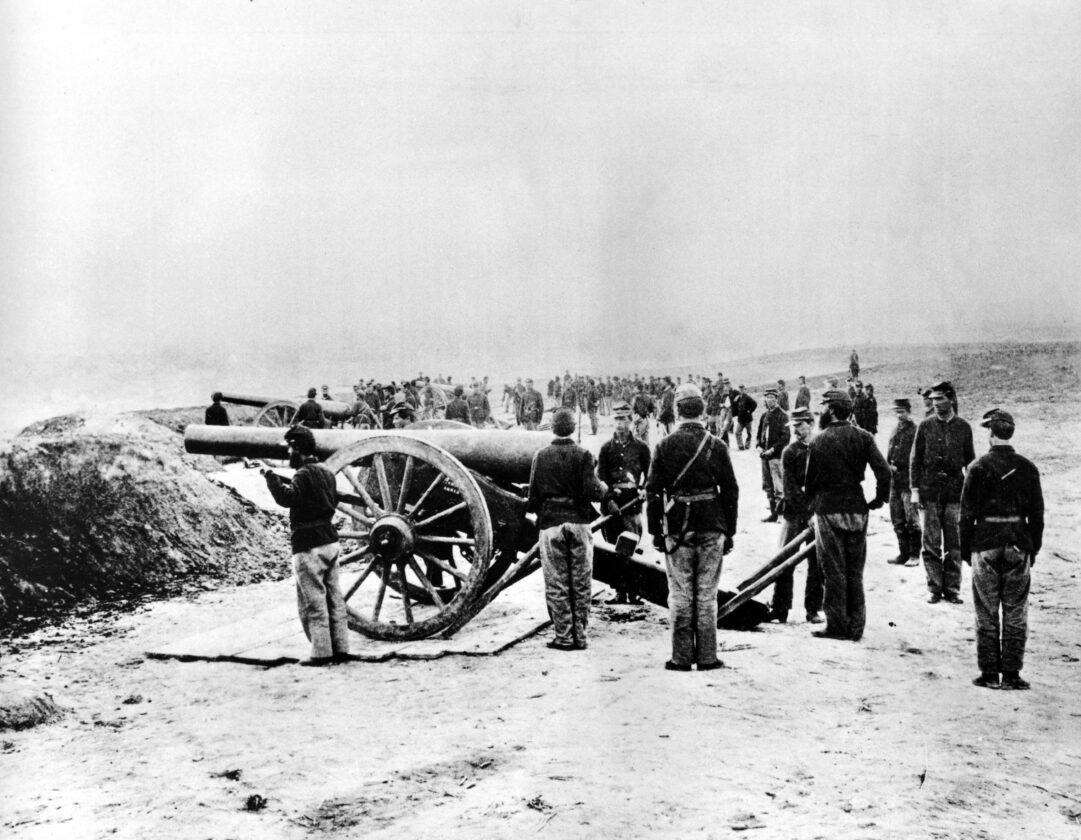
-AP Photo/Mathew B. Brady <br> Federal troops position artillery on Stafford Heights, Virginia, to shell the town of Fredericksburg and the Confederate forces massed on the opposite bank of the Rappahannock River in the Battle of Fredericksburg during the American Civil War in December 1862.
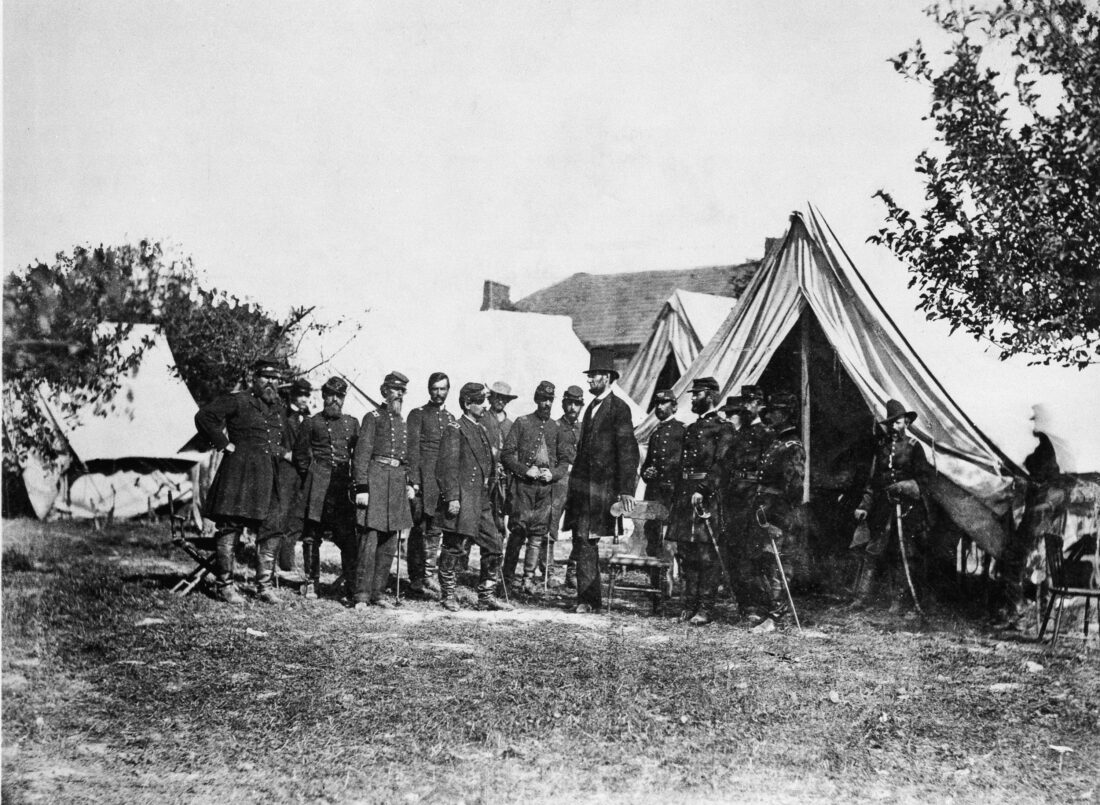
-AP Photo/Alexander Gardner <br> U.S. President Abraham Lincoln, wearing top hat, is shown with Union Army Gen. George B. McClellan, facing Lincoln, and McClellan’s staff at Antietam, Maryland, 1862 during the American Civil War.
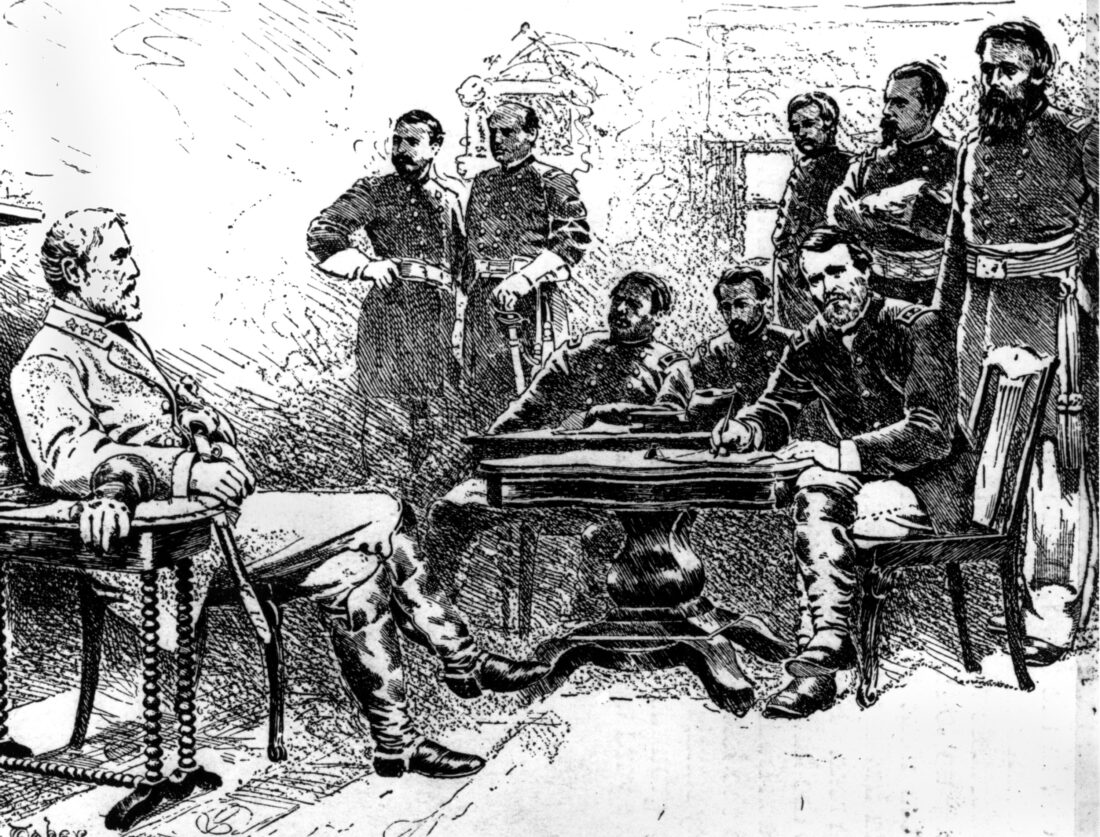
-AP Photo <br> This is a sketch of the surrender at the Appomattox Court House of Gen. Robert E. Lee, left, on April 9, 1865, ending the American Civil War. Overseeing the surrender is Gen. Ulysses S. Grant. They are surrounded by staff members.
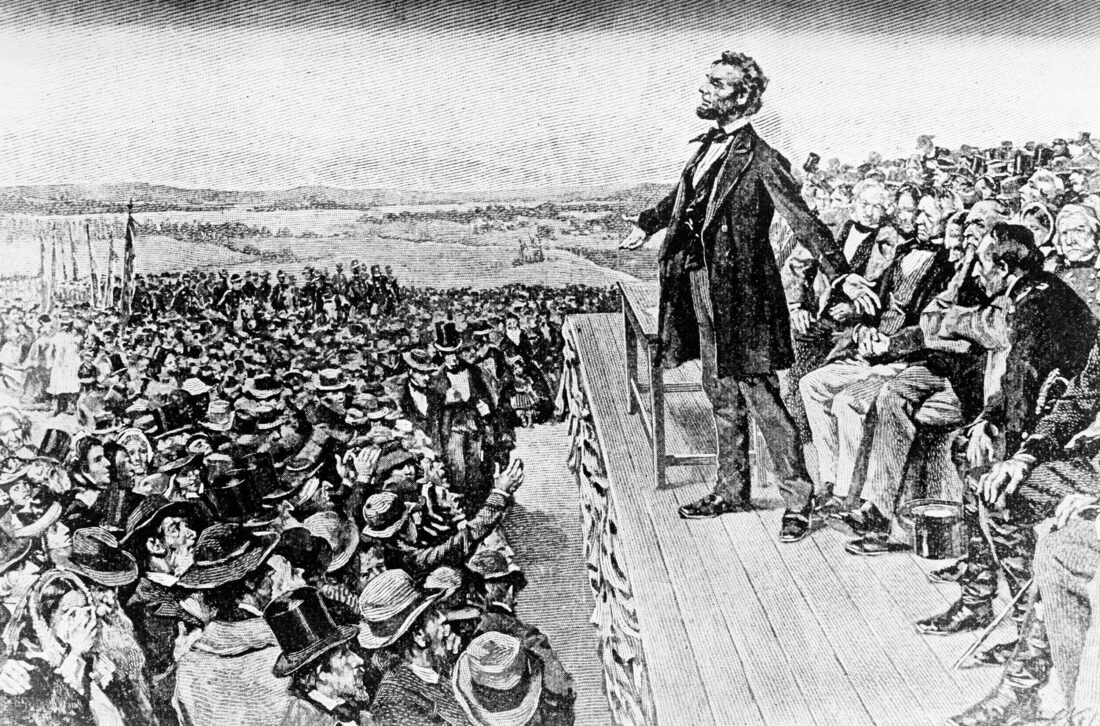
-AP Photo <br> This undated illustration depicts President Abraham Lincoln making his Gettysburg Address at the dedication of the Gettysburg National Cemetery on the battlefield at Gettysburg, Pa., Nov. 19, 1863. The cemetery commemorates soldiers who died in the American Civil War Battle of Gettysburg in July. In moments of crisis, American presidents have sought to summon words to match the moment in the hope that the power of oratory can bring order to chaos and despair.
-AP Photo/Ruth Fremson <br> Re-enactors of the 54th Massachusetts Infantry Regiment stand at attention in the Amphitheater at Arlington National Cemetery in Arlington, Virginia, on Sept. 10, 1996, during a ceremony to celebrate the African-American Civil War Memorial.
-AP Photo/Mathew B. Brady <br> Federal troops position artillery on Stafford Heights, Virginia, to shell the town of Fredericksburg and the Confederate forces massed on the opposite bank of the Rappahannock River in the Battle of Fredericksburg during the American Civil War in December 1862.
-AP Photo/Alexander Gardner <br> U.S. President Abraham Lincoln, wearing top hat, is shown with Union Army Gen. George B. McClellan, facing Lincoln, and McClellan’s staff at Antietam, Maryland, 1862 during the American Civil War.
-AP Photo <br> This is a sketch of the surrender at the Appomattox Court House of Gen. Robert E. Lee, left, on April 9, 1865, ending the American Civil War. Overseeing the surrender is Gen. Ulysses S. Grant. They are surrounded by staff members.
-AP Photo <br> This undated illustration depicts President Abraham Lincoln making his Gettysburg Address at the dedication of the Gettysburg National Cemetery on the battlefield at Gettysburg, Pa., Nov. 19, 1863. The cemetery commemorates soldiers who died in the American Civil War Battle of Gettysburg in July. In moments of crisis, American presidents have sought to summon words to match the moment in the hope that the power of oratory can bring order to chaos and despair.
Trending
Editor's note: Information on the Civil War is well-known, but what about some of the factors that led to its start? This week, we examine some of those issues and how, after years of growing tensions, the nation went to war with itself.
The seeds of the Antebellum period in the United States were planted many years before the Civil War would tear the country apart.
"For the newly independent United States, the first order of business was to establish a national government," explained Roger Micker, president of the Wheeling, West Virginia.-based Ohio Valley Civil War Roundtable. "From1781 to 1789, the Articles of Confederation demonstrated a weakness that would not be able to sustain a united country on the world's stage. On March 4, 1789, the Constitution went into effect replacing the Articles.
"Political, economic and cultural differences generated deep political divisions among the newly created United States, evidenced by four of the states not supporting ratification. In time, several crucial compromises, including the Three-Fifths Compromise, were agreed upon to secure its passage."
Micker, who is a member of the Friends of Gettysburg, added that the greatest cause of the Civil War could be attributed to sectional issues of the consequences and morals of a northern economy based on a concept of free labor, and a southern economy based on slavery and a strong claim for states' rights. A slavery by birth law guaranteed that the institution would perpetuate from one generation to the next, though, occasionally, a slave might receive manumission based on decision from a planters' committee.
The Atlantic Triangular slave trade, he added, would legally exist until 1808.
"Under abysmal conditions, an estimated 13 million people were taken as captives from the west coast of Africa and forced onto slave ships bound for North and South America -- 2 million slaves would die at sea," added Micker, who also serves on the Governor of Ohio Civil War Committee. "An estimated 650,000 slaves would be delivered to the coastlines of the 13 colonies and forced into a harsh life of human bondage."
As the 19th century began, the profits of industries in the north were being impacted by modernizing textile mills and other manufacturing plants and mining, he added. And, in the agricultural south, the market value of cotton was approximately $5.5 million.
Cotton production reached 2 billion pounds a year by 1860, and Virginia, and North Carolina, the chief tobacco-producing states, grew 155 million pounds of tobacco a year.
"The southern planters became the target of high tariffs, which were supported by a Congress dominated by northern senators and representatives, and 70% of the nation's treasury could be traced to the taxation of southern wealth," added Micker, a retired history teacher. "That led to debates in Congress over heavy government spending for northern urban improvements and transportation systems while the economic stress of inflated costs of southern imports were ignored."
Those debates, he explained, led to physical attacks.
"One representative said that 'If a member wasn't carrying a single gun, he was probably carrying two,'" Micker said. "Following his Crime Against Kansas Speech in the Senate, Charles Sumner was severely beaten with a cane by Rep. Preston Brooks."
In the south, the tariffs were labeled as an abomination, and anger spread through state capitals, added Micker, who lectures on Civil War-related topics.
"South Carolina 'fire eaters,' under the leadership of John C. Calhoun, threatened to nullify the tariff law and secede in 1832," Micker said. "President Andrew Jackson reacted with a threat to send troops to South Carolina to enforce federal laws. The next year, the tariff was reduced to the rate held in 1828, which provided very little relief."
At the time, Micker said, southern planters were facing another dilemma: Too much of their fields were being overused. The solution, he said, was a western expansion in the Louisiana Territory and the Indian Removal Act, which would open areas for increased crop production, and statehood would require more slave labor.
"To illustrate -- William Walker, a lawyer, doctor and editor, led a few dozen mercenaries into northern Mexico, took control and claimed the land as a Louisiana colony," Micker said. "After this failed attempt, he led 60 men to invade Honduras in 1860 for the same reason. Managing to gain leadership of the country's liberal faction and help defeat a conservative regime, Walker proclaimed himself as president. While on a mission to seek an alliance with England, Walker was captured by the British Navy. He was returned to Honduras, where he was executed by a firing squad."
States that had been carved out of the Northwest Territory, where slavery and involuntary servitude were prohibited, enforced "Black laws" to discourage free Blacks from northern migration, Micker said. Several laws might have required any of the following as requirements for residency: The purchase of a $500 bond, a $100 registration fee and fines for not carrying permits. In some regions, he added, there were postings warning Blacks to "keep out."
"To challenge the immorality of slavery, abolitionists and abolitionist societies were being heard from," Micker explained. "Harriet Beecher Stowe's 'Uncle Tom's Cabin' set off a firestorm across the country. Meetings, pamphleteering, protests and abolitionist newspapers coincided with maintaining routes of the Underground Railroad System that delivered a message of hope for the enslaved."
Bloodshed, he added, resulted in 1854, when proslavery and Free-Soilers clashed over Kansas' election for statehood.
"Some newspapers exacerbated the slavery issue by reporting rumors or condemning individuals or groups," Micker said. "In 1860, New York City had more than a dozen newspapers published daily, delivering commentary supporting or denouncing the abolitionist issues. Elija Lovejoy set up a print shop to print an abolitionist newspaper in Alton, Ill. His office would be vandalized and the press was tossed into the Mississippi River. Afterward, Lovejoy was attacked and shot to death."
Former slaves, like Harriet Tubman and Frederick Douglass, were targets, Micker added.
"In addition to fulfilling her role as Moses, who led 70 of the enslaved to freedom, Tubman went on to serve as a nurse, cook, scout and spy for the U.S. Army," Micker said. "She is credited with guiding a military raid as Combahee Ferry, S.C., and liberating 700 slaves.
"Following his escape from a slave breaker, Douglass employed his oratory skills that would make him not only wanted by slave catchers for a lucrative bounty, but by abolitionist societies who were eager to hear his lectures in New England as well as in Britain and Ireland."
As the mid-1850s approached, Micker said, the nation's attention was focused on a court case, a meteor and a presidential race, Micker said.
"Dred Scott lived in St. Louis as an enslaved hand," Micker continued. "After he was moved to Illinois and then to Wisconsin Territory, he sued John Sanford for his freedom. The case heard by the U.S. Supreme Court ruled against Scott, reasoning that not being a citizen meant Scott had no rights and he was considered as property and could be taken to a new territory. The Missouri Compromise was then considered to be unconstitutional."
Micker also pointed to Herman Melville's poem "The Portent," which described John Brown as a " … Meteor of the War." His attempt to free slaves in the Harper's Ferry area ended swiftly, and he was hanged on Dec. 2, 1859.
In the next decade, Micker explained, it was thought the new Republican Party could threaten the future of the South. Interest was fervent, he said, among northerners and southerners in the electioneering. Many thought that if Lincoln was elected in 1860, it could lead to the demise of the South's economy and heritage. The Democratic Party, he added, split and Lincoln won in a landslide.
"On Dec. 20, 1860, South Carolina seceded, and the Confederate States of America was established in Montgomery, Ala.," Micker said. "On April 12, 1861, upon Fort Sumter, S.C., another shot was heard 'round the world.'"
In our next installment we'll focus on the post-Civil War era and the growth of the nation. We'll travel to northern Utah to learn about the driving of the Golden Spike, which connected the east and west coasts of the growing nation through the first transcontinental railroad.