
Pieces of Glass by Jim
Six-week class leads to fulfilling hobby for Manson man
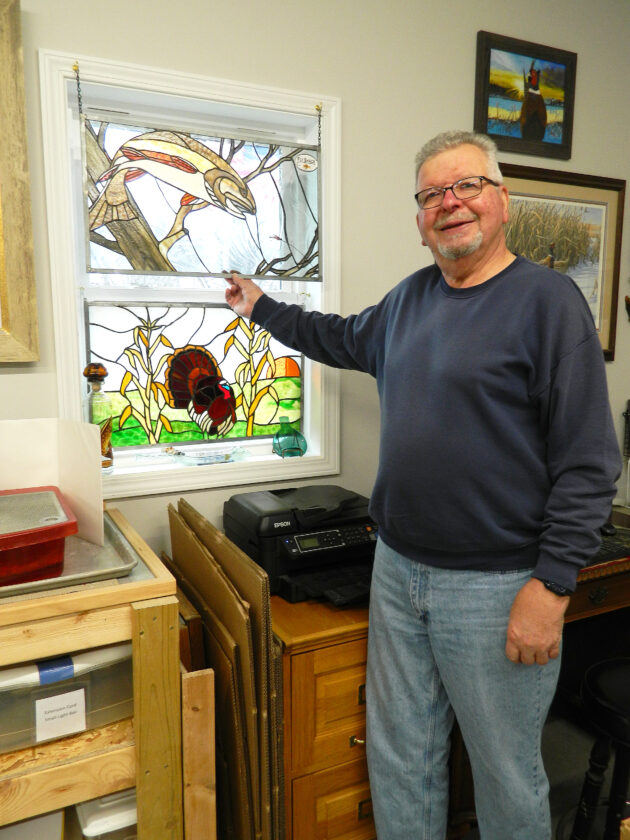
-Messenger photo by Deanna Meyer <br> Jim Mormann, of Manson, stands next to his favorite stained-glass window panel of a brook trout angling for a fishing lure. He first bought the pattern for the piece during a class he took on fused glass from the Delphi Glass Company in Michigan.
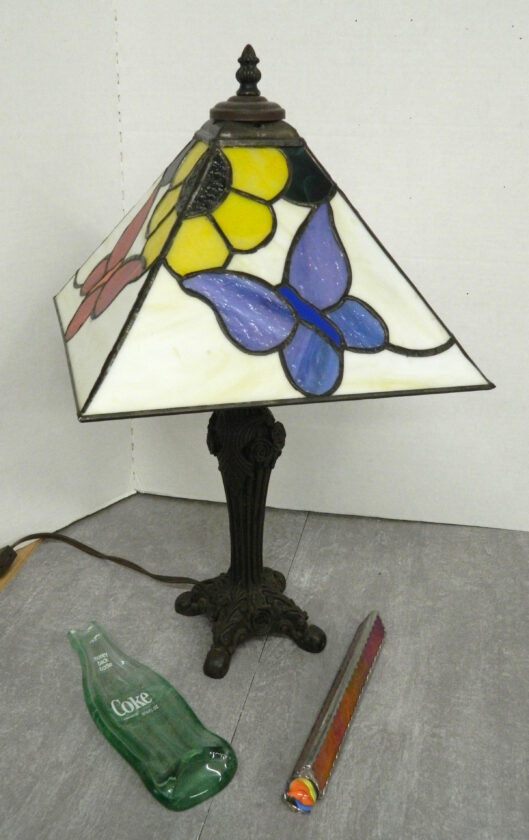
-Messenger photo by Deanna Meyer <br>These three pieces represent Jim Mormann’s first venture into the world of stained glass. The lamp shade, melted Coke bottle and kaleidoscope were created during a six-week course Mormann took in the year 2000 in Waverly.
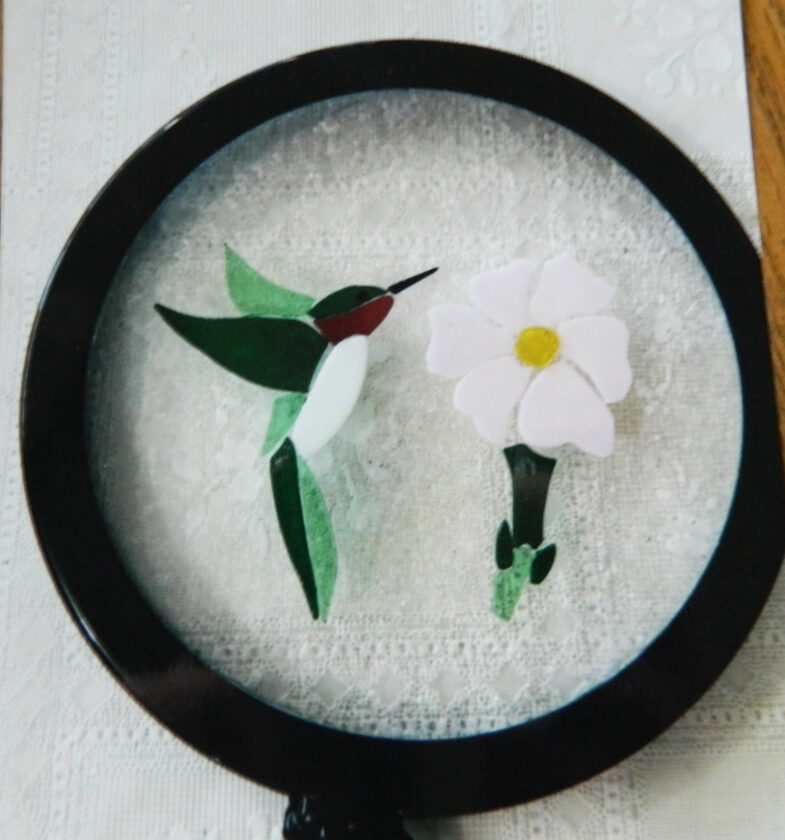
-Messenger photo by Deanna Meyer <br>this stained-glass hummingbird and flower is one of many garden stakes Mormann has created. He also designs and creates stepping stones.
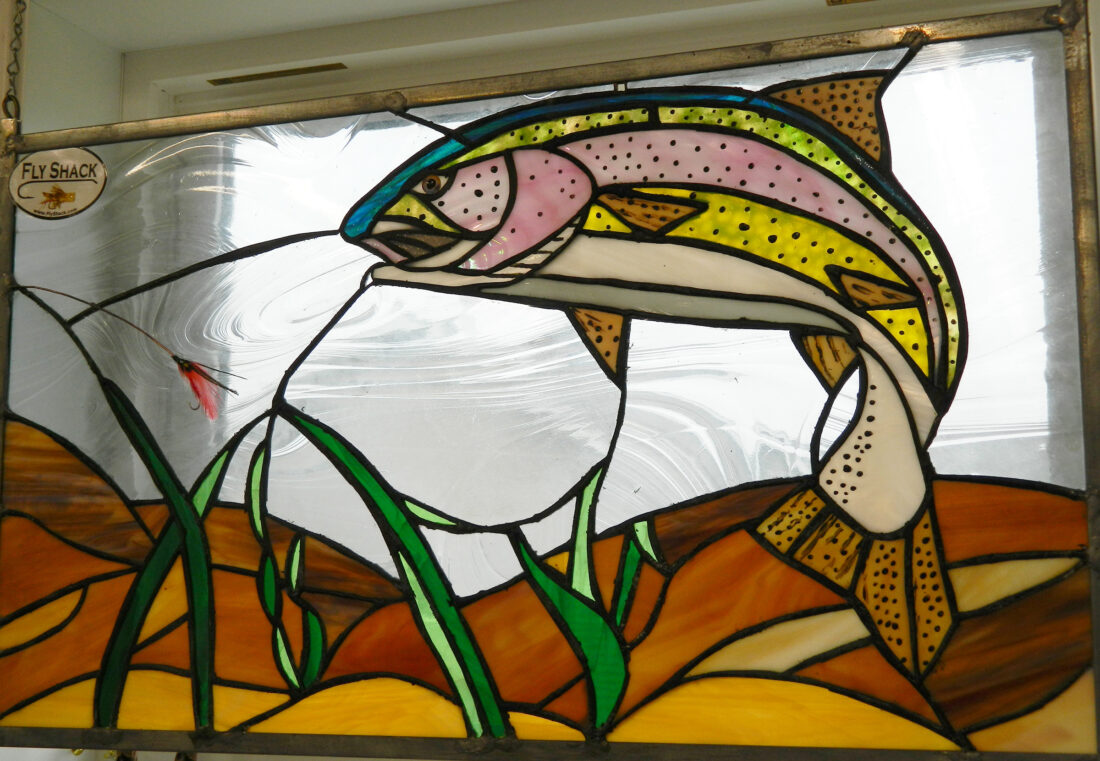
-Messenger photo by Deanna Meyer <br>This stained-glass rainbow trout hangs in Jim Mormann’s Manson workshop.
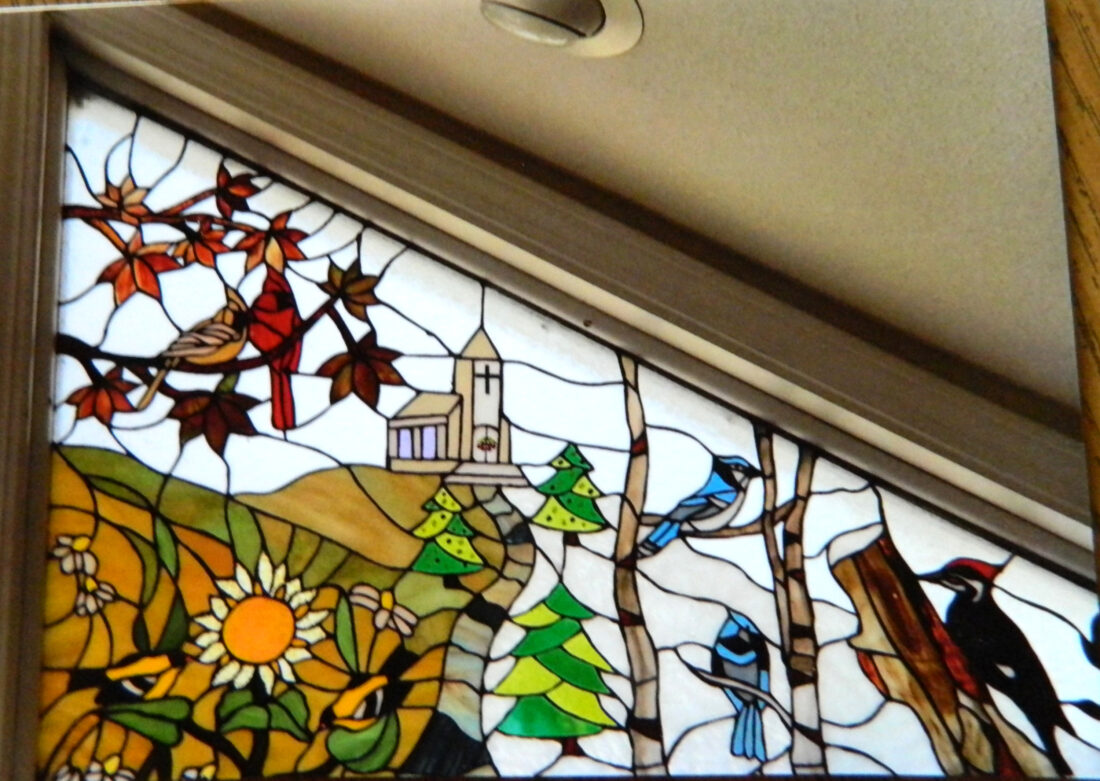
-Messenger photo by Deanna Meyer <br>This is one of three stained-glass windows that Jim Mormann created for his four-season room when he and his wife, Valerie, lived in Missouri.
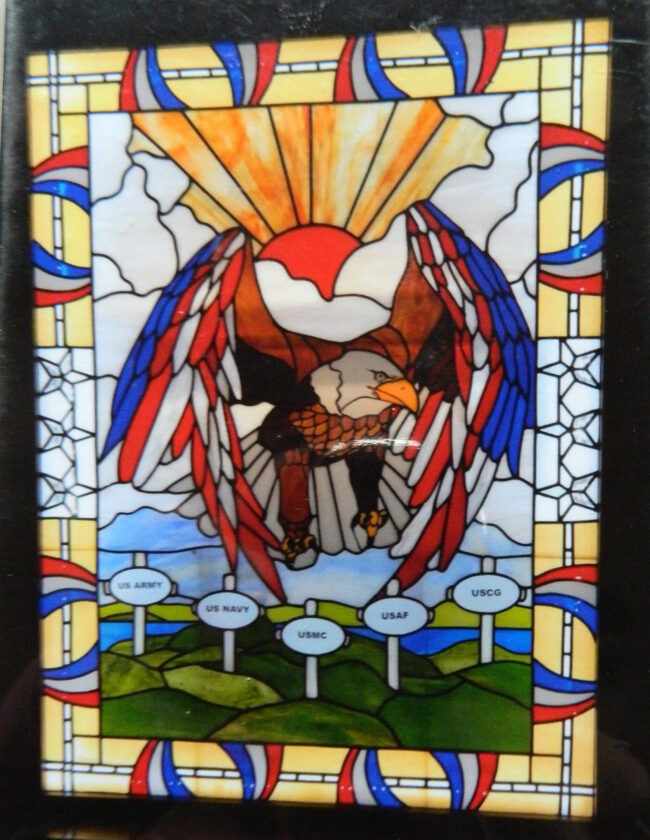
-Messenger photo by Deanna Meyer <br>This stained-glass window, titled "The Guardian," hangs in the Waverly Area Veterans Center chapel. It was designed and created by Jim Mormann in 2018.
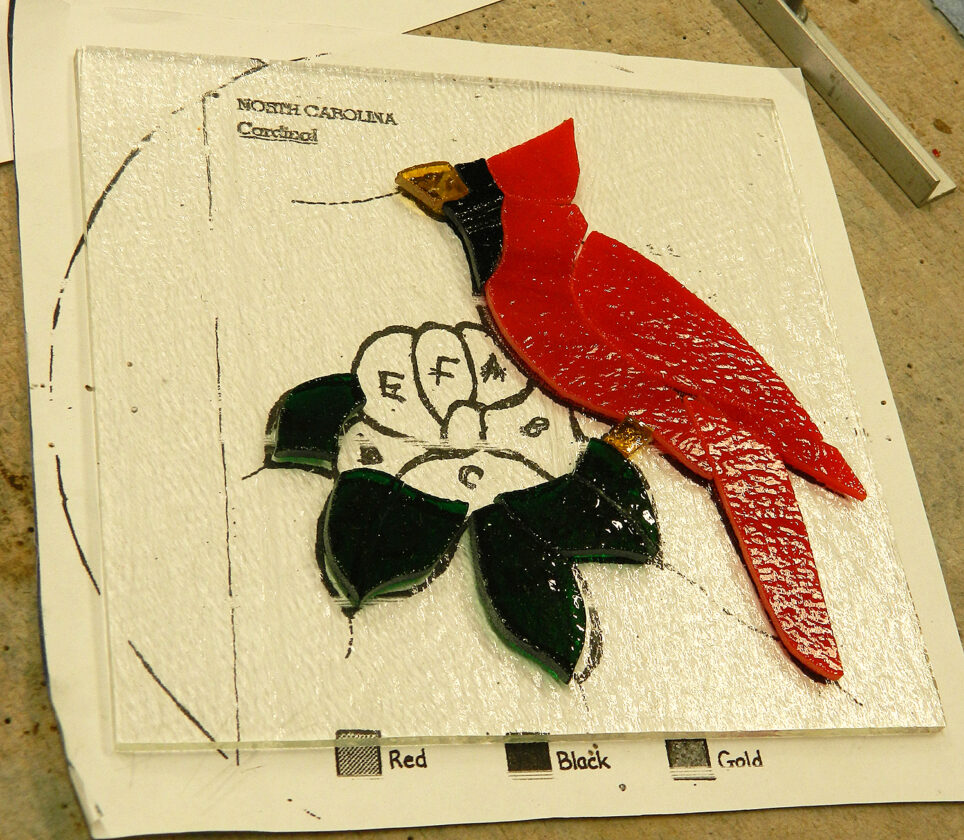
-Messenger photo by Deanna Meyer <br>The image of a stained-glass cardinal on a flower takes shape on a pattern in Jim Mormann’s Manson workshop.
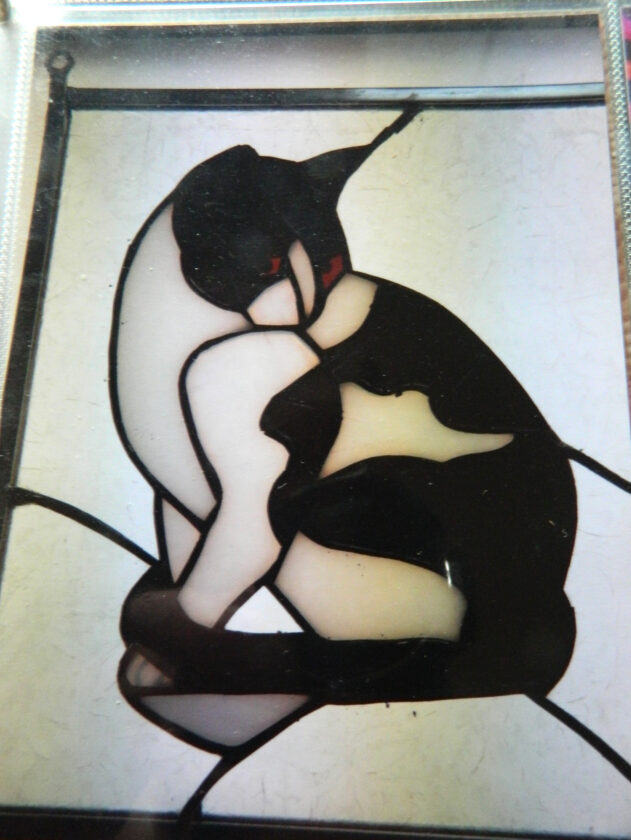
-Messenger photo by Deanna Meyer <br>Jim Mormann has done several stained-glass panels of pets, like this cat. While he can match the colors, Mormann said there isn’t a glass that resembles the texture of fur.
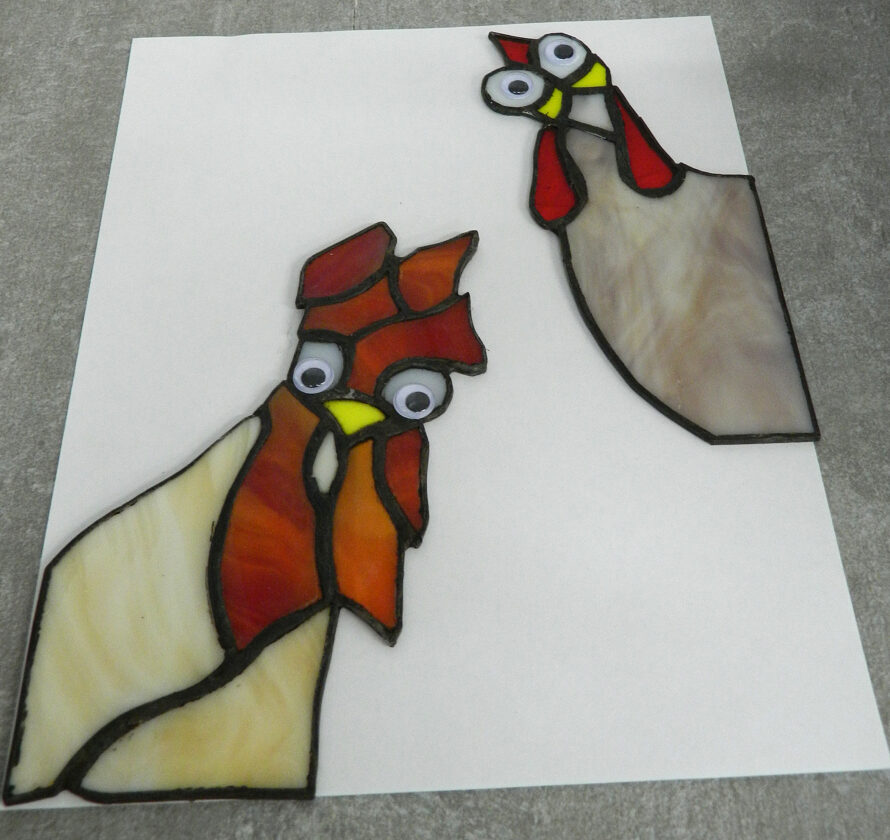
-Messenger photo by Deanna Meyer <br>This stained-glass chicken set has become popular recently, according to Jim Mormann. The stained-glass chickens are generally positioned so that they peer out from opposite sides of a window.
-Messenger photo by Deanna Meyer <br> Jim Mormann, of Manson, stands next to his favorite stained-glass window panel of a brook trout angling for a fishing lure. He first bought the pattern for the piece during a class he took on fused glass from the Delphi Glass Company in Michigan.
-Messenger photo by Deanna Meyer <br>These three pieces represent Jim Mormann’s first venture into the world of stained glass. The lamp shade, melted Coke bottle and kaleidoscope were created during a six-week course Mormann took in the year 2000 in Waverly.
-Messenger photo by Deanna Meyer <br>this stained-glass hummingbird and flower is one of many garden stakes Mormann has created. He also designs and creates stepping stones.
-Messenger photo by Deanna Meyer <br>This stained-glass rainbow trout hangs in Jim Mormann’s Manson workshop.
-Messenger photo by Deanna Meyer <br>This is one of three stained-glass windows that Jim Mormann created for his four-season room when he and his wife, Valerie, lived in Missouri.
-Messenger photo by Deanna Meyer <br>This stained-glass window, titled "The Guardian," hangs in the Waverly Area Veterans Center chapel. It was designed and created by Jim Mormann in 2018.
-Messenger photo by Deanna Meyer <br>The image of a stained-glass cardinal on a flower takes shape on a pattern in Jim Mormann’s Manson workshop.
-Messenger photo by Deanna Meyer <br>Jim Mormann has done several stained-glass panels of pets, like this cat. While he can match the colors, Mormann said there isn’t a glass that resembles the texture of fur.
-Messenger photo by Deanna Meyer <br>This stained-glass chicken set has become popular recently, according to Jim Mormann. The stained-glass chickens are generally positioned so that they peer out from opposite sides of a window.
Trending
MANSON -- Brightly colored butterflies hover near yellow and white flowers -- the design on a stained-glass lamp shade created by Jim Mormann more than 20 years ago.
That lamp shade -- along with a melted Coke bottle and a kaleidoscope -- were the first three glass creations Mormann made as part of a $30, six-week course he took in the year 2000.
At the time, he worked for the State Bank of Waverly; the class was offered by one of the bank's customers -- John Dutcher, owner of John Dutcher Paint & Glass.
"He was the most patient man," said Mormann, adding that he took the class because "it was something to do."
Not long afterward, he bought his first kiln, and then a second from a retiring art teacher in his hometown of Denver, Iowa.
Soon, he developed a full-fledged hobby and became known as "Jim, the bottle guy." When Mormann and his wife Valerie retired in 2006, the couple moved from Waverly to Missouri, packing up everything and taking his hobby with him.
"What I did was melted bottles," he said. "Every time we would come back to Iowa, I would go to Cedar Falls and buy bottles."
For 12 of the 15 years the couple lived in Missouri, Mormann had a booth at the Branson craft mall.
"I literally sold thousands of bottles," he said.
He also set up booths at many craft and vendor shows that would take him to Oklahoma, Arkansas, Missouri and Wisconsin.
"One year I did 22 shows," Mormann said. "We developed quite a camaraderie with the other vendors."
When they built their Missouri home, Mormann created three stained-glass windows for their four-season room -- one featured an eagle with a fish in its talons, a second depicted spring and summer birds, while the third showcased fall and winter birds. At the time, that was the only stained glass he had done.
Three years ago, the couple moved to Manson to be closer to their children. He has since branched out into other areas of stained glass, making garden stakes, glass panels to hang in windows and even stepping stones.
"Those are fun to do because you do (the patterns) in reverse," Mormann said of the stepping stones. He described how the glass is arranged in the mold, the cement is poured over it, then when set, the stone is turned over with the design on top.
He now calls his business "Pieces of Glass by Jim" -- a name that was inspired when he made his own business card holder from glass.
His Manson home was built specifically to accommodate his stained-glass workshop. It is well-organized, with wooden shelves he built to house his tubs of colored glass, each meticulously labeled by color and type. Mormann said he never throws away a piece of glass.
Every piece he creates starts with a pattern -- and the pattern possibilities are seemingly endless, ranging from nature-themed birds, flowers and butterflies to pets to college mascots to religious symbols.
"Basically, children's coloring books make the best patterns," said Mormann.
Once he created a garden stake with an electrical lineman working on a pole. For another woman, whose last name happened to be Morton, he recreated the picture of the Morton salt girl with her umbrella.
"I just love making them personal," he said.
Many have requested special garden stakes to place at cemeteries in honor of a loved one, with cardinals being especially popular. Mormann has also made stained-glass panels from photos of people's pets. He said animals can be challenging to replicate because no glass can exactly match the look of fur.
Currently, he said stained-glass chicken sets, in which a pair of chickens are made to peer out from opposite sides of a window, have become popular.
Once a pattern is chosen, Mormann begins the process of cutting and labeling glass pieces, lining them with copper foil that will solder the pieces together and placing the glass. In addition to a magic marker and a handy lighted table, his primary tools are a pistol grip glass cutter, an Inland grinder to smooth any rough edges and a Taurus ring saw for more detailed cuts.
When a piece is ready for the kiln, it is fired to 1,420 degrees Fahrenheit. Mormann said it takes eight hours to heat up and 12 hours to cool down, with most pieces staying in the kiln overnight.
Square stained-glass window panels take about three days to complete, while he said the chicken sets take about two days start to finish. He will often have more than one piece in the works at a time.
His favorite piece of stained glass art is of a brook trout angling for a fishing lure. He first saw the fish pattern while taking a fusing class at Delphi Glass in Lansing, Michigan. He bought the pattern and the specialty glass for the project several years ago, but didn't create the piece until moving back to Iowa. He said the blue glass appears to flow like water.
But by far the largest stained-glass piece he has created was for the Waverly Area Veterans Center.
In 2018, a widow whose husband had been at Pearl Harbor donated $40,000 to have a stained-glass window put in the veterans chapel, and Mormann -- a Vietnam veteran himself -- was recommended for the job. He was told to submit two designs with the following requirements: the design had to include both men and women, not be overly religious and include all branches of the service.
The result was a stained-glass window titled, "The Guardian."
It features an eagle with its wings outspread, protectively overlooking a cemetery where stakes represent each branch of the armed forces. Within the window, the blue of the sky meets the blue of the Cedar River, while the green of the spring corn melds into the green grass of the cemetery.
To create the 4-foot-by-5-foot window, Mormann used 560 pieces of glass, some as small as his fingernail. He designed and laid out the window in a room he rented from a large stained-glass shop -- a project that took 55 days.
Each day before he began to work, Mormon would read the military prayer that hung on a wall there.
"I think every veteran that died was there guiding my hand," he said with a catch in his voice.
Before it was mounted, the piece was installed in a light box since there were no windows in the chapel to backlight the picture.
Since moving to Manson, Mormann has hosted several programs on how to make stained glass and fused glass for various women's and church groups.
"I would actually like to do more programs," he said, but added he requires about two months' notice.
Today, Mormann's business is primarily online, though he has also set up at a few shows in the area.
"It's just a neat pastime," said Mormann. "It's really fun to do it. I've really enjoyed it."