
THE MAN WITH A PLAN
Love him or hate him, Pollard always stayed loyal to a vision that ultimately made his athletic department better
Trending
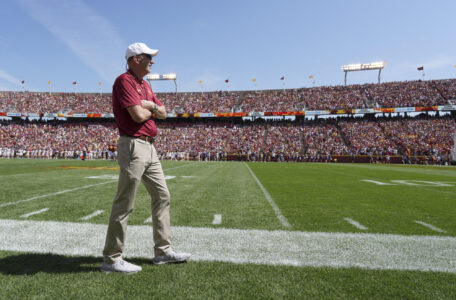
Many words come to mind when describing Jamie Pollard's tenure as the athletic director of Iowa State University.
Memorable. Needed. Innovative. Creative. Polarizing. Controversial.
And never boring.
Pollard announced last Friday that after 21 years in charge - the longest run of any current Power Four AD by a significant margin - he will retire on or before June 30, 2027.
Some Cyclone supporters greeted the news with a sigh of relief. Others felt trepidation. And a significant portion of the fanbase expressed sheer panic.
Who is right? At this stage in the game, it's hard to say.
No one can deny Pollard's impact over the last two-plus decades. Today, for so many of the right reasons, Iowa State's athletic department bears a vague resemblance to the one he took over in September of 2005. Pollard helped graduate ISU from a niche market, so to speak, into a formidable, national brand both on and off the field, court and mat. He did so unapologetically, and wanted Cyclones everywhere to confidently follow his lead.
Pollard brought Cael Sanderson to Ames. Fred Hoiberg. Matt Campbell. T.J. Otzelberger.
Home run hires. His track record for finding coaches hasn't been perfect - no AD is held to such a standard - but his ability to find the right fit at the right time has been impressive overall.
Pollard has also never backed down from a challenge. He's used marketing, advertising and the media to his advantage. He will be honest, transparent and accessible when he feels like he needs to be - even if we're sometimes getting a side to the story instead of the entire truth.
Again, not uncommon.
Pollard has excelled in the arena of fundraising. Iowa State's athletic department brought in $53 million in 2025-26 - a number nearly six times more than at the starting point of his tenure.
Jack Trice Stadium has grown from a capacity of 46,500 to 61,500 on his watch. Actual football attendance, on average, has nearly doubled.
The Cyclone women's wrestling program is set to debut in 2027-28 - another priority of Pollard's to launch.
The good has been very good.
Pollard has certainly faced his share of criticism and detractors as well - especially in recent years.
The women's gymnastics situation was a mess. Campbell left for Penn State last December in a cloud of uncertainty and confusion. The future of the CyTown mixed-use entertainment district - a massive, cutting-edge $200 million Pollard project - is still up in the air to a certain extent, and will not have Pollard running point now if and when it reaches completion.
The NIL era has introduced a whole different ballgame. Collegiate titans who used to seem impenetrable, like Nick Saban, walked away because of it. The gap between haves and have-nots has widened. Rules and regulations - or lack thereof - are spotty at best. The future is both uncertain and maybe even unsustainable.
Where Iowa State - and the Big 12 - fits in this new world remains to be seen. Revenue is always at the forefront of the discussion, and the school's athletic department budget is currently projected to face a $147 million deficit through 2031.
Pollard figured out a way to keep the Cyclones both relevant and ahead of the curve in 2005, 2010, 2015 and 2020. That earned him respect, good will and the benefit of the doubt in the old era of college athletics.
Now? Who knows if Pollard's skillset - or the expertise of really any athletic director moving forward - is right for this ever-changing and rapidly-evolving environment.
Maybe that factored into Pollard's decision - the way it did, to a certain extent, with Saban in 2024. Someday, the whole story may come out - or at least Pollard's side of it. Again, he's been an open book at times in the past about the good, the bad and even the ugly of his job.
This could be a blessing in disguise for Iowa State - even if finding an identity without him seems like a huge risk at first. Pollard, for better or worse, did things his way for over 20 years. The school's athletic department is better because of it. That doesn't mean, though, it can't both survive and thrive without him. Breakups in sports often seem inconceivable at first, yet a fresh perspective is exactly what is frequently needed to move forward.
Pollard should absolutely be recognized as someone who changed the game forever at Iowa State. Finding his replacement will be a tremendous challenge, without question.
This doesn't need to be the "end" of anything, though. If the school plays its cards right, Pollard will be replaced and remembered as someone who opened the door to the next generation of ISU athletics - not a landlord who is walking away with the key.
Eric Pratt is Sports Editor at The Messenger. Contact him via email at sports@messengernews.net, or on Twitter @ByEricPratt