
Trending
In the early days of newspapering in Fort Dodge, long before broadcast and computers and the Internet and AI and many other technological advancements, a young Walter Howey delighted in a feat still important to newspaper editors of today: Being first with the story.
Fort Dodge was a lively newspaper town back in the early 1900s with two competing dailies -- The Fort Dodge Messenger and the Fort Dodge Chronicle - that were constantly at each other's throats to capture local readership.
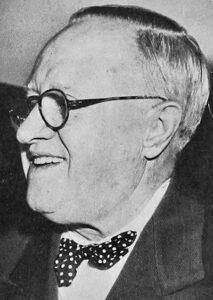
Howey was born in Fort Dodge on Jan. 16, 1882, son of Frank Harris Howey and Rosa Crawford Howey. His father ran a drugstore located right across from the Messenger offices. Howey went through Fort Dodge schools before attending the Chicago Art Institute from 1899 to 1900, then returned to Fort Dodge.
Chronicle Publisher John F. Duncombe took a chance on him, hiring him to his editorship even though Howey was barely 18 years old. It was a gamble that paid off in short time.
Howey's first journalistic coup was scooping the state's press on the death of President William McKinley in 1901. The president had been shot by an assassin in Buffalo, New York, and stayed alive eight days before dying from the wound. During this period, Howey wrote the story of McKinley's death in advance, and the life story of his successor, Vice President Theodore Roosevelt, and had them set in type.
"I got hold of a servant at the house in Buffalo," said Howey, "and told him I'd give $10 to the first person there who would telephone me the minute the president died. The call came through as I knew it would. In a few minutes the pages were on the press, and we were out on the street hours ahead of our opposition."
Howey was just 20 years old when The Messenger lured him away from the Chronicle in 1902 and soon was heading the newspaper's coverage of a notorious murder trial at the Webster County Courthouse. To be first with the verdict, Howey ran off two editions, one with a "Guilty" headline and one with a "Not Guilty" headline. He held both editions in the pressroom until he received a flash from the courtroom - from a reporter signaling to another at a window -- and then let newsboys rush out hawking the verdict even before the judge had dismissed the court.
That sixth sense for smelling out a news story carried Howey far in the newspaper profession, first to Des Moines in 1903 to work as a cub reporter on the Daily Capitol, then to Chicago, Boston and New York.
His career in Chicago spawned one of the most famous Broadway plays, "The Front Page," which debuted in 1928 and is still performed in theaters to this day. It became even more famous when made into a 1974 film starring Walter Matthau and Jack Lemmon that remains highly popular.
Howey's move to Chicago was depicted this way by The New York Times: "One summer day in 1903, Walter Crawford Howey came out of Fort Dodge, Iowa, determined to make a tumultuous impact on journalism. He did. Young, flamboyant, with an iron drive, he descended on Chicago, his arrival signaling the beginning of one of the most raucous eras in Midwest newspaperdom."
How true--to--life was the play's portrayal of the irascible Walter Burns and a rowdy band of newspaper reporters? Very accurate -- if you're speaking of cut--throat Chicago journalism in the early 1920s. And Walter Burns. Was he real, or was he a fictitious character dreamed up by playwrights Ben Hecht and Charles MacArthur?
Answers MacArthur, "I worked for him for 10 years in Chicago. His real name is Walter Howey."
Howey's bombastic carryings--on while managing editor of the Chicago Herald--Examiner inspired Hecht and MacArthur, two former Chicago journalists, to dramatize him in their play. Indeed, he was the ruthless, unpredictable Walter Burns who outsmarted his star reporters and rival newspapers and who could finagle with the best of politicians.
"When the play opened on Broadway," said MacArthur, who worked under Howey at the Herald--Examiner, "a newspaperman questioned its authenticity and also complained that no mother would ever let her son be a newspaperman if she saw the way editors and reporters carried on in the play. I replied that the play was an understatement of the times."
Likewise, Howey was a man of the times. He was flamboyant, opportunistic, ruthless, and all the other adjectives one attaches to the "stop the presses" image of a Walter Burns. Yet he was a journalist whom MacArthur called "the greatest newsman ever," whom Newsweek magazine termed "a quiet, coldly efficient worker," and who, according to a Hearst associate, "was a genius whether it was on big plans, electronics or getting the most out of one news story."
Howey, at just 21 years old, bluffed his way into his first job in Chicago. In his own words, he describes how he accomplished it:
"The Daily News was my first stop. I went in and said to the editor, 'I hear George Ade is sick.' That was the first big writer I could think of. 'There's nothing the matter with George Ade,' said the editor. 'Never mind,' I said, 'is anybody else sick? I'm a versatile writer.' 'No,' he said, 'but I could use a reporter who knows the town. Do you?' 'Every alley in it,' I assured him. 'Then do you know the corner of Madison and Monroe?' 'Who doesn't?' 'Fine!' he said. 'Get going.' I ran out and asked the first cop, 'Where's the corner of Madison and Monroe?' 'Not in this world,' he answered. 'They both run east and west!'
Undaunted, Howey later returned to the newsroom with a hair--raising description of events he had seen -- at Madison and Monroe -- complete with full names and addresses. The editor was impressed.
"You're hired," he said. "I don't want you to be too honest, anyway."
Reporter Howey stumbled onto a story later in 1903 that turned out to be one of the biggest in Chicago's history -- the Iroquois Theater fire of Dec. 30, in which about 600 were burned and trampled to death. How he discovered the fire was a matter of luck, but how he handled its coverage was a brilliant display of skill.
Returning to the office on that winter day, he was startled when a manhole in the street opened and out popped a knight in armor and three elves with wings. They turned out to be a group of actors who had escaped the burning theater by way of an underground passage. Howey, showing remarkable poise for a young reporter, established a city desk in a nearby store, from which he telephoned his paper the first news on the disaster and directed the efforts of other Daily News reporters.
Howey later worked briefly for the Chicago Evening American, and then moved to the Inter--Ocean, where, as city editor, he made newspaper history with a daring first -- a full page of photographs. His reward, when the bills came in, was being fired.
When Howey joined the Chicago Tribune as its city editor in 1907, the mood of journalism in Chicago was beginning to change. A man who worked as a cub reporter during this time described the atmosphere:
"In those days there was a fresh, frontier approach to public morals which reached a high point in the fang--and--claw ethics of the daily press. It was commonplace for newspapers to plant spies in rival editorial offices and saboteurs in pressrooms; to kidnap and jail rival reporters on trumped--up charges; to highjack murder suspects and key witnesses from one another -- and from the police."
Money spoke big in those days, and press lord William Randolph Hearst, publisher of many large newspapers, had plenty to spend. After Howey quit the Tribune in 1917 following an argument with the paper's owner, Hearst offered him a job as editor--in--chief of his Chicago Herald--Examiner. Howey's new salary of $35,000 a year was four times what he made as city editor of the Tribune.
The arrival of Howey marked the beginning of a competitive news conflict between the morning rivals, the Herald--Examiner and the Tribune.
A legion of legends exists about Howey and his bold actions as editor of the Herald--Examiner.
"Howey would sit at his desk and make monkeys of all of us," said Hecht, who worked for the Tribune. "If he couldn't scoop us, he'd invent a switch or an angle for the story that outfoxed us."
At the Herald--Examiner, Howey often grabbed the first edition and boarded an elevated train. Once aboard he would open the paper and comment to a train passenger about a particularly "hot" front page story. He would get reader reaction from one or two men and the same number of women, and then would take another train back to the Loop. At the newspaper office, he would often have his staff rewrite the story, stressing or clearing up points that his elevated train friends had mentioned in discussing the story.
"Humanity is a Wonderful Thing." This was a formula for news that Howey practiced throughout his career. Another formula was the repentance of "wayward souls."
"It is the simplest thing on earth to create circulation, but it took me years to discover the secret," Howey said. "People are more interested in the repentance of a wayward soul than they are in themselves."
The repentance theme was employed by Howey when Hearst sent him to Boston to become editor of the faltering Boston American in 1922. Hearst told Howey to add 50,000 circulation to the American and gave him six months and a generous budget to do it.
Howey found a wayward soul -- a woman who, in a holdup, had killed a policeman and was awaiting execution. Howey convinced her that she should repent her sins -- exclusively for the American -- in return for a handsome sum of money for her daughter. The story of her life of crime and her repentance unfolded daily in Howey's paper, and its circulation shot up by 54,000 in six days.
Howey was managing editor of the American for two years, and in 1924 he went to England for Hearst to study newspapers published by Lord Northcliffe. Upon his return later that year, Howey's ideas for a picture newspaper led to the establishment of Hearst's New York Mirror.
Unlike newsman Walter Burns, Howey was a solid production man. He carried a printer's union card and owned 17 patents, including inventions for making engravings and methods of transmitting pictures and messages by wire. In 1931, his invention of an automatic photoelectric engraving machine was unveiled in Washington in the presence of Hearst editor Arthur Brisbane and officials of the Federal Bureau of Engraving.
Howey developed the sound photo for Hearst in 1935; this machine transmitted halftones by ordinary telephone. His inventions, an outgrowth of his belief in the importance of pictures, hastened the nationwide use of wire photos.
The remainder of Howey's years was spent supervising Hearst publications and working as Hearst's editorial assistant. Howey was editor--in--chief of Hearst's three Boston papers -- the Evening--American, Daily Record, and Sunday Advertiser (1939); supervising editor of American Weekly magazine in New York (1940); and editor of the Chicago Herald--American (1942). He divided his time among these three jobs. In 1944, Howey was appointed special editorial assistant to Hearst.
Howey's life ended on a tragic note. In January 1954, he was badly injured in Boston when a skidding taxi pushed a mailbox onto him. Ten days later, his wife died of pneumonia. Howey was slowly resuming his duties as editor of Hearst's Boston newspapers when he died of the accident injuries on March 21, 1954. He is buried in Queens, New York. Howey left one son, William Randolph Howey, whose name was evidence of the high regard he had for Hearst.