
Fort Dodge once had its own steamboat
The Charles Rogers traveled the river in 1859
Trending
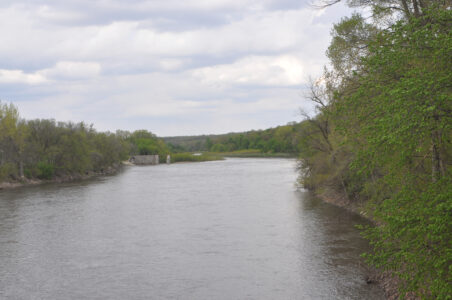
During the summer months, kayaks and inner tubes can be seen on the Des Moines River near Fort Dodge. Occasionally, a personal water craft might be spotted. But the river is generally too shallow for anything else.
It wasn't always that way. Surprisingly, a small steamboat traveled the waters around Fort Dodge for a few months in 1859.
It was called the Charles Rogers. It was locally owned by the Fort Dodge Navigation Co. And it briefly gave rise to the hope that the city would become a hotbed of river commerce.
There was another short-lived boat based in Fort Dodge prior to the Charles Rogers. It was called the Rolling Wave, and was powered by sail and human muscle.
Francis E. Beers and a handful of other men, none of them with any boat building experience, assembled the Rolling Wave in 1858.
The Rolling Wave traveled to Madrid to pick up a load of 40 sacks of flour. The trip took 16 days.
After seeing the Rolling Wave prove that river travel was possible, the Fort Dodge Navigation Co. was formed in 1858 to obtain and operate a steamboat. Beers was a key figure in the company.
On July 21, 1858, a small group representing that company left Fort Dodge and headed for Pittsburgh, Pennsylvania, which was a boat-building hub at the time. The group arrived in Pittsburgh on Aug. 6 and quickly employed a boat-builder.
The vessel was completed in October 1858.
It was 75-feet long and 19-feet wide. It had a two-cylinder engine that relied on steam from a boiler obtained second-hand from the Pennsylvania Railroad.
The boat cost $2,250.
It was named Charles Rogers after the man who built it.
The Fort Dodge crew left Pittsburgh aboard their new boat on Oct. 14, 1858. They sailed west down the Ohio River, then north up the Mississippi River. From the Mississippi, the boat entered the Des Moines River at Keokuk, arriving there around Oct. 29, 1858.
To earn some money, the crew made at least three round trips between Keokuk and Des Moines, hauling meat and groceries.
The steamboat finally arrived in Fort Dodge on April 6, 1859, after the river was free of ice.
The book "Iowa: The Rivers of Her Valleys" reported that the boat "came snorting up to Fort Dodge levee amid tumultuous rejoicing."
The boat stirred up a lot of public excitement. People not only wanted to see it, they wanted to ride on it. To meet the public demand, a pleasure cruise was scheduled.
Here is how John Duncombe, one of the first attorneys in the city and the editor of the Fort Dodge Sentinel, described the trip in an article in the newspaper:
"It will be remembered by many of our citizens with feelings of extreme delight for many years to come. By the politeness of Capt. F. E. Beers, of the Charles Rogers, in company with about one hundred and twenty ladies and gentlemen of the town, we enjoyed the first steamboat pleasure excursion on the Upper Des Moines river. The steamboat left the landing at Colburn's ferry about two o'clock and after crossing the river and loading with coal from the mines, started for' the upper ferry. All our citizens are well aware of the shallow ford on the river at the rapids at this place, which is at the head of the island at the mouth of Soldier creek, where the river divides into two equal channels. The steamer passed up over the rapids in the west channel with perfect ease. At the mouth of Lizard creek the boat 'rounded to' and passed down the eastern channel of the river at race horse speed. The scene was one of intense interest. The beautiful plateau on which our town is built was covered with men, women and children. The river bank was lined with joyful spectators. Repeated hurrahs from those on the boat and on the shore filled the air."
It appears that the Charles Rogers made five round trips between Fort Dodge and Des Moines that year.
Also in 1859, a second steamboat, the Des Moines Belle, came to Fort Dodge. That ship was not locally owned and it may have only been in the city once.
The prospect of having not one, but two and perhaps more steamboats serving Fort Dodge, fueled plenty of optimism in the community. But 1859 was to be the last year of steamboat traffic to and from Fort Dodge.
The boat was operated by the Fort Dodge Navigation Co. for a little over eight months between Oct. 14, 1858, and June 29, 1859.
A combination of factors led to the demise of the steamboat traffic. One of those factors was the river itself. In 1859, the water level in the Des Moines River was reportedly pretty high. But by mid-summer of that year, the level was dropping. The next year, the water levels were lower, making steamboat travel to Fort Dodge impossible.
Then in 1861, the Civil War began. Whatever steamboats were available were put to use on war-related work on the nations' major rivers. After the Civil War ended in 1865, the nation's railroads experienced explosive growth, making them the preeminent mode of transportation.
The Charles Rogers was sold, but various histories offer different accounts of who bought it.
But a replica of the steamboat will be returning to the Fort Dodge riverfront in the near future. It will be built at the playscape surrounding the Matt Cosgrove River's Edge Discovery Center on First Street.