
The National Road connected a young nation
Trending
Editor's note: With new settlements being established in the Northwest Territory, leaders of the still young United States tackled another issue -- how to link cities in the east with new opportunities in the west. This happened through an act of Congress creating what came to be known as the National Road. The concept of a national road actually goes back to our first president, George Washington, who understood that for the new nation to unify, it needed a connector. What initially was known as the Cumberland Road began construction in 1811 in Cumberland, Maryland, and reached Wheeling, Virginia, in 1818. Construction resumed in 1825 in Ohio before ending in Vandalia, Illinois, in 1839.
To have a United States of America during its infancy, you had to have a truly united country. Not just by national unity with its citizens, but by physically connecting the east with what was then the western frontier across the Allegheny Mountains.
Or at least that's what President George Washington thought at the time.
"It was his dream," historian Brady Crytzer said of the idea of a national road. "He understands that America is an east-west country. There are thousands of people over the mountains and he fears it could break into two (countries)."
While Washington didn't live to see his dream become a reality, his successors picked up the torch and continued down that path.
"He lays the groundwork for it to be done. It's always his vision," said Crytzer, who released a new book in April called "The National Road: George Washington and America's First Highway West," that is listed as an Amazon Top Release.
To help ease the movement of goods and livestock across the mountains, the federal government wanted to build a route from Cumberland, Maryland, to Wheeling in what was then Virginia (present-day West Virginia) in order to connect the Potomac River to the Ohio River. It would not be easy building a road traveling 130 "treacherous" miles, including over steep and rugged terrain through the mountains, Crytzer said.
While the young nation's third president Thomas Jefferson is credited with signing the act to create a national road in 1806, it's Treasury Secretary Albert Gallatin who did the heavy lifting. Gallatin lived on Friendship Hill overlooking the Monongahela River near New Geneva, Pennsylvania, which gave him credibility both with the western settlers where he lived and the power brokers on the East Coast.
Crytzer, who is a history professor at Robert Morris University in Coraopolis, Pennsylvania, said Gallatin was able to get the new road financed not through new taxes, but by taking a percentage of the sales from land purchases in Ohio, Indiana and Illinois. Those settlers would ultimately benefit from such a road, so it only made sense to use a portion of those proceeds to pay for the infrastructure project, Cyrtzer said. Gallatin also figured out how to finance the Louisiana Purchase, the Lewis and Clark expedition and the War of 1812, all while reducing the national debt.
"The government doesn't have to pay for it. The settlers are the ones who pay for it," Crytzer said. "Gallatin is a financial mastermind."
While the act to build the road was signed in 1806, ground would not be broken for another five years due to squabbling in Congress about every detail on how it should be built and under what uniform specifications. They eventually settle on the road's width and maximum grade, while also mandating the use of rings to measure the size of the stones that are laid.
Even the route from Cumberland to Wheeling was controversial. While the shortest path between the two points was ideal, it ran into backlash in Washington, Pennsylvania, where the locals were furious that it bypassed their town. They promised to shoot any workers building the road if it didn't go through town, and having just quelled the whiskey insurrection in the region a little more than a decade earlier, Gallatin was happy to acquiesce to their demands.
"He knows they're serious," Crytzer said.
The first contract for construction on what was then known as the Cumberland Road was awarded on May 8, 1811, according to the National Park Service, and work began later that year. The southeastern leg from Cumberland to Uniontown was most challenging, with the mountains as the biggest impediment. But once that section was finished, workers were able to use the remnants of the Mingo Trail from Uniontown to Washington and other indigenous trails heading toward Wheeling.
"It's the first infrastructure project in this country," Crytzer said. "People in America didn't believe they could do something this big, to cross the mountains like they did."
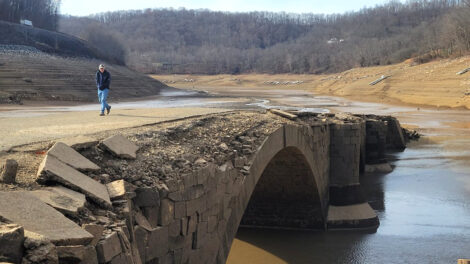
While travelers used sections as they were completed, the road finally reached Wheeling in August 1818. A couple months earlier, a new stone-arch bridge spanning the Youghiogheny River between Fayette and Somerset counties in Pennsylvania also opened with a ceremonial visit from President James Monroe.
"When they built that bridge, that was the real statement, 'We did this. It's permanent.' It's made from local stone because it comes from the mountains out there," Crytzer said. "The president is there and that bridge was the crowning achievement of the road."
The road terminated in Wheeling, but construction restarted on the Ohio side of the river in 1825, stretching through Indiana and ending in Vandalia, which was the Illinois state capital at the time. That section was much easier to build thanks to the flat terrain, but the total cost of the newly-renamed National Road was about $6.8 million at the time, Crytzer said.
"That road is the reason we have a Midwest," Crytzer said. "They would never say it was a waste. It was their lifeline."
The Wheeling Suspension Bridge, built by the Wheeling and Belmont Bridge Co., opened in 1849, briefly becoming the longest suspension bridge in the world and easing travel across the Ohio River. Before then, ferry boats carried travelers from one side to the other. The Suspension Bridge carried the National Road from then-Virginia into Ohio.
Sarah Collier, who is executive director of the National Road Heritage Corridor, said the completion of the road achieved the original goal of stitching together far-flung regions of the nation.
"The most important thing is it promoted national unity," Collier said. "It allowed western farmers to sell what they grow. It kind of brought the west to the world, and the world to the west. Commerce (previously) died at the mountains, so it allowed everyone to have a piece of the American dream, no matter where you lived. There were so many places you couldn't reach, and now you could."
Travel along the National Road at that time was limited to horses, horse-drawn stagecoaches and for freight, Conestoga wagons. The Conestoga drivers helped derive the term "stogie" due to the long, cheap cigars they smoked while hauling freight.
A few decades after the National Road was completed, the canal system became a fad for transportation and helped to bolster use of the road. But the rise of the railroad by the mid-19th century all but put the National Road in the history books.
"The canal system was that we could do even more," Collier said. "The heyday was up until the railroads."
By the turn of the 20th century, the National Road appeared to be at the end of the road as it was obsolete, outdated and overgrown by vegetation, Crytzer said. But the invention of the automobile and the affordable Model T that made driving accessible to average Americans gave it new life.
"They want to drive on an open highway, but they can't find them (outside the cities)," Crytzer said. "Then they discover this road through the mountains. Let's rehabilitate it. When they have bicycles and cars, they rediscover it."
U.S. 40 generally follows the National Road through most of its original sections, but there are twists and turns along the way where they deviate and small towns that sprouted up on the old pike are a little off the beaten path.
"They go around these bends and through these towns," Crytzer said. "They were always there, but we took it away from them."
There are several museums and historical groups that tell the story of the National Road. The National Parks Service's Fort Necessity National Battlefield near Farmington, Pennsylvania, has a robust museum exhibit featuring the National Road. Meanwhile, the National Road Heritage Corridor in Washington and National Road-Zane Grey Museum in Norwich, Ohio, also pay homage to the road that connected a young nation.
"People saw it as proof we could do big things," Crytzer said.
We're just over halfway through our look at America at 250 years old, told through the lens of how some of the most important events in the nation's history took place right here in our communities. Next week, we'll tell the story of how a group of men in then Wheeling, Virginia, refused to follow their state into the Confederacy and instead set in motion the creation of West Virginia -- the only state born directly out of the Civil War.