
Traffic lights or stop signs?
City of Humboldt weighs its options with downtown pilot project
-
-
-Messenger photo by Chad Thompson
Delineators, the white posts surrounding the stop sign, are used here to simulate curb extensions along Sumner Avenue in Humboldt. The simulation is part of a larger pilot project downtown where traffic lights have temporarily been turned off and replaced with stop signs.
-Messenger photo by Chad Thompson
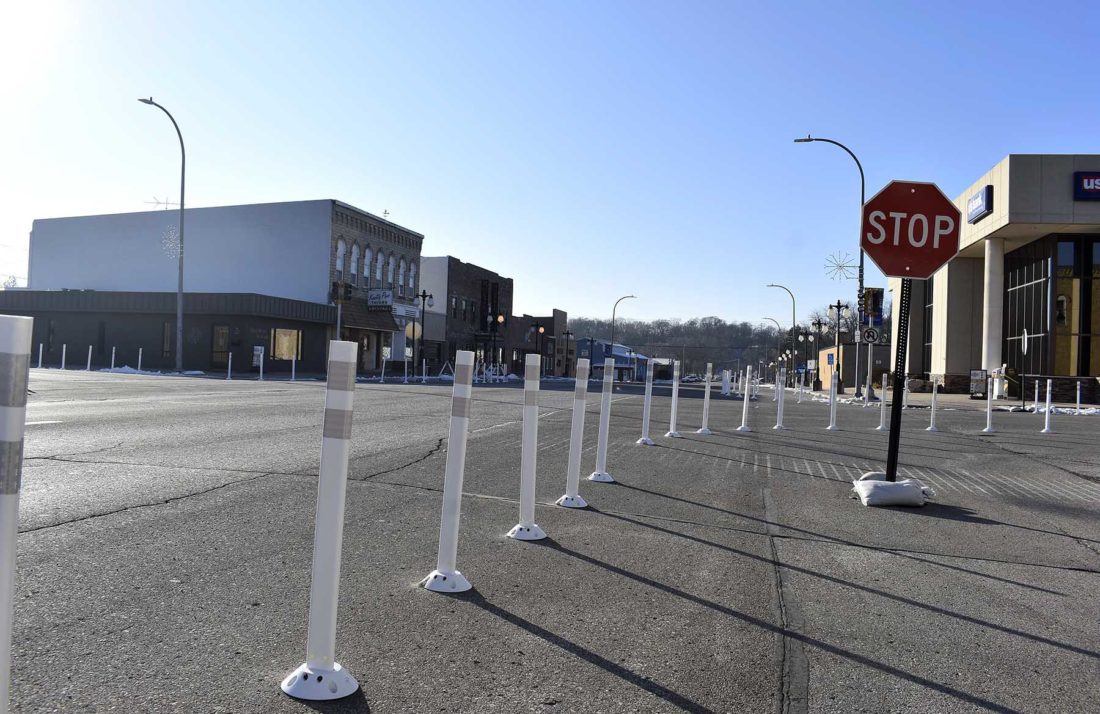
Delineators, the white posts surrounding the stop sign, are used here to simulate curb extensions along Sumner Avenue in Humboldt. The simulation is part of a larger pilot project downtown where traffic lights have temporarily been turned off and replaced with stop signs.
HUMBOLDT — Travelers to the downtown Humboldt area during Thanksgiving break may have noticed the traffic lights along Sumner Avenue had been turned off and replaced with stop signs.
That’s because the city of Humboldt is trying out a new concept with no traffic lights, according to Travis Goedken, city administrator.
Four-way stops have been installed at the two most heavily traveled intersections along the city’s main street — Fifth Street and Sumner Avenue and at Taft Street and Sumner Avenue.
Two more stop signs were placed at intersections to stop north and southbound traffic on Sixth Street and Eighth Street.
The pilot project is part of an overall plan for improvements to the city’s main street, according to Goedken.
It began Nov. 19 and will be in place for about two weeks.
“We are re-evaluating,” Goedken said. “We may actually make some changes to the design and pilot for another week or two. It may be extended.”
If permanently implemented, the removal of those lights would save the city money and hopefully result in safer streets, he said.
“We hope to have safer streets for vehicle traffic, pedestrians, and bicyclists,” Goedken said. “We have had a lot of feedback over the years regarding the stop lights.”
He said the timing sensors in the current traffic lights need to be replaced.
“They are from the ’70s and we can’t get the parts anymore to fix them,” Goedken said. “We are looking at either having to replace them at $7,000 apiece or looking at alternatives. That’s where the stop signs versus stop lights discussion came in.”
The traffic lights do not meet the standards of Americans with Disabilities.
“They don’t have the audible crosswalk alert that tells you to walk or don’t walk,” Goedken said. “We don’t have the visual that says walk or don’t walk. There’s no countdown.”
He added, “At this point, if someone is crossing the street, they might start crossing and the light turns yellow and it’s about to change. Well they didn’t know that, now they are out in the middle of the street as the light changes green. We had that as a concern.”
Another element to the pilot project involves delineators.
Delineators are small posts used to communicate traffic flow and direction.
Those were installed at the Sumner Avenue and Taft Street intersection to simulate the use of a bump-out or curb extension.
“We wanted to try out shortening the crosswalks at Taft because that’s one of the more heavily pedestrian traveled intersections and these bump-outs reduce the crosswalk on Sumner from 66 feet to 36 feet,” Goedken said. “That still allows for 18 feet lane of traffic, which is still plenty big, but it shortens that crossing up dramatically. It also allows us to get that stop sign out into the line of sight for people driving, because right now they are 66 feet wide curb to curb, so the stop lights are about 75 feet apart from each other. They are tucked way back.”
The crosswalk is two blocks south from the entrance of Taft Elementary School.
Goedken said most of the feedback he’s received from the changes so far have been positive.
“We had people in the past urging us to get rid of the stop lights because the downtown traffic didn’t warrant it,” he said. “We did do a traffic study last spring while school was still in session. We wanted to know who was crossing the crosswalk, who is driving.”
He said a team was stationed for 12 hours a day at Fifth Street, Sixth Street, Taft Street, and Eighth Street along Sumner Avenue to count traffic.
“Where it was coming from where it was going,” Goedken said. “Car, heavy truck, pedestrian.”
He said that data supports the notion that there is no need for traffic lights. Instead, stop signs would be the best model, he said.
An exact timeline on when permanent changes could be made is not yet known, but should come sometime in 2019.
“The final resolution will be part of the overall downtown streetscape project as a whole,” Goedken said. “Hopefully next calendar year we will see a final product from this.”
Local News
Supervisors approve speed limit change
The Webster County Board of Supervisors approved updating speed limits on 390th Street and Union Avenue in southern ...
Junk Days on Demand returns
The city of Fort Dodge’s popular Junk Days on Demand program is back for the sixth year, and municipal crews are ...
Fort Dodge prepares to honor the fallen

Governor’s Scholars recognized
Listening to his body saved his life
Jury finds FD man guilty of child abuse
A Fort Dodge man has been convicted of 21 counts of assault, neglect, and child endangerment. A Webster County ...