
In the rear view
After 62 years fighting fires for tiny Knoke, George Mack, 91, has retired
-
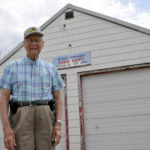
- -Messenger photo by Joe Sutter George Mack has retired from the Knoke fire department after 62 years. Mack was around to help establish the department and build the building in 1950, but didn’t officially become a firefighter until 1955.
-
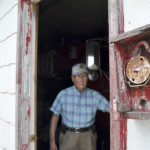
- -Messenger photo by Joe Sutter George Mack steps out of the Knoke firehouse next to the old switch that still controls the 1950s-era building’s fire siren. In the old days, Mack said the fire chief would cross the street and switch on the siren to alert the people. One woman would go out to the field with a white sheet and wave it to bring her husband in to fight the fire.
-
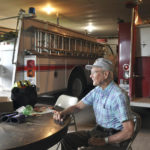
- -Messenger photo by Joe Sutter George Mack takes a seat in the Knoke fire department building. The trucks were smaller when the building was built in 1950; now the doors must be propped open just to get the fire engines out with 2 or 3 inches of clearance. A 10,000 gallon cistern beneath the station holds water to fill the trucks when they return from a call.
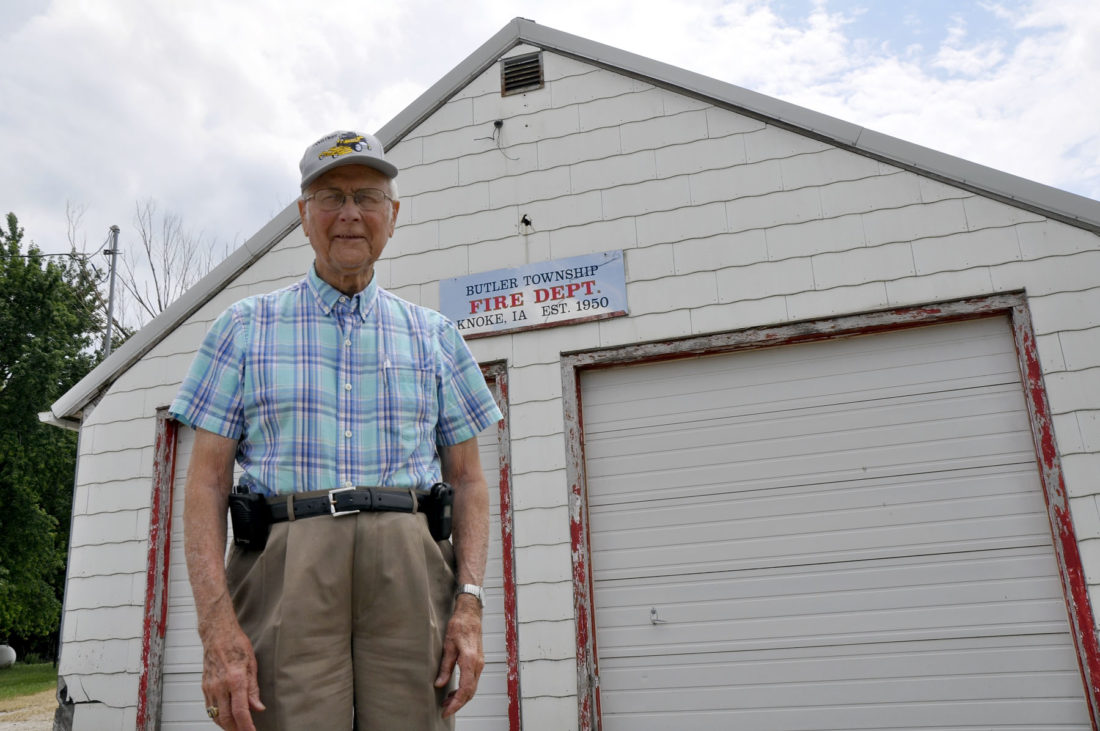
-Messenger photo by Joe Sutter George Mack has retired from the Knoke fire department after 62 years. Mack was around to help establish the department and build the building in 1950, but didn't officially become a firefighter until 1955.
KNOKE — In a place that barely exists, George Mack, 91, has retired.
He has left the Butler Township Fire Department in the unincorporated Calhoun County blip of Knoke after 62 years.
Mack was around when the department was incorporated in 1950.
He joined it in 1955.
“I was assistant fire chief, and I just retired and gave up my position all at one time,” Mack said.
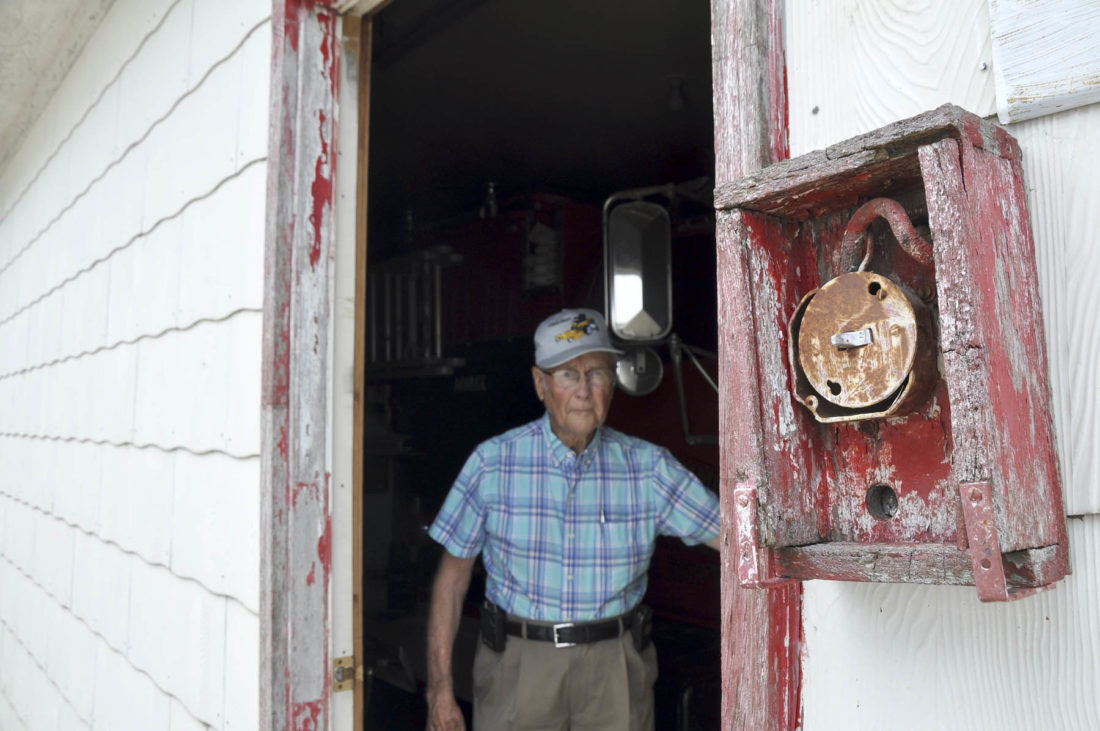
-Messenger photo by Joe Sutter George Mack steps out of the Knoke firehouse next to the old switch that still controls the 1950s-era building's fire siren. In the old days, Mack said the fire chief would cross the street and switch on the siren to alert the people. One woman would go out to the field with a white sheet and wave it to bring her husband in to fight the fire.
In 1955 Knoke was a busier place.
“We used to have a guy here run the filling station, and we had a guy here with a tavern and pool hall. We had a guy run a grocery store. We had livestock-buying facilities and a post office,” Mack said. “Then we had a guy who was selling implements. It’s all disappeared. The only thing we have left now is the grain elevator, and we do have a guy buying hogs yet.”
Long ago, township trustees were concerned that the closest fire station was in Pomeroy, eight miles away, Mack said. So the Butler Township department was established. In the early ’50s, Mack said, they put up the little fire station with two bays.
The station speaks to a time when fire trucks were shorter.
“If we can get a grant, we want to tear this building down and build a new fire house, a three-stall with bigger doors,” he said. “The doors now, we have to put a prop under them to hold them up because we’ve only got about 2 inches of clearance to get the trucks out.”
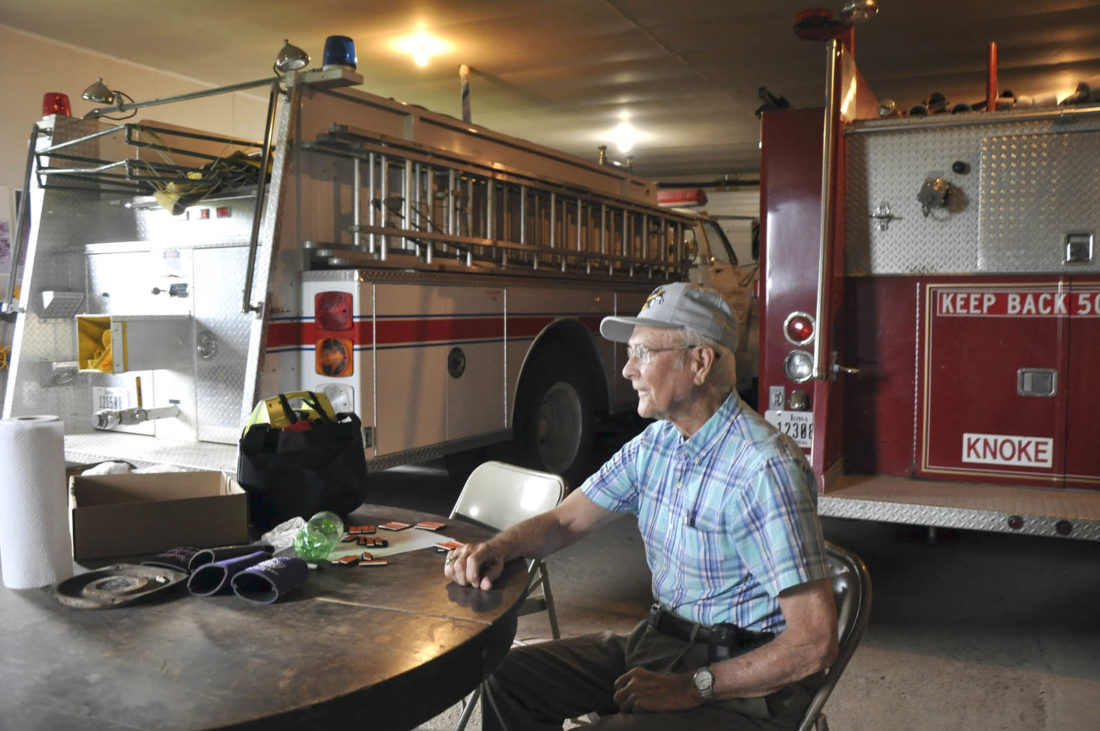
-Messenger photo by Joe Sutter George Mack takes a seat in the Knoke fire department building. The trucks were smaller when the building was built in 1950; now the doors must be propped open just to get the fire engines out with 2 or 3 inches of clearance. A 10,000 gallon cistern beneath the station holds water to fill the trucks when they return from a call.
The station still has an old light switch next to the door inside a wooden box with faded red paint that turns on the fire siren.
“The fire chief lived right across the street. If a call came in he’d run over here and turn the siren on,” Mack said. “One lady, she lived just to the east, when she heard it she grabbed a white tablecloth and her husband was a farmer, and she’d run out to the field and wave that white tablecloth, then he knew there was a fire so he’d come over.
“We had four or five of them who lived right here, one of them was the store keeper, and another was a mechanic, so we had three or four that when the whistle blew they were right there. But the rest of us we were all called on the telephone. Later on we got the pagers, like we have now.”
The first call they ever went to was in Pomeroy, Mack said.
“They had an implement store, and it was right at 10 below zero,” he said.
The worst fire he ever saw was also in Pomeroy. Four teenagers didn’t make it out, he said.
“That was the worst fire I was ever called to. I knew right away when we got there, if you’ve ever smelled burning flesh in a fire, you’ll recognize it,” said Mack. “The grandpa, he was living there and he was downstairs. He got a ladder and put it up and hollered at them but by that time the smoke and stuff had got ’em, and there was no way of getting them out. And it wasn’t long the whole house was in a blaze.”
After the Knoke firefighters went in to recover the bodies, one of the volunteers quit, Mack said.
“When that went through he said, I’m off the department. I never want to go through that again.”
Fires have changed over the years.
“We used to have a lot of hog barn fires,” Mack said. “People were having heat lamps and stuff for baby pigs, and once in a while a sow would break out or something would happen and the lamp would pull down on the straw, and pretty soon you have a fire.
“Now we don’t have that kind of farming anymore,” he said.
“And the other thing, we used to have a lot of chimney fires because people were using coal and cobs to fire, and they’d get the soot in the chimneys, and pretty soon that would catch fire and get out, start on the roof. And now we don’t have those because everyone’s got a gas furnace or an oil furnace, and it’s all controlled heat.”
But there are more field fires now then there used to be, he said.
“We used to not have very many field fires because we were picking with corn pickers. Well, now we have these combines, and these combines will catch fire, or sparks come off these combines.”
Mack has lived in Knoke his whole life.
“I still live out there on the farm,” he said. “I’ve lived there all my life, except a year and a half while I was in military service. Still sleep in the bedroom I was born in.”
Mack went on a couple calls with the fire department when it was formed, before becoming a member officially because they needed the help.
“At first when we organized each fireman had to pay a dollar so we had some refreshments we could use in the firehouse, but later on we got far enough ahead we don’t do that anymore,” he said.
When Mack got on, the department had 15 firemen. As numbers dwindled, the department strengthened its partnership with Pomeroy and Jolley.
“For a while we just had four or five of us and we just couldn’t get anybody to go along with,” he said. “Finally a couple years ago we got a couple young fellas and they induce a couple more fellas, and then we sent them to fire school this past winter.”
With the numbers back up to 13 or 14, Mack decided it was finally time to quit.
“In fact, the last couple years I told them I’m not putting on the mask anymore,” he said. “I said I’ll drive the trucks and I’ll run pumps, but I’m not going in there with a nozzle anymore.”
That doesn’t mean Mack won’t keep his pager on.
“They made me an honorary fireman,” he said. “I said, when there’s a fire I’ll probably still come over here and help you guys.”
Local News

Paivarinta pleads guilty to non-forcible felony charge
Firefighters battle blaze in ravine
A social networking success story
Board OK’s church expansion
42nd annual Farmers Market to open June 13
The Fort Dodge Farmers Market will open to the public on June 13, according to Director David Ash, who spoke to the ...