
East Sac County Community Schools: a time of transition
East Sac officials consider closing schools in light of declining enrollment; official sees silver lining in coming changes
-
-
-Submitted photo
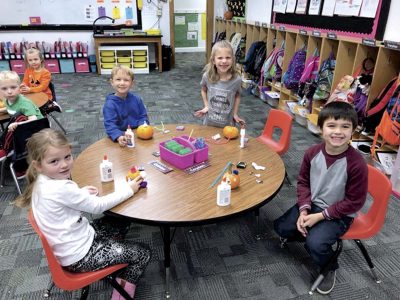
Elementary students from Kaylene Henningsen’s class in East Sac County Community School decorate pumpkins they got as a PBIS reward back in October. From left to right are Quinlee Hugeback, Wallace King, Addison Harms and Cayden Young.
-
-
-Submitted photo
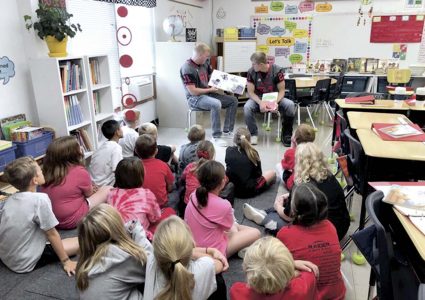
East Sac County Community School District senior football players Reese Potthoff and Derek Aschinger read to the third-graders in Wall Lake Elementary during Homecoming week.
-Submitted photo
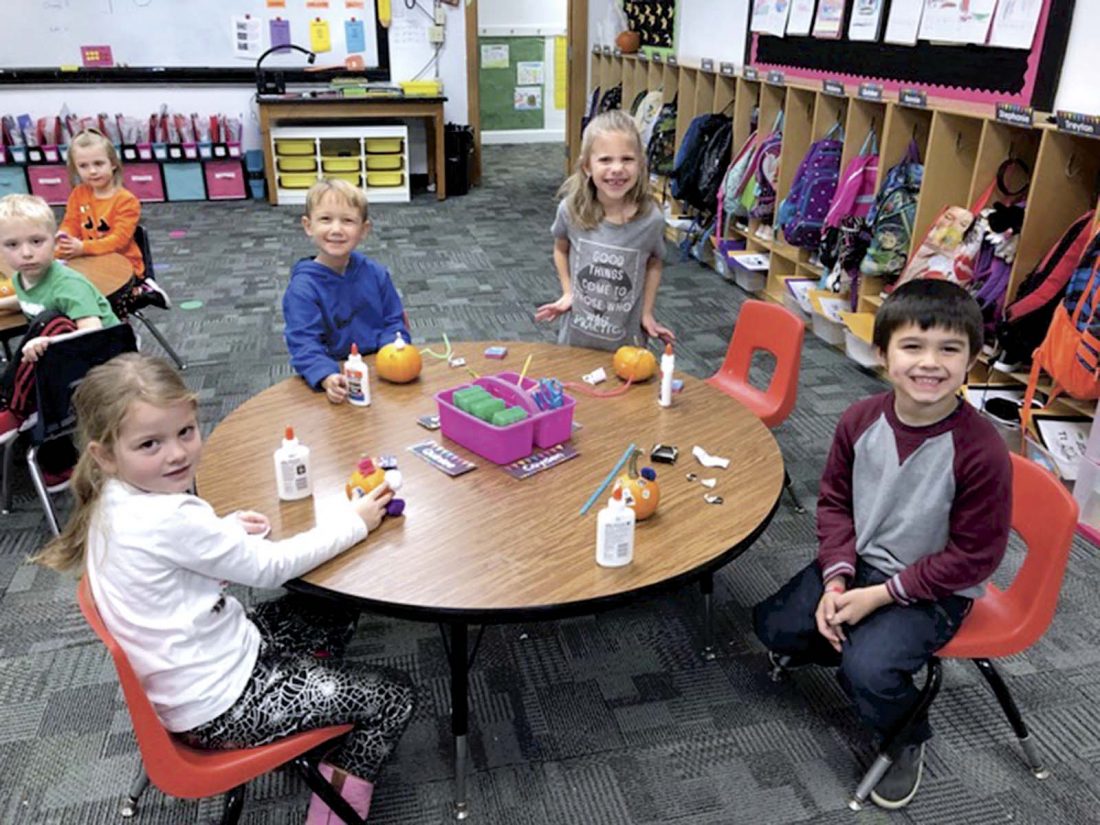
Elementary students from Kaylene Henningsen’s class in East Sac County Community School decorate pumpkins they got as a PBIS reward back in October. From left to right are Quinlee Hugeback, Wallace King, Addison Harms and Cayden Young.
SAC CITY — In a landscape of rural depopulation, some school districts are finding that the only way to make progress is to consolidate.
As East Sac County Community Schools thinks about its future, with a decline in enrollment and state supplemental aid growth that has lagged behind the rate of inflation, district Superintendent Jeff Kruse and the school board have some difficult decisions to make.
One of those decisions is closing schools. Kruse said the district, which encompasses a large swathe of 300 square miles, is looking to close two of its four buildings in the near future.
“It’s been a difficult decision, there’s no doubt about it,” he said.
But in the hard choices he sees a silver lining.
-Submitted photo
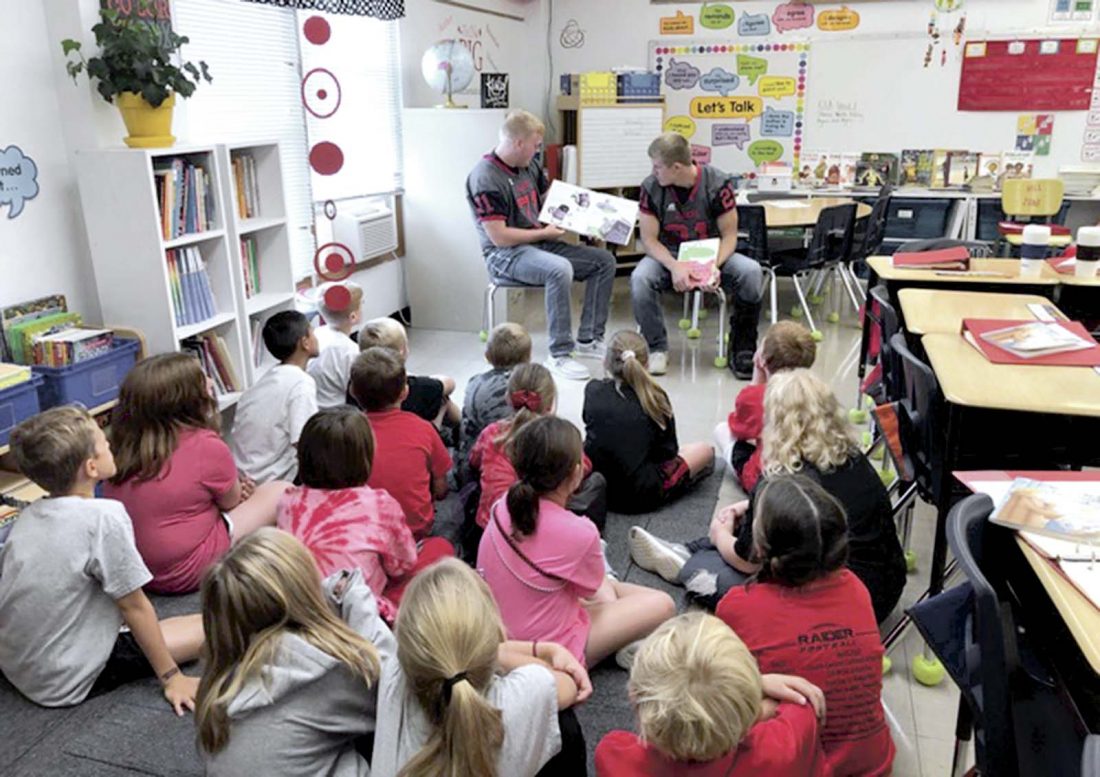
East Sac County Community School District senior football players Reese Potthoff and Derek Aschinger read to the third-graders in Wall Lake Elementary during Homecoming week.
“It can strengthen a culture for learning because everyone gets a chance to interact with each other more,” he said. “Fears come about because it’s change. But what I have found is once you get through the change and present reasons and rationale for change, most people are pretty accepting of it.”
After enrollment declined by about 100 over the last four years in the district of now 800 students, the board started discussions to close two buildings: the elementary school in Wall Lake, which has served southern district students, and the middle school in Sac City.
Long-term plans envision an elementary school in Sac City and a combined middle school and high school building in Sac City.
In the midst of such a large drop in enrollment, Kruse says it doesn’t make sense to continue to maintain the same number of buildings.
While the closings won’t be easy, particularly in small towns where a culture is partly built around educational institutions, Kruse knows the residents and students of his district are strong enough to weather the storm.
“For Wall Lake, that’s their community school building,” Kruse said..
But with strong industry and an industrious spirit, he has faith they can remain strong even without a school.
The senior superintendent, who has shepherded other rural districts through similar situations before, does not foresee any more mergers with other districts. East Sac, which was formed by a consolidation with another district eight years ago, simply does not have any viable options around it. Neighboring South Central Calhoun’s district encompasses 450 square miles.
“The problem is a lot of schools around have consolidated,” he said, telling The Messenger that transportation for students becomes inefficient at a certain size.
Though the closings would ideally take place over one year, Kruse acknowledged the district may need more time to adjust. No moves have officially been approved by the school board yet.
“As a rural district you have to think of long-term,” he said. “We have to think of a vision for the district.”
As populations evolve, balancing tradition with the needs of the community becomes a precarious part of the equation.
Positive outcomes may include more sharing opportunities with other schools, particularly at the high school level, to allow students the use of more technology or access to more vocational programming by blending the strengths of multiple schools for the benefit of all students.
And in sections getting as small as 12 students, Kruse sees a potential benefit to bulking up classes to put about 18 in a section — benefiting both teachers and students in professional and academic development.
Financially, the move would also help the district stabilize its unspent balance, which has worn thin in recent years.
But even with the benefits, Kruse said the district will find a tailored approach.
“Do you make the buildings fit, or is your approach finding the right fit?” he asked. “Our approach is let’s try to find the right fit.”
The consolidations will require a handful of classrooms and spaces to be added on to remaining buildings in the first phase to make the new fit more appropriate for educational needs.
Kruse said the district is working with an architect to draft a contract and preliminary sketches for those changes.
“I don’t want to go through this (drawn out),” he said, “because it is very hard on a community. There’s a healing process after you’ve gone through this.”
He hopes promoting a unified vision and strength through positivity will speed up that healing — part of his role as a leader in a place with fewer people.
Progress 2020 Education

Iowa Central Community College: Leveling the playing field
Laurens-Marathon Community Schools: tomorrow’s workforce
LAURENS — There’s a new facility in Laurens at the high school to help meet the area’s need for skilled ...

Community Christian School: Developing young leaders

Humboldt Community School: education that works

Fort Dodge Community School District: Moving forward
