Voters approve new EMS tax
Move establishes essential service in Webster County
-
-
-Messenger file photo
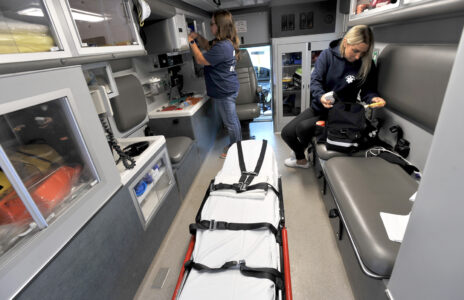
Dayton Rescue Squad EMT Sara Pieper, at left, along with fellow EMT Steph Swanson check over supplies and equipment in one of the ambulances. The Dayton Rescue Squad is one of the units that will benefit from a countywide levy of 75 cents per $1,000 of taxable value the voters approved to support emergency medical care as an essential service.
-Messenger file photo
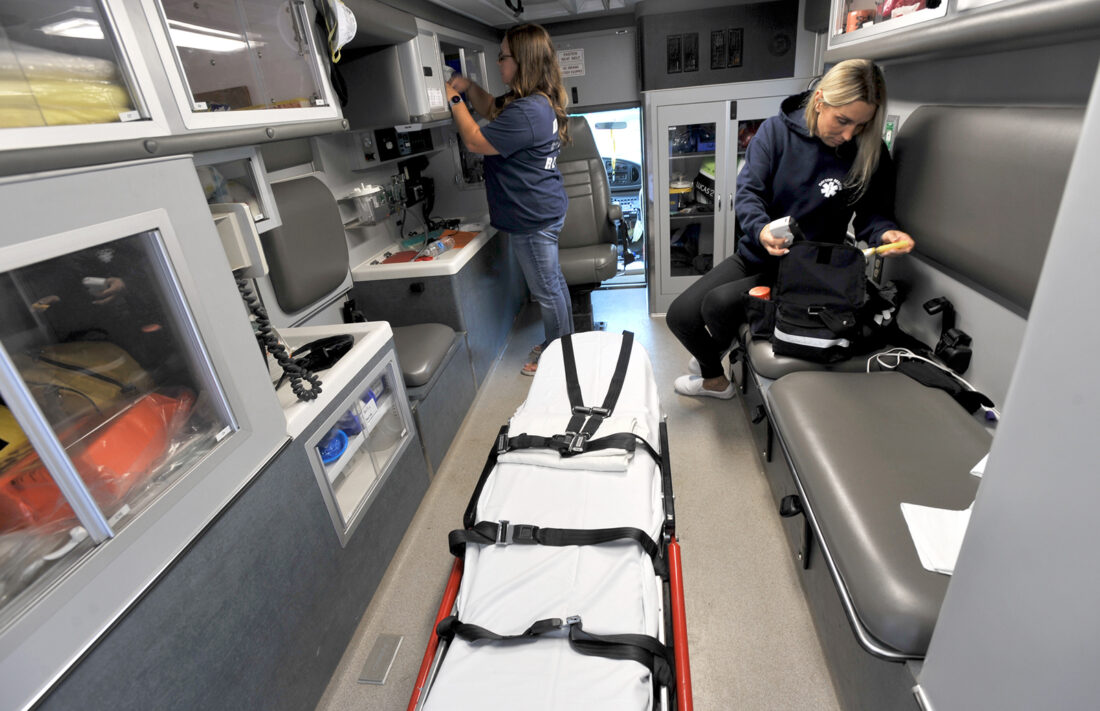
Dayton Rescue Squad EMT Sara Pieper, at left, along with fellow EMT Steph Swanson check over supplies and equipment in one of the ambulances. The Dayton Rescue Squad is one of the units that will benefit from a countywide levy of 75 cents per $1,000 of taxable value the voters approved to support emergency medical care as an essential service.
In March 2025, the voters of Webster County decided that emergency medical service should be an essential service, supported by its own property tax.
Nearly a year later, the processes and agreements are being put in place to channel the revenue from that tax to the county’s ambulance services and the volunteer fire departments that provide care before an ambulance arrives.
While emergency care would appear to be essential, under Iowa law it is not considered essential in the way that police and fire protection are. Police and fire departments have long been supported by taxes, but EMS providers have not. But Iowa law does provide a way for voters to make EMS a tax-supported essential service.
In early 2025, a plan was unveiled to make EMS essential in Webster County.
That plan called for a property tax of 75 cents per $1,000 of taxable value to pay for it.
That tax is estimated to generate $1.6 million a year.
The plan called for dividing the bulk of the money, about $1.4 million, between the three ambulance providers in service in Webster County at the beginning of 2025 — the Fort Dodge Fire Department, Dayton Rescue Squad and Southwest Webster Emergency Medical Service in Gowrie.
The Fort Dodge Fire Department, which provides ambulance service to the city and all of northern Webster County, would receive 76 percent of the money. Fort Dodge has the only paramedic level ambulance service, so it also assists the Gowrie and Dayton units with the most critically ill or injured patients.
Gowrie would receive about 14 percent and Dayton would receive about 10 percent.
The fire departments in Badger, Barnum, Callender, Clare, Harcourt, Otho and Vincent would each receive $10,000 for their work as emergency medical first responders.
The proposal also included an emergency medical service coordinator position. The coordinator is to help the leaders of the various departments, advising them on training, medical supplies, equipment and compliance with rules and regulations.
The voters approved the new property tax for EMS on March 4, 2025, by an 83 percent margin.
The process of implementing it, however, became complicated by the Otho Fire Department beginning an ambulance service in February 2025, right before the vote.
Multiple, sometimes stormy, meetings of the Webster County Emergency Medical Service Advisory Council were held through 2025 as that body tried to reach a decision on funding Otho as an ambulance service or as an emergency medical first responder agency.
In October 2025, the council decided to move forward with the original concept, providing money to Otho as a first response agency rather than an ambulance service.
That decision enabled the council to finalize the agreements that would allow all of the communities to access their share of the money from the new tax.
Those agreements were forwarded to the Webster County Board of Supervisors for its approval this month. The agreements were finally approved after a long board meeting at which the supervisors considered changing them.
Now 10 months after the voters approved the new tax, the agreements await signatures from local officials. Only after those final approvals are obtained will money begin flowing to the EMS providers.