
Building a Grade A dairy
Jones Dairy expansion leads to 1,500 cows, new visitor’s center
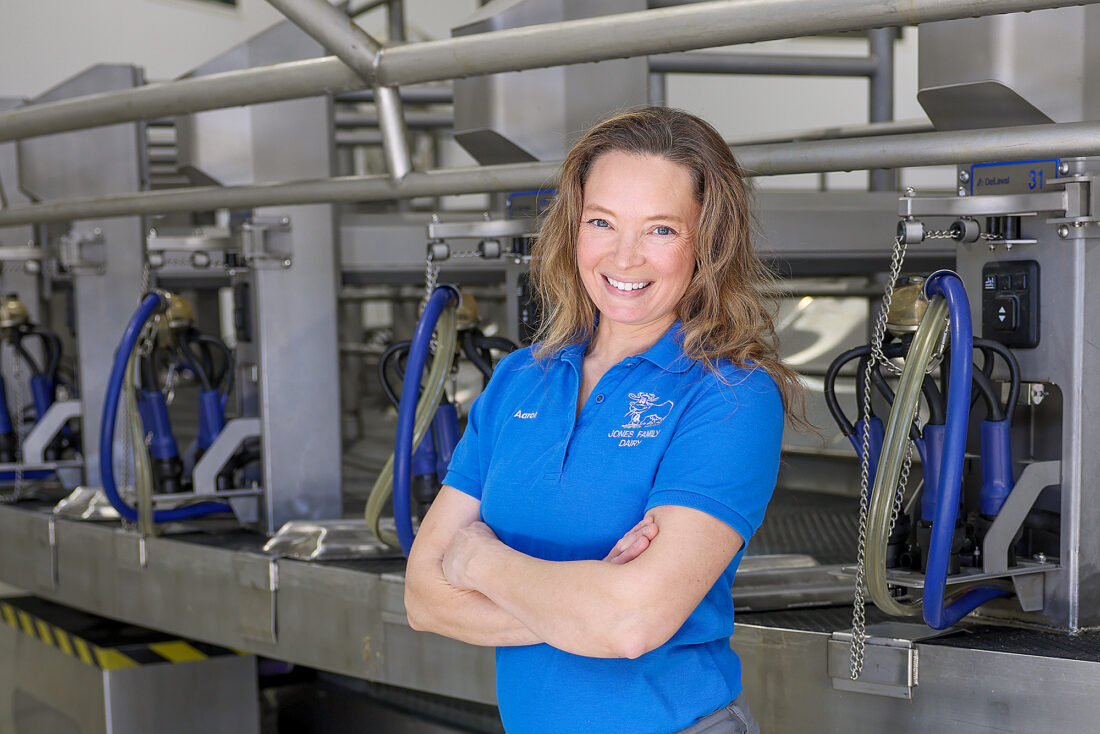
-Submitted photo courtesy of Jones Dairy <br> Aaron Titterington stands inside the milking parlor at Jones Dairy. She, along with her brother Nate and father Patrick, traveled to more than 20 dairies in the Midwest to explore the best way to expand their dairy.
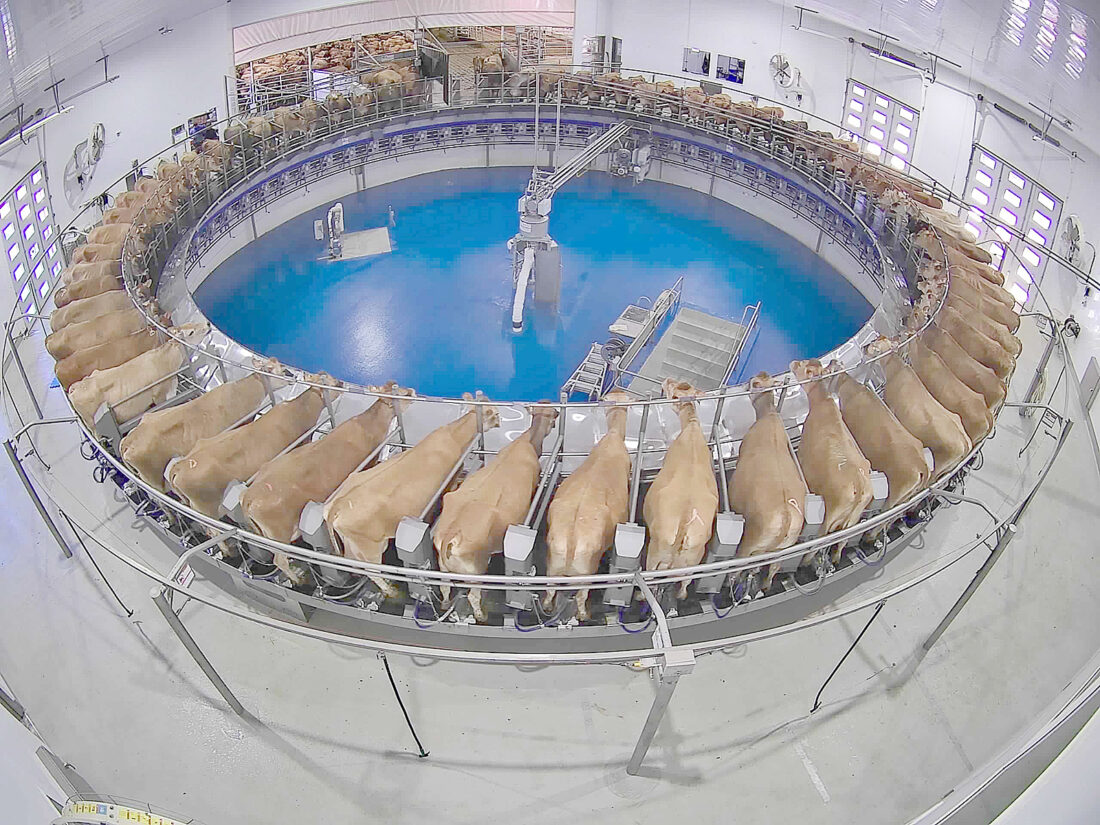
-Submitted photo courtesy of Jones Dairy <br>Dairy cows fill the carousel-style milking parlor, which holds 64 cows. The Joneses discovered the carousel helps create calmer cows. They can milk 350 cows an hour.
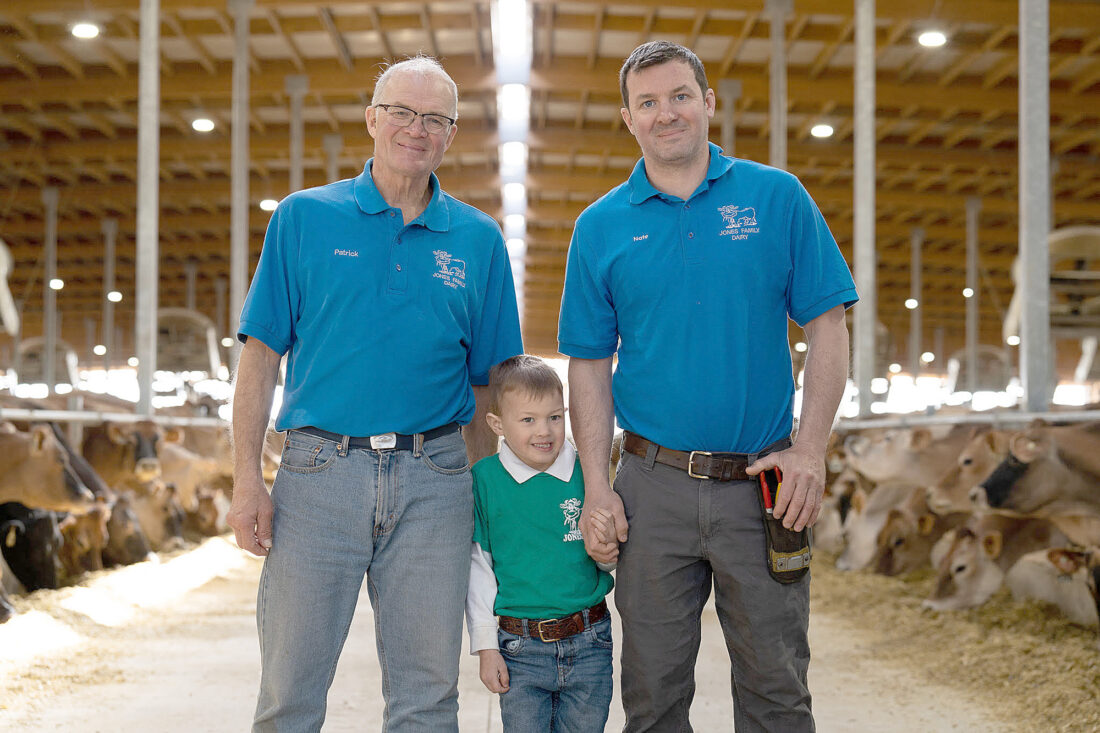
-Submitted photo courtesy of Jones Dairy <br> The long road to today’s Jones Dairy began in 1977 when Patrick Jones, left, was in high school and took particular interest in the dairy cows his parents, Dale and Iola Jones, owned. The older Joneses helped Patrick Jones get a Jersey dairy set-up started and, in time, Patrick Jones and his wife, Nancy Jones, had 70 cows, which they milked by themselves, and later with the help of their eight children. Pictured with Patrick Jones are his son Nate Jones, at right, and Nate's son, August.
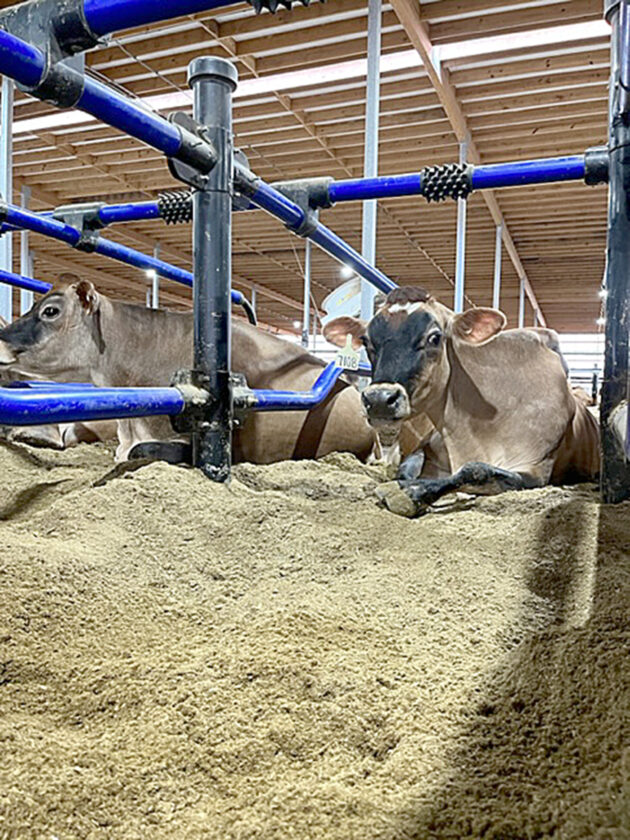
-Photo courtesy of Jones Dairy <br> A dairy cow rests in its stall at Jones Dairy.
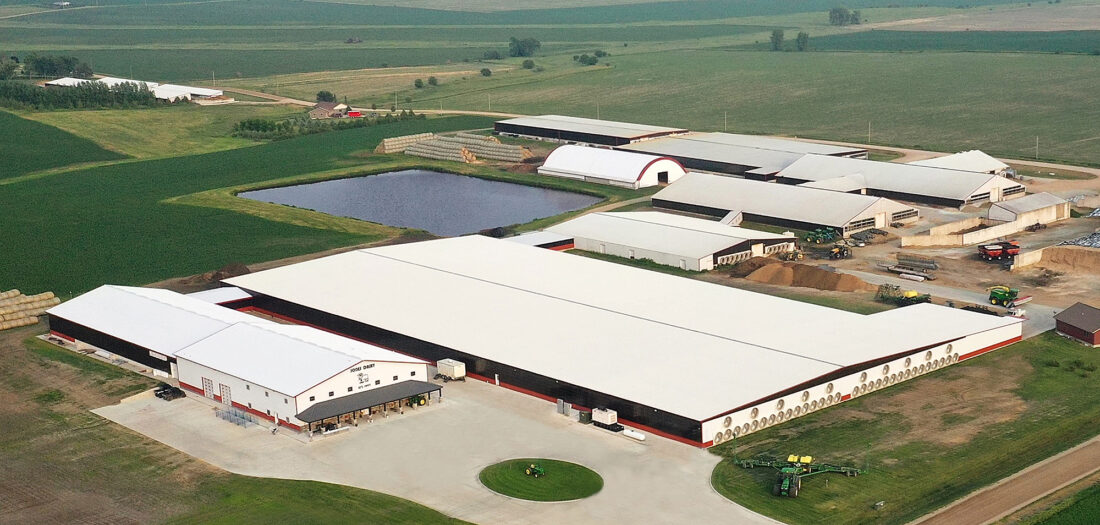
-Submitted photo courtesy of Jones Dairy <br>In 2023, Jones Dairy completed an expansion that allowed the family to bring in more dairy cows. In addition to a new carousel-style milking parlor, the dairy added a new barn and visitor's center.
-Submitted photo courtesy of Jones Dairy <br> Aaron Titterington stands inside the milking parlor at Jones Dairy. She, along with her brother Nate and father Patrick, traveled to more than 20 dairies in the Midwest to explore the best way to expand their dairy.
-Submitted photo courtesy of Jones Dairy <br>Dairy cows fill the carousel-style milking parlor, which holds 64 cows. The Joneses discovered the carousel helps create calmer cows. They can milk 350 cows an hour.
-Submitted photo courtesy of Jones Dairy <br> The long road to today’s Jones Dairy began in 1977 when Patrick Jones, left, was in high school and took particular interest in the dairy cows his parents, Dale and Iola Jones, owned. The older Joneses helped Patrick Jones get a Jersey dairy set-up started and, in time, Patrick Jones and his wife, Nancy Jones, had 70 cows, which they milked by themselves, and later with the help of their eight children. Pictured with Patrick Jones are his son Nate Jones, at right, and Nate's son, August.
-Photo courtesy of Jones Dairy <br> A dairy cow rests in its stall at Jones Dairy.
-Submitted photo courtesy of Jones Dairy <br>In 2023, Jones Dairy completed an expansion that allowed the family to bring in more dairy cows. In addition to a new carousel-style milking parlor, the dairy added a new barn and visitor's center.
Trending
SPENCER -- A 2023 expansion brought more dairy cows, a new carousel-style milking parlor, new barn and a visitor's center to Jones Dairy, located northeast of Spencer.
Jones Dairy produces Grade A milk, which is transported to Le Seuer, Minnesota, to be made into cheese.
This newest expansion updated facilities that were becoming outdated, according to dairy manager, Aaron Titterington.
"We were in a facility that was requiring a lot of upkeep every year," she said. "We didn't feel like we were getting a lot out of the repair money and didn't feel like we were serving the cows or the people."
Titterington said this expansion was "a bit of a leap financially" with markets as risky as they had been. But she said adding on to the other facilities didn't seem possible because they couldn't bring in more cows if the opportunity presented itself, and they recognized the need for newer technology to further modernize their operation and to continue attracting potential employees.
"It was also hard to give tours there and present agriculture in the way we wanted to present it," she said. "We wanted to have a quality face, and it was getting harder to do that there."
Jones Dairy owners and managers sat down then to decide how to best serve the cows, the people who worked there (or who would work there) and how to serve the people of the community.
Titterington, her brother, Nate Jones, and father, Patrick Jones, went to more than 20 dairies in Iowa, South Dakota and Wisconsin to explore their expansion idea opportunities. She said Patrick Jones is a logical thinker and is good at taking lots of ideas and "putting them into a line," to form a plan.
Between the three of them, the latest Jones Dairy expansion began to take shape.
Construction began in 2022, and milking in the new facility began in March of 2023.
"We essentially built a new dairy," said Titterington.
She said they decided they needed some additional housing for their dry cows and heifers, so they moved into the old milk cow facilities, and they built a new milk cow barn that holds 1,250 milking cows. She said 450 cows are housed in a previously existing barn, in order to keep making use of all available facilities. Those cows have a bit of a walk to get to the milking carousel, but Titterington said they don't seem to mind.
"Because we're milking very efficiently here, the cows enter the rotary for nine minutes and leave, so they're in the holding area for less than 40 minutes. By the time they lollygag there and back, they're only out of their pen for much over an hour," she said, adding there is still plenty of time for them to sleep, eat and drink before being milked again.
Jones Dairy milks three times a day.
Titterington said all systems are operating as well as they had hoped.
"I would have slept a lot better during the building process if I had known how amazing this would be," she said. "By day three the cows were just coming in -- they had never been in a parlor like this, but they like it."
Why the carousel?
Jones Dairy looked at different types of milking parlors and decided on the carousel. The carousel holds 64 cows at a time.
"It seemed like the cows were the calmest in a carousel situation, and it works better for the milkers," she said, explaining that in a parallel parlor (featured in their previous milking barn) all the cows came in and left at once for each batch to be milked. It may have meant that a cow on one end may not have had the milking unit on as long as a cow on the other end.
"The cows do seem to like to look at their spot and get on. In a parallel they get on and (things seem more hurried for the cows). Here they don't seem to mind taking turns to get on ... they just seem to like riding it," Titterington said. "This last summer when we had those four days of terrible heat, this was the hottest place on the farm, but the cows still felt calm riding it."
Titterington said they looked at robotics very hard while doing their research on this new facility, and felt like they made the right decision.
"This style of parlor seemed to fit with the people who were already working here. And when you open the gate, the cows all hit the road to head to the parlor. Our cows seem to want to do things as a herd. The efficiency is out of this world -- our (milking) guys have no steps; I bet they used to have 30,000 steps to get the milkings done."
They milk 350 cows per hour.
Since 2014, Jones Dairy recycles the cow manure produced there, putting it through an on-site process that presses the liquids out of it. They use the remaining fiber for bedding for their free-stall cows.
Titterington said people seem surprised that the cows enjoy laying in it, but said it's true.
"It changed our cow health because we were able to control our udder health, the moisture and the usage of the fiber solids (or recycled fiber), so we were able to make it and put it in the stalls on the same day -- and it's from our own cows, so there are no outside germs."
The process worked so well in their previous expansion, that they knew they wanted to tweak it and continue it in this latest barn.
The scrapers run continuously through the wide solid concrete alleyways, with manure being collected and pressed daily. The alleyways are of solid concrete with no slats, keeping solids and liquids together until the scraper comes by again.
Titterington said it keeps the cows very clean.
"You can walk in our barn with tennis shoes," she said. "Our barns are also connected by hallways, so you can work in the barns and hardly even know it might be 54-below zero outside. The cows are comfortable here."
Visitor's Center
Part of the mission of Jones Dairy is to help educate the public about the dairy industry and agriculture in general.
That mission was the impetus behind a visitor's center, open every day all day for anyone to come in and watch the cows get milked. Visitors can view the carousel of cows from the main floor, or watch from the upstairs level, through several very large windows. It gives a full view of the milking process.
"We're passionate about our cows, but we're also passionate about our product," said Titterington. "Our milk all gets (shipped out), but that doesn't make us any less passionate about milk and dairy. We deeply believe that healthy children and healthy people are still going to be reliant on animal agriculture ... that the nutrition of the world will not be solid without animal agriculture."
Titterington said they wanted to shine a positive light on it because she said so many people don't know anything about it.
"People come here and didn't know before that the cows are comfortable and the place is clean.
That's why we did it -- knowledge is power," said Titterington.
About 500 school children per year visit Jones Dairy annually. Titterington said their family hopes as those children grow and have families of their own, they remember what they saw at Jones Dairy and know the milk is safe and from contented, clean cows.
"Our margins are determined by the level of comfort we provide to the cows," said Titterington of the link between contented, comfortable cows and the amount of milk they give.
A closed-circuit television in the upstairs area of the visitor's center helps people see all that goes on out in the barns and in the milking parlor as well.
The television also helps the employees of Jones Dairy see what's happening in the barns and around the dairy at all times as well, and they use images to help teach people about the dairy industry. People can see the holding and sorting pens, and the bulk tank area -- places where it's difficult to take people in a tour situation.
"They're seeing things happening here in real time," Titterington said of the various views people can see on the television. "We want people to see we're transparent, and the cameras help with that."
Previous expansions
The long road to today's Jones Dairy began in 1977 when Patrick Jones was in high school and took particular interest in the dairy cows his parents, Dale and Iola Jones, owned. The older Joneses helped Patrick Jones get a Jersey dairy set-up started and, in time, Patrick Jones and his wife, Nancy Jones, had 70 cows, which they milked by themselves, and later with the help of their eight children.
With 70 cows to milk morning and night, and with their growing children getting involved in school events, the Joneses needed to decide how to get to those events without missing a milking. They needed more flexibility for that to happen, and Patrick and Nancy Jones wondered how many of their children would want to be part of the dairy after graduating from high school.
That brought on a 1997 expansion to 300 cows in a barn built west of their home place, and put up mostly by the family's own sweat equity. They also hired some help with milkings, so the Joneses could be gone if they needed or wanted.
By 2004, they were starting to become crowded from having grown internally to 400 cows, and another expansion was in the works. They built a second barn at that time, and could then hold 700 to 900 cows comfortably. They stayed at that number for a while, growing slowly enough for the need for yet another expansion.
This latest expansion to 1,500 cows will "set" them for a while, Titterington said.
"I don't think of this as big; I think of it as better," said Titterington. "We've leveled up. We're proud of our family, proud of what we do and proud of our product. Our future is to keep learning and leveling up, and figuring out the next step."
Jones Dairy has conducted several community open houses to show visitors the dairy, and educate people about the dairy and agriculture. Twenty people are employed at Jones Dairy today.