
Larson, Meyer support bid to stop eminent domain
Representatives want law to assist property owners against pipeline company
-

-
-Photo by Cami Koons/Iowa Capital Dispatch
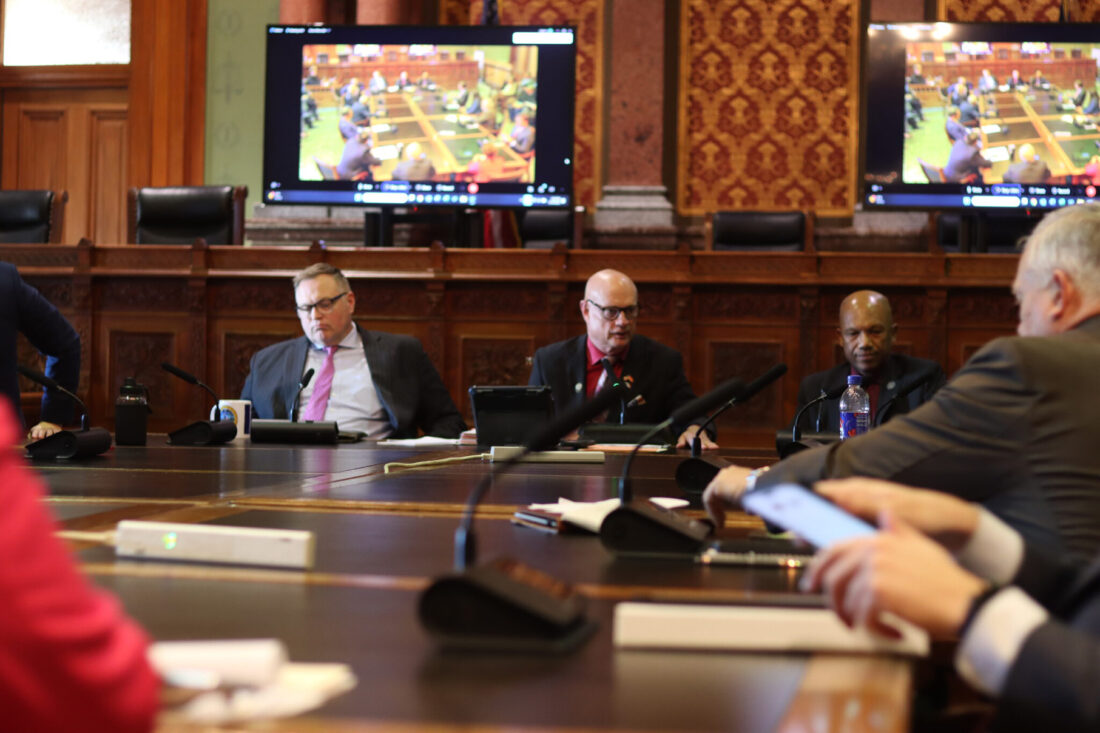
House Judiciary Committee members, from left, Rep. Judd Lawler, Rep. Steven Holt, and Rep. Ross Wilburn discuss legislation banning eminent domain for carbon pipelines on Wednesday.
-Photo by Cami Koons/Iowa Capital Dispatch
House Judiciary Committee members, from left, Rep. Judd Lawler, Rep. Steven Holt, and Rep. Ross Wilburn discuss legislation banning eminent domain for carbon pipelines on Wednesday.
A swiftly-moving effort in the Iowa House of Representatives to stop the use of eminent domain for the construction of carbon dioxide pipelines has the support of a pair of lawmakers representing Webster County.
New state Rep. Wendy Larson, R- Odeboldt, made opposition to eminent domain a key part of her campaign leading up to the Dec. 9 special election to replace former state Rep. Mike Sexton, R-Rockwell City.
She said she knows a farmer who spent $10,000 on legal fees to defend their property from pipeline developers.
“I feel like the House is very united in standing against eminent domain,” she said.
State Rep. Ann Meyer, R-Fort Dodge, has supported past bills intended to curtail eminent domain and said she will support the one now advancing in the House.
“I don’t think that property rights should be infringed to benefit private companies,” she said Wednesday evening.
Meyer said she expects the bill to be voted on by the full House Tuesday, just about a week after the legislative session began.
Eminent domain is a process in which a buyer can obtain land from an unwilling seller. Once granted the power of eminent domain, the buyer gets an appraisal of the property, pays that amount to the owner and takes the land.
Summit Carbon Solutions is seeking to use eminent domain to get property for the construction of a pipeline that will carry carbon dioxide from Iowa ethanol plants to a place in North Dakota where it will be sequestered underground.
CO2 pipeline eminent domain ban advances from House committee
By CAMI KOONS
Iowa Capital Dispatch
A bill that would prohibit the acquisition of land via eminent domain for carbon sequestration pipelines in Iowa advanced Wednesday from a House committee.
House Study Bill 507 is one of several expected bills related to property rights and carbon sequestration pipelines expected in the 2026 session.
Opponents of the bill said it would kill the proposed Summit Carbon Solutions pipeline which, according to lobbyists for the company, already has more than 1,400 easements with willing landowners for the pipeline.
Rep. Steven Holt, R-Denison, sponsored the bill and said it protects Iowans’ “fundamental right” to private property.
“Eminent domain should be incredibly rare and must meet the constitutional requirement of a public use,” Holt said.
Proponents of the bill said it is a simple bill, unlike the bill that Gov. Kim Reynolds vetoed last year that would have restricted the use of eminent domain by CO2 pipeline operators.
A group of Republican lawmakers have been vocal in their opposition to the carbon sequestration project, which was granted the right of eminent domain by the state utilities commission in 2024. The House passed a similar bill in 2025 to ban the use of eminent domain by carbon capture pipelines, but the Senate did not take up the bill.
Rep. Ross Wilburn, D-Ames, expressed hesitancy advancing the bill Tuesday during a subcommittee meeting on the proposed legislation, because of the Senate’s inaction on the similar bill last year and the governor’s veto.
Wilburn reiterated his concern Wednesday, noting that Reynolds was “silent” on the issue of eminent domain and property rights during her Tuesday Condition of the State address.
“So when I say nothing has changed, the political conditions around this have not changed,” Wilburn, who was one of two no votes on the bill, said.
Holt responded that neither the House nor the Senate can control what the governor does, nor can the two chambers control one another.
“What we do is, we do what is right and we move forward and who knows what dynamics might change,” Holt said.
In addition to bringing tax credits associated with the ultra-low carbon ethanol market, lobbyists for Summit argued in the subcommittee Tuesday the pipeline project would also be an economic opportunity for Iowa due to tax credits for enhanced oil recovery that were recently made available in the federal “big beautiful” law.
Ethanol producers would have access to 45Z tax credits for producing the low carbon fuel by sequestering carbon dioxide into the pipeline. The carbon sequestration pipeline would be eligible for 45Q tax credits as it transports the carbon to underground storage and now, as that carbon is strategically pumped underground to increase the efficiency of oil wells.
Holt said the Summit project is not a public use project, but “an economic development project.”
Holt said public use refers to infrastructure projects like roads, schools or essential energy projects that are “convenient and necessary.”
“The use of government power to seize property for a private economic development project is not constitutional,” Holt said.
Senate leadership has also indicated it plans to file a bill that would address the property rights issue by allowing pipeline operators to deviate from their state-approved routes in order to find willing landowners.
House Republicans appear to be united over the eminent domain ban, despite the differences from the Senate. The only other dissenting vote on the bill in committee Wednesday came from Rep. Rick Olson, D-Des Moines.
House Speaker Pat Grassley said in a Wednesday taping of “Iowa Press” that the House’s narrow eminent domain bill was rolled out early on to show that “it still is something that we really care about.”
Grassley said the fact that the Senate is working on its own bill is a “positive sign towards finding some level of resolution.”
“For the last several years, it’s just been bill after bill from the House’s perspective, heading over to the Senate,” Grassley said. “Regardless if we agree with one another, I think it’s a positive step forward … that there’s actual movement on both sides.”
Local News

McGowan supports action on Venezuela
Man jailed after threatening woman, leading officers on a chase
A man has been jailed on a long list of criminal charges after pointing a gun at a woman’s head and later leading ...
Humboldt man arrested for breaking into home
HUMBOLDT — A Humboldt man was arrested after allegedly stealing a car and breaking into a Humboldt County home. ...
Larson, Meyer support bid to stop eminent domain
One arrested in Dayton shooting
DAYTON — One of two men wanted in connection with a late December shooting incident in Dayton has been ...
Fort Dodge announces FOG and cross-connection compliance program
After 12 years of relying on voluntary community self-monitoring for fats, oils, and grease (FOG) and ...