
‘Weather’ or not
Daggett outlines how schools decide whether to delay, cancel or stay in class
-
-
-Messenger photo by Britt Kudla
Matylda Rasch, 7, of Fort Dodge, leaps into a pile of snow on Nov. 30 in Fort Dodge. School districts have to evaluate weather forecasts when deciding whether to delay or cancel school.
-Messenger photo by Britt Kudla
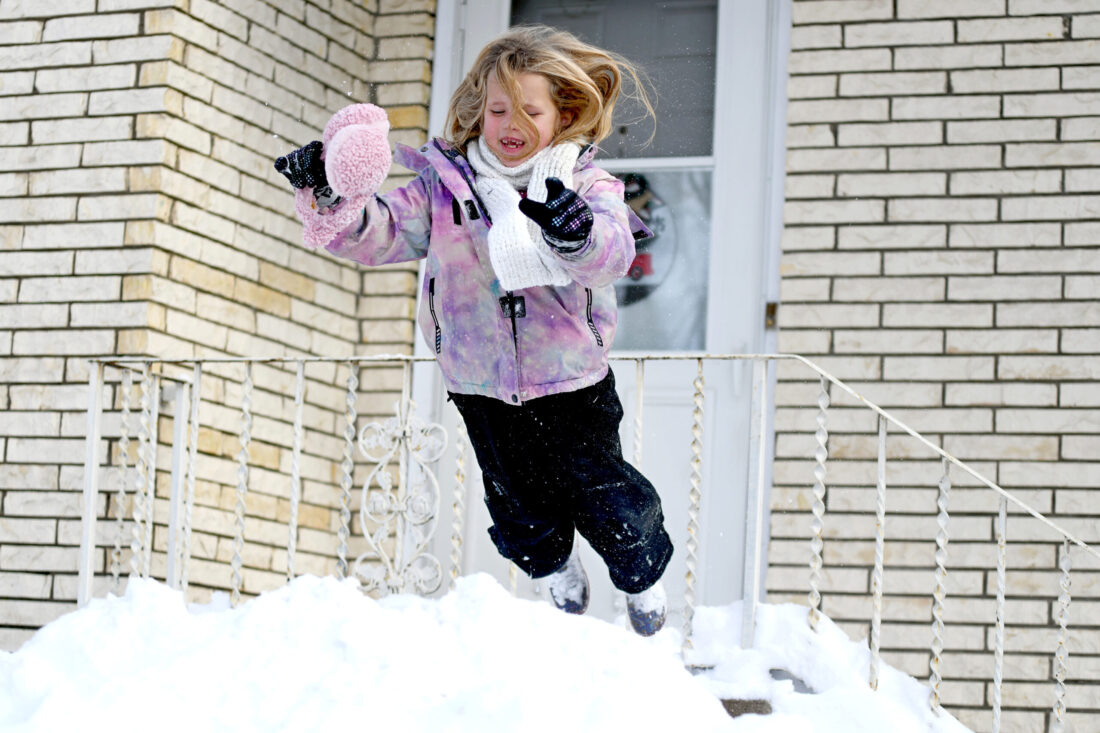
Matylda Rasch, 7, of Fort Dodge, leaps into a pile of snow on Nov. 30 in Fort Dodge. School districts have to evaluate weather forecasts when deciding whether to delay or cancel school.
MANSON — At just before 9 a.m. Thursday, Justin Daggett’s phone is already pinging with alerts and messages regarding the weather.
No, he’s not a meteorologist, but the superintendent of Manson Northwest Webster schools.
With snow predicted to begin falling by 11 a.m. and to continue until at least 8 p.m., he had just made the decision to let school out at 12:15 p.m. Several other area schools made similar decisions Thursday.
“As a superintendent, you have to also be a meteorologist and you have to be able to predict the future,” said Daggett. “Some decisions are easier than others.”
When it comes to deciding whether to delay, cancel or stay in school, a superintendent’s decision is rarely an easy one.
“Like today’s situation, you’re taking an assessment of what the current road conditions are and what’s anticipated to come,” said Daggett. “I always think about our buses and our high school kids driving, and you try to mitigate as much risk as you can. I just don’t want anyone to be in any dangerous or precarious position.”
When making weather-related decisions, Daggett reviews all of the National Weather Service’s briefings and webinars, and also consults KCCI’s forecast.
“Based on the models you’re presented with, you try to make the best decision,” he said.
Daggett also talks with county road officials and superintendents in neighboring districts, specifically Pocahontas Area, South Central Calhoun, Fort Dodge, Southeast Valley and Humboldt.
He also takes into consideration how the winter’s already gone.
In the past week alone, the district has already had to make two weather-related decisions.
On Saturday, Manson Northwest Webster hosted the Doug Wood Invitational wrestling tournament.
“We knew that between noon and 3, we were supposed to get 1 to 2 inches. The wrestling meet was going to be done between 3 and 4,” Daggett said. “With the information we had, it wasn’t supposed to get bad until around 6. Well, we were wrong on that one.”
Unfortunately, superintendents don’t have a crystal ball.
“That was a case, where in hindsight, we’d move everything up,” said Daggett.
Then Tuesday, on the night of the junior high/high school Christmas concert, winds were predicted to pick up between 6 and 9 p.m.
“What we didn’t know was how that was going to impact visibility and road conditions,” Daggett said.
Officials decided it would be better to “be safe than sorry.”
As it turned out, they could have had the concert, Daggett said, “but we didn’t know,” so it was postponed.
In the case of Thursday, when students were already in class, he said, getting everyone lunch was also a priority.
“We’ve got to serve everybody lunch, then we can get them home,” said Daggett.
But after that, the goal is always the same.
“You just want to get people home and safe before it gets bad,” he said.
Some situations are “no-brainers.”
“If it’s forecasted to get 6 to 8 inches of snow overnight with 30-mile-an-hour winds, blizzard-like conditions, if we’re in any kind of warning, like a blizzard warning or a winter storm warning, and that’s going to go into the next school day, we’re at a minimum delaying, if not canceling,” Daggett said. “We try to let the parents know the night before so that plans can be made.”
In other situations, he said they might not be able to make a decision until morning. On those days, MNW Maintenance Director Jeff Hansen will generally go out early and check one of the southern bus routes, while Daggett will take the northwest route. Then the two will compare notes on road conditions.
“What makes our decision really challenging at times, is our school district is in three different counties,” Daggett said.
The Manson Northwest Webster district covers 218 square miles, and includes Webster, Calhoun and Pocahontas counties. He said road crews in each of those counties handle snow events differently.
“There are times when Webster County roads are great, but Calhoun County not so much because maybe Calhoun County got hit more,” Daggett said, “Or maybe those guys are doing blacktops but they haven’t made the gravel (roads) yet.”
Often, he said, the roads in the Pocahontas County portion of the district are the last to be cleared.
“There have been times when Webster County and Calhoun County are good to go,” he said, “but I’ve got two routes that go up into Pocahontas County, and those roads have not been touched yet.”
All of these factors go into making a school closing or delay decision. In the end, he said, it comes down to the road conditions and safety.
“Like today, when you get outside of town, roads are pretty good. In town, not so much,” Daggett said. “I tell my two teenage drivers, go slow. Don’t slam on your brakes.”
Not every decision is popular.
“No matter what decision you make,” he said, “people are not going to be happy.”
Local News
Go and Do: Dec. 12, 2025
Around the area LEHIGH — The Lehigh Methodist Church will be serving Second Sunday Supper from 5 to 7 p.m. ...
Firefighter injured, dog dies in house fire
EG Police chief faces felony charge
EAGLE GROVE — The interim police chief for the Eagle Grove Police Department is facing criminal charges after he ...
‘Weather’ or not

A MESSAGE OF PERSEVERANCE