A busy year
Webster County Animal Protection gives update to Board of Supervisors
-
-
-Submitted photo
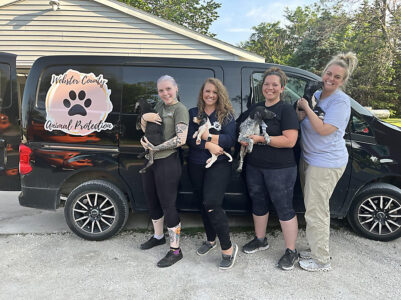
Webster County Animal Protection, with help from Moffitt Animal Shelter and Peace Creek Animal Sanctuary & Rescue, took in 17 puppies from a hoarding situation in Fort Dodge last June. From left are: Haley Studyvin, animal control officer; Kaila Benson, animal control officer and owner of WCAP; Kim Colwell, Peace Creek Animal Sanctuary; and Miranda Peterson, Moffitt Animal Shelter.
-
-
-Submitted photo
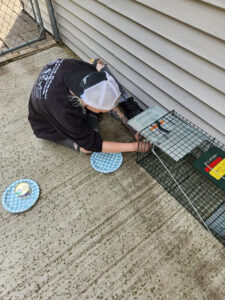
Animal Protection Officer Haley Studyvin sets a live animal trap during a trap-neuter-release operation by Webster County Animal Protection.
-
-
-Submitted photo
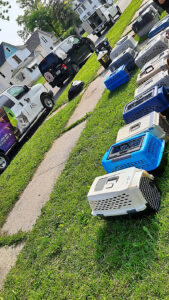
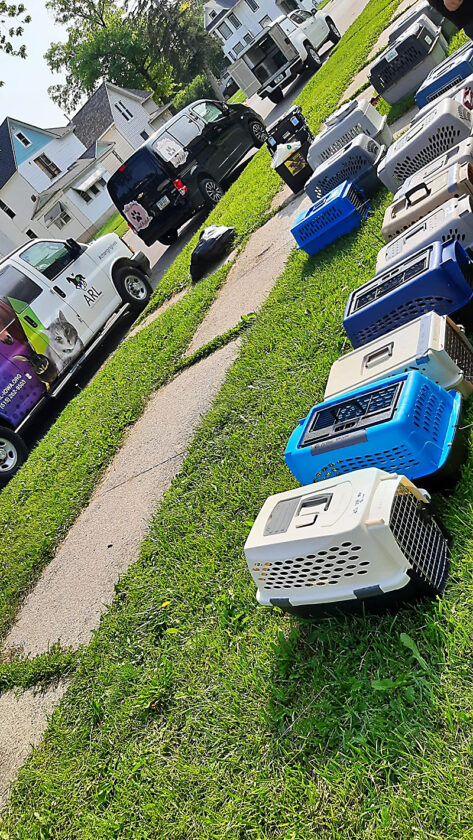
The Animal Rescue League of Iowa assisted Webster County Animal Protection in June with rescuing 14 cats from a home that had already had seven cats taken two weeks prior.
-
-
-Submitted photo
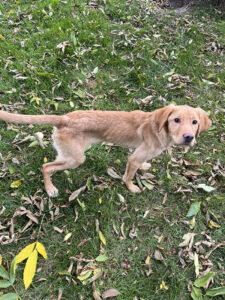
Louis was the first case of an emaciated dog that Webster County Animal Protection handled.
-
-
-Submitted photo
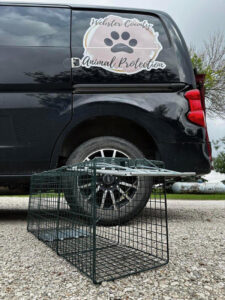
Webster County Animal Protection has several live animal traps for its trap-neuter-release program, which aims to keep the feral cat population low.

-Submitted photo
Webster County Animal Protection, with help from Moffitt Animal Shelter and Peace Creek Animal Sanctuary & Rescue, took in 17 puppies from a hoarding situation in Fort Dodge last June. From left are: Haley Studyvin, animal control officer; Kaila Benson, animal control officer and owner of WCAP; Kim Colwell, Peace Creek Animal Sanctuary; and Miranda Peterson, Moffitt Animal Shelter.
Two years ago, Kaila Benson and her business, Webster County Animal Protection, took over the animal control contract with the city of Fort Dodge and Webster County. In those two years, WCAP has taken more than 5,500 animal calls.
“So I thought this would be a prime time to kind of review what we do, how we do it and some of the stuff that we’ve been working on,” Benson told the Webster County Board of Supervisors on Tuesday morning.
Animal control is more than just enforcing local and state animal ordinances and catching pooches off their leashes, Benson said.
“There’s a lot of situations that we’re involved in that I don’t think people pick up on,” she said.
For example, Webster County Animal Protection assists local law enforcement agencies during search warrants when animals are present and works with the Webster County Attorney’s Office to prosecute animal neglect cases. It also often deals with animal hoarding and backyard breeding operations.
-Submitted photo
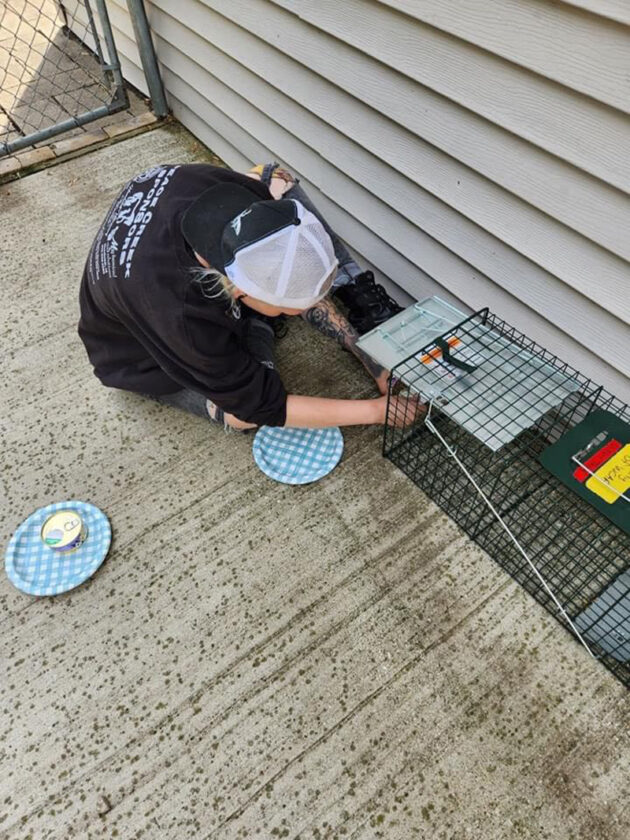
Animal Protection Officer Haley Studyvin sets a live animal trap during a trap-neuter-release operation by Webster County Animal Protection.
In 2022, WCAP received 2,474 total calls, 103 of which were county calls and 780 were not assigned to a specific location.
In 2023, those numbers went down slightly, to 2,154 total calls with 64 county and 627 not assigned. That decrease is attributed to the decision in 2023 that WCAP would no longer handle deer calls.
“We work with domesticated dogs and cats and, though we’ve never actually dealt with ferrets, but we would if we had to, and it didn’t make sense for us to also be hauling and handling these large dead animals,” Benson said.
Over the last year, Benson and WCAP have handled several animal hoarding and backyard breeding cases in Webster County. While WCAP might have fewer county cases, they tend to be bigger cases, Benson said.
“Which means we are pulling resources from anywhere we possibly can,” she said.
-Submitted photo
The Animal Rescue League of Iowa assisted Webster County Animal Protection in June with rescuing 14 cats from a home that had already had seven cats taken two weeks prior.
In Harcourt, WCAP was assisted by the Animal Rescue League of Iowa and Moffitt Animal Shelter, of Humboldt, with seizing 14 dogs from a backyard breeding operation. Puppies were found with at-home “crop jobs” (surgically cropped ears), hookworms and whipworms. The Webster County Sheriff’s Office also assisted in this seizure, Benson said.
In June, 17 puppies were taken from another house and taken to Moffitt and Peace Creek Animal Sanctuary, another small animal rescue near Badger.
In another situation in Harcourt, dozens of animals were seized by WCAP with assistance from the WCSO and the Iowa Department of Natural Resources. In that case, they seized three Tibetan mastiffs, 10 Great Pyrenees, four hounds, more than 100 various birds and one Canada goose. Canada geese must be permitted, which is why the DNR was called to assist.
“So when I tell you that the numbers are far less when it comes to the county, I cannot say they are less work,” Benson said. “They are probably tenfold the amount of work because what we see in the county is so much larger.”
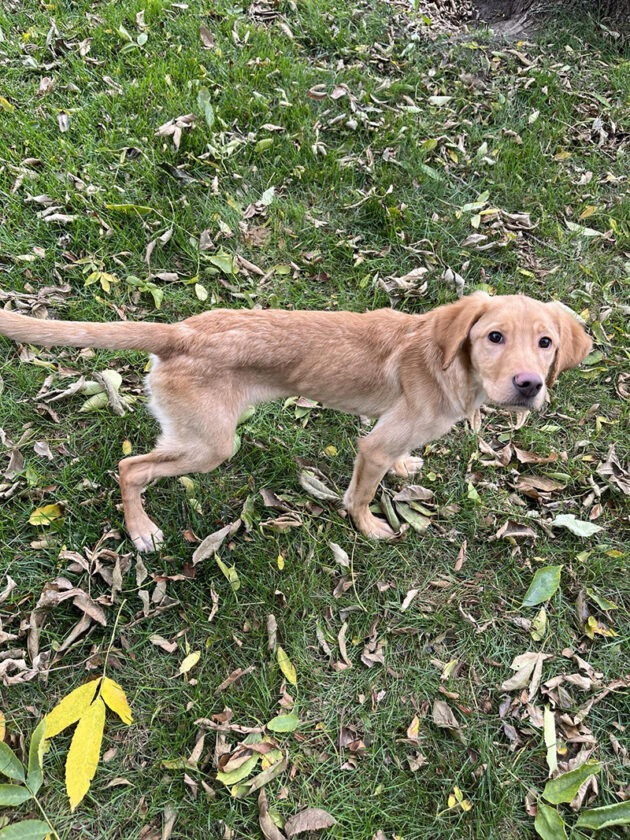
WCAP has also taken care of a few emaciated dogs this last year.
-Submitted photo
Louis was the first case of an emaciated dog that Webster County Animal Protection handled.
WCAP is Level I certified through the National Animal Control Association and Benson has aggressive dog training certification. WCAP has also done on site work with the Animal Rescue League of Iowa.
“We want to be the best, so we decided to work with the best,” Benson said. “The ARL has assisted us in a few big cases, and we’ve learned a lot every time that the ARL comes down.”
Another major concern of the WCAP is the feral cat population in the county.
According to the ASPCA (American Society for the Prevention of Cruelty to Animals), feral cats are not considered domesticated animals, Benson said.
“They are considered wild in the same way that racoons or possums are,” she said. “So that does not put them within the scope of what Webster County Animal Protection will handle. Because I am not someone that just lets problems be problems, we did start a nonprofit for trap-neuter-release.”
-Submitted photo
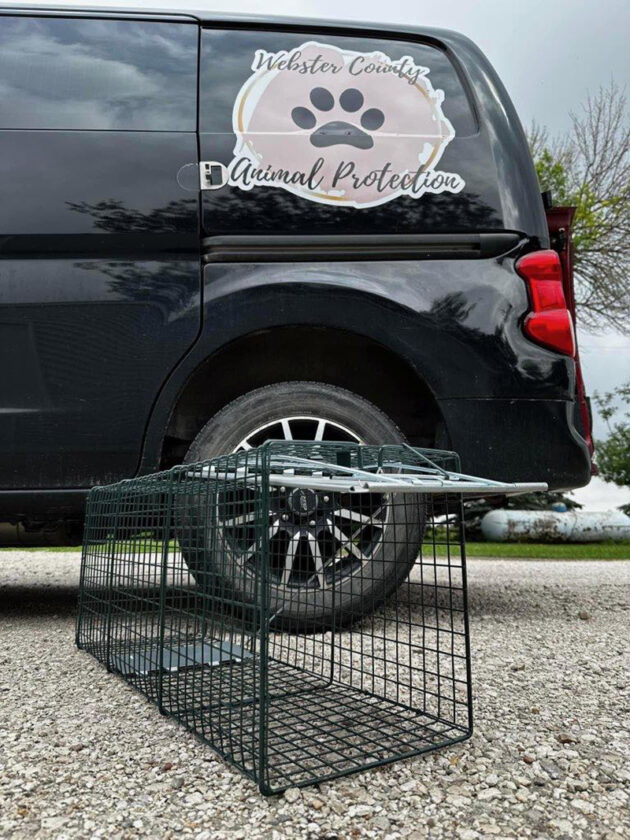
Webster County Animal Protection has several live animal traps for its trap-neuter-release program, which aims to keep the feral cat population low.
Stay Wild TnR (trap-neuter-release) is a new nonprofit started by Benson and WCAP to help contain the feral cat populations in the counties. As the name indicates, feral cats are trapped, taken to a veterinarian to be neutered or spayed and then released back to where they were found.
“TNR, statistics show us, is the only beneficial way to work through a feral cat population in any location…The reason this has been chosen is because cats are territorial,” Benson said. “So we’ll go in, we’ll vet them, we’ll fix them and then we put them back. This prevents any unfixed cats from moving into an area and then as the seasons go by and the cats die off naturally, what you’ll see over time is that population will then extinguish itself.”
The “catch-and-kill” method of trapping and humanely euthanizing feral cats is not as effective, she said, because once a feral cat colony has been taken out of an area, another colony moves in, starting the problem all over again.
Local News
Fort Dodge to Denver flights resume
Flights between Fort Dodge and Denver, Colorado, resumed today. The first United Express flight from Denver ...
Feenstra bill aims to support rural maternity care
U.S. Rep. Randy Feenstra is working on legislation he says will enable small rural hospitals to provide childbirth ...

A GUIDING LIGHT
Supervisors approve speed limit change
The Webster County Board of Supervisors approved updating speed limits on 390th Street and Union Avenue in southern ...
Junk Days on Demand returns
The city of Fort Dodge’s popular Junk Days on Demand program is back for the sixth year, and municipal crews are ...