
Return to Haiti
McCarvilles help Hugues Bastien, who is on a mission
-

- -Submitted photo The school in Haiti run by Hugues Bastien’s Cocina organization feeds around 2,500 kids every day, who might otherwise not get anything to eat. The organization runs a K-12 school, a vocational center, and a hospital supported mostly by charitable donations.
-
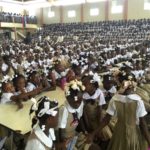
- -Submitted photo Students are seen in the Haiti school founded by Hugues Bastien. The school began in 1994 as a kindergarten only, with 84 students. Today it has about 2,500 students in K-12. After a crew from Fort Dodge and Ames traveled to Haiti to help build a kitchen for the organization next door, Bastien visited Iowa and Omaha meeting with churches and talking about his development work.

-Submitted photo The school in Haiti run by Hugues Bastien's Cocina organization feeds around 2,500 kids every day, who might otherwise not get anything to eat. The organization runs a K-12 school, a vocational center, and a hospital supported mostly by charitable donations.
When scores of people were trying to get out of Haiti, Hugues Bastien was heading back in.
Born in the town of Ouanaminthe, Bastien’s parents had fled the country when he was young, and he grew up and got his education in New York City.
But in 1991, Bastien felt called to return as a missionary, to help the poor. It was a difficult time to live in Haiti — people were still trying to escape political unrest there by coming to America in boats.
“Haiti had elected a president democratically for the first time in history,” Bastien said. “Within seven months he was ousted by a brutal military coup. That’s what has happened, all the boat people,” he said. “You see a lot of Haitians drown as a result. This was the time I wanted to go back to Haiti. So you can see why people thought I was crazy.”
Today, Bastien’s nonprofit organization runs a large school for K-12, a food program for students, a vocational tech training college, a medical clinic, and more.

-Submitted photo Students are seen in the Haiti school founded by Hugues Bastien. The school began in 1994 as a kindergarten only, with 84 students. Today it has about 2,500 students in K-12. After a crew from Fort Dodge and Ames traveled to Haiti to help build a kitchen for the organization next door, Bastien visited Iowa and Omaha meeting with churches and talking about his development work.
Bastien was in Fort Dodge last week to visit with some new supporters and friends. Brothers Joe, Pat and Dennis McCarville, and Dennis’ son Mason, learned about Bastien’s project on a trip to Haiti in August to help build a kitchen for nuns who are feeding poor children.
“It’s not exactly an orphanage,” Joe McCarville said. “It’s more of a soup kitchen. Some of the kids stay with the nuns; most of them go home or sleep on the street. They don’t stay there.”
Bastien isn’t directly affiliated with the nuns, who are from Colombia, but the two neighboring charities respect and support each other, Joe McCarville said.
Bastien organized the crew of Haitian men to provide some of the work.
“Hugues’ men built it,” said Pat McCarville, a contractor with RoJohn in Fort Dodge. “We did the plumbing, electrical, drainage.”
Bastien’s father came to New York City when Bastien was 6, and brought his wife and children to the country over the next eight years.
Bastien finished high school in the city, and got his engineering degree from City College. He became very involved with his church and became a youth leader while there.
Since he didn’t speak English at first, he watched a lot of TV and picked up the language from soap operas.
“By watching so much TV I used to watch a lot of the news,” he said. “That’s where I saw the famine that was in Africa, in Ethiopia. Seeing the children dying of starvation, malnutrition, and somehow that touches me and I felt the call to be a missionary.”
Bastien was only about 15 when he left Haiti, he said, and never realized how dire the need was there as well — it just seemed normal.
“We would eat whatever we found, play with whatever orange or mango we had. It never really crossed my mind that we didn’t have much,” he said.
Bastien had no reason to go back to Haiti until the political situation there temporarily improved, and his parents decided to retire to the country. A few years later he went to visit.
“That’s when I saw the need that I’d never seen before when I lived in Haiti,” he said. “Now that I’d been in the U.S., I was able to compare. What I had in the states — I had a job, I went to school, finished high school, finished college; I had a car, I was making money. Whereas in Haiti most adults never even had the chance to get a job in their whole life, much less own a car, or to know how to drive.”
“I felt like I needed to give back from what I had been given.”
When he chose to move back to Haiti as a missionary, even his church questioned if this would be safe, and his parents thought he was crazy.
“People in the community in Haiti also thought I was crazy. They said you don’t need your passport, give me your passport, I want to get out.”
People wouldn’t believe he would choose to come back; they thought he’d been given a lot of money to move, and then expected to be paid for any kind of project to better the community, he said.
Before he left the states, Bastien created a nonprofit called Cocina — Coalition of Children in Need Association. Its website is haiticocina.org.
Education was the best way to help, he decided, and so he started a school in 1994.
“Because what we see is just like a tree,” he said. “If you have a small tree and you want that tree to go straight, it’s while it’s young you can guide it to grow straight. But once the tree is crooked, it would be very difficult to make it straight. So we figured try to educate young minds, to guide them what they should do in the future.”
The school was just a kindergarten, with 84 students and two classrooms. The idea was, every year he would add a grade.
“Now today, 22 years later, we have 2,500 students in our school,” Bastien said.
The students often didn’t have enough to eat, so after a few years the school began a lunch program.
It started when a youth group from Ohio visited and went back home to hold a fundraiser.
“They did some fundraising at the school, and asked the kids to give up their lunch for one week,” Bastien said. “As a result they raised about $6,000 for the lunch program, and that’s how our lunch program started. Today we are feeding 2,500 kids every single day.”
After this, Bastien’s group started a clinic.
“Today we have 10 doctors and a large facility doing surgery,” he said.
Doctors and medical specialists are brought in from all over the world, and 50,000 people a year come from long distances to access the care.
The clinic employs doctors from Cuba, who are paid $1,000 a month.
“That’s a lot of money for these people,” Bastien said. “Otherwise in Cuba, with it being a communist country, they may get $200 or $300 a month. They feel good about getting away from Cuba too.”
After that, the group started building apartments to host missionaries and doctors who would visit from the states.
As kids graduated high school and needed jobs, they built a trade school. Students who weren’t able to go to college were able to learn skills in auto mechanics, in industrial sewing, in computers, in accounting, in electricity, and solar.
The organization also started a bakery, a barbershop and a chicken farm. The businesses create a few jobs and help raise money for the organization.
“Because we depend so much on outside funding, and when the funding doesn’t come, we find ourselves in trouble,” he said.
With its clinic and school the Cocina organization in Ouanaminthe is the second-largest employer in the region, Bastien said.
The town is located in a demilitarized zone between Haiti and the Dominican Republic. Every day thousands of people cross from the Haitian side to work in a Levis plant just across the border.
“We are the second-highest employer in the region, after Levis,” Bastien said. “They employ 6,500, and we have about 250. So we are not only giving people hope for the future, giving them education, but also giving them a job to take care of their families.”
The Levis workers are paid $5 a day — “and that is five times the average pay of Haitians, or so,” said Pat McCarville. “They think they’re riding high.”
The McCarvilles got involved with Haiti because of their uncle, Chuck Filipi, a retired surgeon who for years put together medical mission trips to the region, Joe McCarville said.
Joe McCarville has been to the Dominican Republic or Haiti, but this was the first trip for Pat and Dennis McCarville.
“We’re not missionaries,” Pat McCarville said. “Joe is. The rest of us are not.”
“He’s crazy,” Dennis McCarville said.
But Filipi convinced them to go, he added.
“It was a moment of weakness,” he joked.
“Chuck asked us to do this, and we’re glad we did,” Pat McCarville said. “To see it is different than just to talk about it.”
His brother wasn’t quite so reluctant in Joe McCarville’s version of the story.
“My brother Pat is a contractor, and he said let’s go down there and build something. What do they need?” Joe McCarville said. “Chuck said they need a kitchen.”
The nuns used to have to walk two or three blocks to their kitchen, he said.
The brothers traveled in August to help build, after raising the money for the project.
“The money was the big thing,” Joe McCarville said.
“These Haitians, this group of six guys that helped us, they are incredible workers,” he said. “It was 95 degrees, high humidity. They worked 36 hours straight. They had to because in order for us to put the electricity and plumbing in, things have to be done in a certain order, and we were kind of stopped until certain things got done. So they worked for 36 hours straight to get it done.”
“We put in 12 hours a day, and we were shot ,” Pat McCarville said. “We left, they stayed there, and when we came back they were still working. I’d like to bring at least six of them back here, I think.”
Some people ask if workers from the states traveling to Haiti does any good, Pat McCarville said. But Bastien’s group is run by native Haitians, and will be there for the long term.
“You have to start with education, I think, and then you can move up the ladder from there,” he said.
In spite of all the money sent to the Red Cross, you don’t see a lot of new buildings going up in Port Au Prince after the recent earthquake, Pat McCarville said.
Bastien said with his group, there is no administration overhead; everything goes to the people.
“Our struggle is mostly to pay the teachers,” Bastien said. “The kids, even though we ask them to pay a small tuition, throughout the year, 50 percent of them are not able to pay. So we depend on, almost 60 percent of our costs have to come from outside, to pay for the school, and also the clinic.”
He said his group is ready and able to put funds to good use even before there is another earthquake or flood to inspire donors.
“They don’t have to wait for a disaster,” he said. “Right here, 2,500 kids are being helped every single day.”
After his stop in Fort Dodge, where he spoke at the First Presbyterian Church, Bastien headed for Omaha.
Local News
Time for a Second Chance
Fort Dodge’s first Second Chance Job Fair, offering employment opportunities to persons with criminal histories, ...
America at 250: Expansion of a new nation started with trip along the Ohio River
Coal, gypsum were key to growth of Fort Dodge
Living on the road
Ready to take on the world
Man gets 125-year prison sentence for sexual abuse
LIVERMORE — A Humboldt County man has been sentenced to 125 years in prison for sexually abusing three juveniles, ...