
Law aids steel mill project
Measure would allow $1.4B in tax incentives
Trending
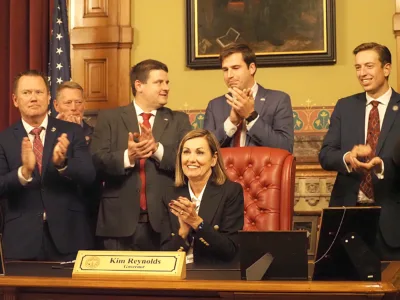
DES MOINES -- Gov. Kim Reynolds signed into law Friday a measure changing a state's economic development program that could provide nearly $1.4 billion in tax incentives for a $15 billion steel mill project planned in southeast Iowa.
"Today, we advance the most consequential economic development project ever to come to our state," Reynolds said.
The governor signed House File 2801 just hours after lawmakers approved the proposal during a special session Friday, convened for the sole purpose of considering the legislation. The Iowa House approved the bill in a 75-17 vote, and the Senate approved the bill in a 28-19 vote. The proposal would modify the state's Major Economic Growth Attraction (MEGA) program to include further incentives for businesses within rural areas, a targeted change to benefit the Mesabi Metallics project planned in Lee County.
At a news conference Monday, President Donald Trump announced the steel plant was a $15 billion project. When operational -- with a goal of 2030 -- the steel mill is estimated to create 1,750 permanent jobs paying an average of $48 per hour, alongside 6,000 temporary construction jobs as the facility is built, state and business officials said.
Rep. Matt Rinker, R-Burlington, said the project would be a major victory for southeast Iowa and was the culmination of years of work from local, state and federal officials alongside Mesabi Metallics.
During his time at the Burlington City Council and as a state legislator, Rinker said he has had thousands of conversations with members of his community about what was needed to bring success to the area. He told the House, "I'm proud to say that what everyone has been asking for has finally arrived."
"Our vote today isn't just about a change to something that already exists, or just about incentives for a steel plant, or just about bringing a new industry to Iowa," Rinker said. "It's about mortgage payments, grocery bills, dance lessons. It's about infrastructure and public safety. It's about opportunities for Iowans and growing our communities while also supporting them at the same time. It's about thousands of new homes. It's about the revitalization of a region of our state that has experienced its fair share of tough times."
As she signed the measure into law, Reynolds thanked "everybody who helped pave the way for this moment," including local southeast Iowa leaders, companies and workers who advocated for the business to locate in Iowa.
"We don't do this without you, so thanks for being bold and believing in this state and believing that in America we build things, and we are really going to build things right here in Iowa," Reynolds said. "And then again, I just want to thank Mesabi Metallics for this opportunity. And we really truly look forward to a very long partnership with them and what this means for our state."
Sen. Dan Dawson, R-Council Bluffs, who voted against the bill, called it the "largest corporate giveaway in the state of Iowa's history."
He also warned the change to the tax incentive program for Mesabi Metallics would influence any future negotiations between the state and companies considering bringing their facilities to Iowa, "because the ceiling now becomes the floor."
"Incentives are supposed to make a good deal better, not a bad deal good," Dawson said. "So to all my colleagues, I know you've been put in a difficult position. And you've been put into position by people and entities who, frankly, do not care. If they did, you wouldn't be jammed with this bill in front of you today."
The bill would allow the Iowa Economic Development Authority to authorize a tax credit for a business up to 10% of the business' qualifying investment in a rural county -- an increase from the 5% tax credit currently allowed under the MEGA program for projects representing $1 billion or more in capital investment.
According to analysis from the nonpartisan Legislative Services Agency, the net impact of changes to the MEGA program's Investment Tax Credit made by the bill would result in estimated revenue decreases to the state's general fund of $575 million from fiscal year 2029 through 2041 -- on top of the $575 million that would come under the current MEGA program structure. The MEGA program's sales and use tax refunds and withholding tax credits are not changed by the legislation, but under the current program, Mesabi Metallics would be eligible to claim $215 million in tax incentives from FY 2028 through 2041.
IEDA Director Debi Durham said this investment will provide greater benefits for Iowa through later revenue to the state, as well as an expansion of jobs and economic value to the region.
"The state's portion on the deal that is before you today (is) a 1 to 5.6% return," Durham said. "So that means for every dollar that we invest as a state, that we get that return back. And when you think of manufacturing, it is the largest part of our gross state product -- there is a multiplier of jobs attached to manufacturing, anywhere from three to five jobs will follow. When you happen to talk about a (project) as complicated as this, and as many investments, the investment being made, it is a 5-to-1 job ratio as well, meaning, for every job that they hire, there's a follow-on job that will occur in our economy."
Rep. Carter Nordman, R-Adel, floor manager for the bill in the House, said the change is not an increased tax incentive for the MEGA program -- created with wide bipartisan support in 2024 -- but a way to combine the two 5% MEGA program investment tax credits that IEDA can currently offer. The IEDA has not previously awarded any MEGA program tax incentives.
"The reality is we are not reinventing the wheel here," Nordman said. "All we are doing is modernizing and combining two existing incentive programs into one, so Iowa is not on the sidelines, but actively competing on the national and global level for large projects. When creating those incentives of packages a couple years ago ... this body could never have imagined the possibility of a $15 billion investment landing here."
Dawson said this was a fundamental misunderstanding of the original intent of the MEGA program -- a measure Dawson said he helped negotiate when it was approved in 2024.
"To be clear, the intent was never 5% plus 5% equals 10%," Dawson said. "And that the intent was never that we throw the entire farm into one basket, and it could be a 'one and done' proposition. We wanted to see this spread throughout Iowa."
Durham told lawmakers increasing the tax credit to 10% was necessary for Iowa to bring the steel plant to Iowa.
"We basically do have to be competitive in the marketplace," Durham said. "So, we look at deals all across the country with this type of industry, and I will say 10% is a national average of what these businesses are getting."
The IEDA director said the states of Arkansas and Kentucky were also competing for the steel mill project, with Arkansas being "our biggest competitor."
Dawson said Senate Republicans were told Arkansas lawmakers were expected to meet in a special session called by the governor to create an offer providing "cash up front" to the company by modifying their state's recycling tax credit and funding the tax credit change by borrowing against the Arkansas teacher pension fund. He said officials who knew about the Arkansas proposal told him Arkansas officials walked away from these negotiations, "because the companies seemed to lack equity and could never locate where the equity would come from and the paperwork that they provided to the state."
"While I respect Governor Reynolds' deep desire to bring a MEGA site to the state of Iowa before her term ends, because she wasn't willing to walk away from this deal, it's my belief she negotiated against herself," Dawson said. "Because Arkansas, I do not believe, was ever actually at the table seriously. And by negotiating against herself, she negotiated against the Iowa taxpayer."
Durham also emphasized the bill is written to ensure the state will not provide tax incentives to the Mesabi Metallics if the project is not completed. The measures states the tax credit will not be issued to a business until the business begins operations, or until "a designated portion of the project" has been placed in service, and until at least half of created jobs -- which must meet a qualifying wage threshold -- associated with the project or a designated portion have been added to the payroll. The legislation also states the 10% tax credit will be remitted over the course of a decade.
Some Democrats had questions about portions of the bill which allow the tax credit to be transferred to another person or entity. During the House subcommittee meeting on the bill, Jacoby shared concerns from a constituent that the state would not be able to claw back tax credits "against the buyer if the project goes wrong" -- a statement Durham said was incorrect.
"We will have not only oversight into the transferability, we will have approvals over the transferability, and so that is not correct," Durham said. "We will be fully protected even with the transferability."