ISU Soil Machine Dynamics Laboratory: FROM IOWA TO THE MOON
ISU team tests equipment that will help NASA harvest water from the moon
-
-
-Submitted photo
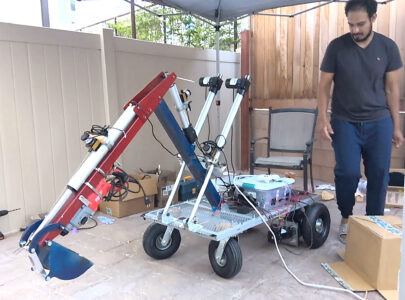
Zamir Syed, who graduated from ISU with his doctorate in 2017, preps for an autonomy test. He has teamed up with Paul Schafbuch, professor of mechanical engineering at Iowa State, and Mehari Tekeste, associate professor with the department of agricultural and biosystems engineering at ISU, to determine which size of a chisel could be successfully used by the U.S. National Aeronautics and Space Administration to bust through the icy, rough terrain of the moon to reach the water.
-Submitted photo
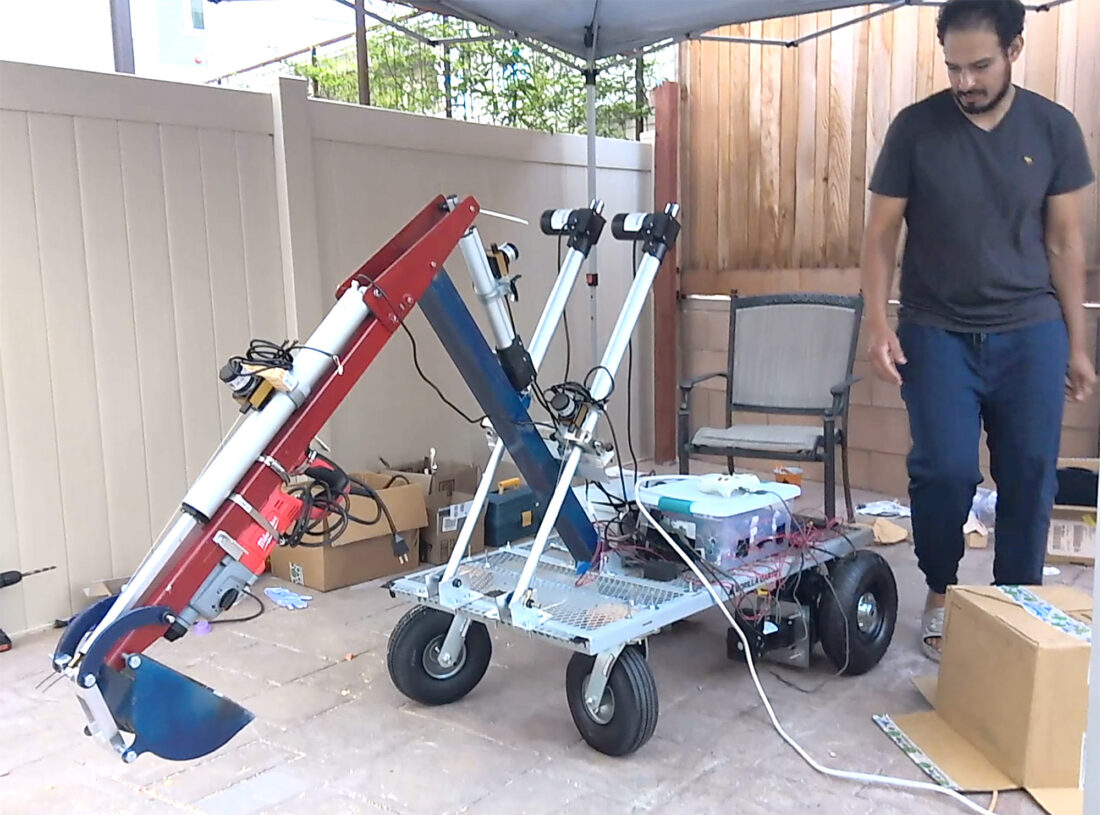
Zamir Syed, who graduated from ISU with his doctorate in 2017, preps for an autonomy test. He has teamed up with Paul Schafbuch, professor of mechanical engineering at Iowa State, and Mehari Tekeste, associate professor with the department of agricultural and biosystems engineering at ISU, to determine which size of a chisel could be successfully used by the U.S. National Aeronautics and Space Administration to bust through the icy, rough terrain of the moon to reach the water.
An Iowa State professor and former grad student have helped NASA discover how they could harvest water from the moon.
Mehari Tekeste, associate professor with the department of agricultural and biosystems engineering at ISU, also is director of the Soil Machine Dynamics Laboratory at Iowa State. At the ag lab, innovative science is applied to problems with an end goal of reaching a solution. Tekeste works with ISU students, industry leaders and government agencies to better understand interactions between machinery and soil resources.
Projects tackled with the technology available at the lab include wear-testing equipment design and researching levels of soil compaction from ag tires. It’s the only lab in North America that can perform accelerated weight tests. It also allows researchers to carry out tests in a replicated environment in Iowa’s winter when the fields are frozen.
One of Tekeste’s first grad students, Zamir Syed — who graduated with his doctorate degree from ISU in 2017 and owns Singularity Solutions in California — teamed up with Paul Schafbuch, professor of mechanical engineering at Iowa State, and Tekeste to determine which size of a chisel could be successfully used by the U.S. National Aeronautics and Space Administration to bust through the icy, rough terrain of the moon to reach the water.
Syed’s company landed the grant.
“In 2020, there was confirmation that molecular water existed on the moon through NASA’s Stratospheric Observatory for Infrared Astronomy (SOFIA),” Syed said. “It detected the first confirmed physical water molecule in a summit region on the moon that wasn’t bound into a block of frozen mud. They’re estimating there’s millions and millions of gallons of water on the moon.”
The NASA-funded study predicted wear rates for a chisel to harvest the water trapped in icy regoliths, which are layers of unconsolidated rocky material covering bedrock.
“I looked at it from the eyes of what tools do you need firstly. If the ground is aggressive, you have to go with a vehicle that doesn’t fail. The plan for Artemis 3 is to use a vehicle with a payload of 1,760 pounds payload. If it ended up being chisels that they would take, you can’t take a lot of the tools to the moon, so we have to provide them with exactly what they need,” Tekeste said. “You also can’t go back and get more tools.”
Scientists have discovered that icy regolith in permanently shadowed lunar craters are ideal to be excavated to support what’s called “in-situ resource utilization” for the Artemis missions. In-situ resource utilization is the harnessing of local natural resources at mission destinations, instead of taking all needed supplies from Earth, according to NASA.
“To excavate on the moon, we didn’t know how many chisels to take with us, what type of fueling to take, so we needed to perform these tests to determine that, to mine X kilograms of water, you need to take Y number of chisels to the moon with you,” Syed said.
Tekeste explained that the lunar regolith is abrasive and damages machine elements that interact with it. The team used a bin of special soil Tekeste’s team developed that simulated characteristics of the moon’s surface conditions. They had to replicate in the lab the extreme temperature fluctuations and rocky, icy terrain the chisel tool would experience when on the moon.
Data from the tests helped validate modeling to predict how the tool would wear, how long it could be expected to operate and how many of the tools would be needed. They studied specifically how a stainless steel pin held up against two compositions of icy granular soil.
Their results were highlighted in a recent issue of Earth and Space on Engineering for Extreme Environments.
But how are these results being used in real time?
“There are technologies NASA is developing that use heating elements to take the icy mud, dry it out, then collect the water vapor and turn that water vapor into liquid water,” Syed said. “They need to be able to start habitation on the moon, and there are grand plans to build these habitats, similar to a very small village, and need to provide sustenance for people, including drinking water. They’re also looking at using the moon as a refueling station where researchers can load up on fuel and much more easily get to Mars, Jupiter or one of Saturn’s moons.”
Tekeste said that in a year or two, NASA plans to send a lunar vehicle to the moon to try and harvest water.
Iowa State continues to work with NASA on projects involving space exploration and the moon. Currently, Tekeste is part of a multi-institutional group reviewing specs of mobility studies on extreme deformable surfaces for a new autonomous vehicle that is part of NASA’s Artemis mission for Mars exploration.
“There’s no AAA on the moon, so if a tire fails, what do you do? The goal with this next project is for the vehicle to be on the moon for 10 years. It needs to be tires that can handle the terrain there,” Tekeste said. “The moon is very, very aggressive and you have the change in temperature, plus the terrain, so I doubt it’ll be rubber.”
Syed added that the material of the tire has to be invulnerable to the extreme environments of the moon, so it can’t be a rubber or regular polymer that would degrade in the radiation environment.
“You also can’t use regular steel, because it becomes affected by the radiation. So you have to look at a small group of materials you can use that would survive the environment,” he said.