Beth Doran: A Hall of Fame career
Doran honored for longtime work in the beef industry
-
-
-Photo courtesy
of Iowa State Extension
Taking a walk in the pasture (above) is just one benefit of a long career in the beef industry for Beth Doran. The retired Extension beef specialist was recently inducted into the Iowa Cattlemen’s Association Hall of Fame.
-Photo courtesy
of Iowa State Extension
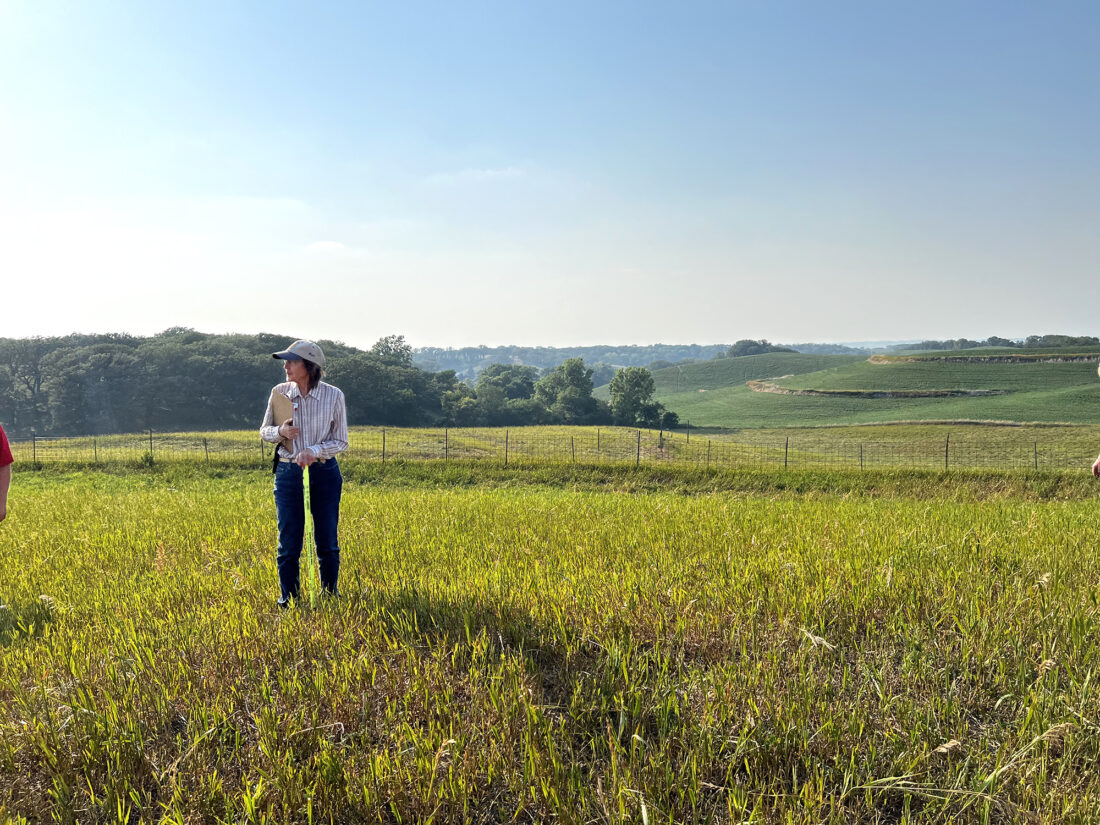
Taking a walk in the pasture (above) is just one benefit of a long career in the beef industry for Beth Doran. The retired Extension beef specialist was recently inducted into the Iowa Cattlemen’s Association Hall of Fame.
There is something about a spring day, one where the ditches still hold some snow, but the first new calves of the season are finding their feet on the ground that is finally warming.
Beth Doran has seen her share of new calves and has spent decades working to keep the Iowa beef industry on solid ground.
In a lifetime of working in the cattle industry and on behalf of Iowa State University Extension, Doran has never grown tired of promoting the producers who put beef on the table for the state and the nation. She knows very well that raising cattle can sometimes be a struggle, but she holds firm to the belief that it’s all worthwhile.
“There’s a sense of accomplishment and a sense of adventure,” Doran said. “No matter how long you’ve been in the livestock business, and with whatever species you work, you always learn something new and no two days are ever alike.”
Recently retired from Iowa State University Extension, Doran was honored this winter by the Iowa Cattlemen’s Association (ICA) when she was inducted into the ICA Hall of Fame. It was an unexpected honor for a woman who has devoted her career to the beef industry.
“It was totally unexpected,” Doran said of her induction into the Hall of Fame. “It was almost overwhelming because there are so many people out there so deserving. It was quite an honor for me.”
A 1971 graduate of Ogden High School, Doran grew up helping with just about every job on the family farm near the tiny Boone County town of Beaver. At Iowa State University, she chose what was then a very traditional major for young women, earning a bachelor of science degree in home economics education in 1975, back when it was still called home ec.
Her first stint with Extension began soon after, serving in a 4-H and youth position in Bremer and Chickasaw counties from 1977 through 1981.
The degree in home economics education would be only the first step in a career path that would be anything but traditional.
“I have two B.S. degrees from Iowa State,” she explained. “I went back and finished a bachelor’s degree in animal science in 1981.”
By that time, more women were starting to enter the field, but she was still a trail blazer. She would also become a life-long learner. Her next step would keep her in what was then the Big 8 Conference, earning both a master’s degree and then a doctorate in animal science and animal nutrition from Oklahoma State — but she certainly remained a Cyclone at heart.
Doran expanded her horizons further, becoming part of the Big 10 when she joined Michigan State University Extension as a livestock specialist. Nearly five years later, she returned home to Iowa and ISU Extension. Since 1993, Doran has served as Extension’s beef specialist in the state’s busiest livestock area, including 17 counties in northwest Iowa.
“I was based out of Sioux County, the largest county in Iowa for cattle being fed on feedlots,” she explained. “The numbers have gone down, but at one time Sioux County fed about 500,000 head of livestock annually.”
That’s a lot of beef, a great investment for producers, both financially and in terms of time to feed out a beef animal and get that fresh steak, juicy roast, or hamburger on the table for Americans.
“I think producers are passionate about their work,” she said. “You have to be, or you wouldn’t want to be out there on some of the winter days that we have, and face all of the challenges, or go out on summer days and work. Our farmers and producers have had some big, weather-related challenges over the last four years.”
For Doran, whether she was working with kids in the 4-H and youth programs, or serving producers as beef specialist, education was the common theme of her career.
“I guess the biggest focus was the age of the producer,” she said. “Whether you’re teaching kids or adults, the basic principles don’t change. It’s just how you deliver it.”
While animal health and nutrition were a few of her advanced specialties, she also kept her interest in home economics alive as part of her career focus.
“Maybe because I had a home ec background, one of the things I got into, especially with people who didn’t have a farm background, was spending a little time talking about how beef animals are raised,” she said. “I wanted to help them understand what we do.” Helping the public as consumers know about the beef they were purchasing has also been an important goal.
“I would spend a lot of time on the consumer end, helping people know how to pick out a good piece of beef, and the right cut of beef for what they wanted to do,” she explained.
Beef, she would explain, can be a part of almost any health-conscious diet, simply by tailoring the right cut with the health needs of individual consumers.
“Beef is very nutritious,” she said. “If people are on a fat-conscious diet there are different cuts that are leaner.”
Grass-fed beef is often leaner, while corn-fed beef offers a tender, robust flavor. As for Doran, she knows what she likes.
“I like to go with a product that’s fresh, with a bright red color, and then I look for marbling, little flecks of fat in the lean meat,” she added.
Over the years, Doran has also offered programs where she will cook up the different USDA grades of meat so that consumers can know what those grades mean, both in taste and quality.
“I would cook the different quality grades, select versus choice; different kinds of hamburger, blends of fat versus lean, and help people see the difference and how that affects what you want to do with it.”
Working with consumers has been rewarding, but Doran has clearly enjoyed her time with producers and empathizes with the different challenges they face in the beef cycle.
“The big problem with the whole industry right now is that we have the smallest cow herd since back in the 1950s, so consequently we don’t have as many calves, and that means we don’t have as many animals in the feed yard,” she noted.
Beef animals are a long-term investment for producers, and that affects the number of cattle on feed.
It’s the age-old issue of supply and demand, which can lead to higher prices up and down the food chain, she noted.
“It makes for high-priced calves in the feed-yard,” Doran said.
The challenges may be great, but they are not really new. Doran remains an optimist, just like every producer when the first calf hits the ground in springtime.