
Dennis Lawler to fellow seniors: Don’t wait for tomorrow to make critical living decisions
Trending
“I can’t think about that right now. If I do, I’ll go crazy. I’ll think about that tomorrow.”
Scarlett O’Hara was referring to her beloved plantation Tara and winning back Rhett Butler in these closing lines from “Gone with the Wind,” but to Fort Dodge native and author Dennis Lawler, that famous quote well describes the attitude many of his fellow seniors take when considering the next levels of care they someday may need.
Aging in place or moving into a retirement community? Let’s think about it tomorrow...well, maybe the tomorrow after that...or the tomorrow after that...
Lawler would like to change that attitude – or to at least get seniors to think about and understand the pluses and minuses of the decisions they make, perhaps the most vital in their lifetimes, and do so when they're not in a crisis situation.
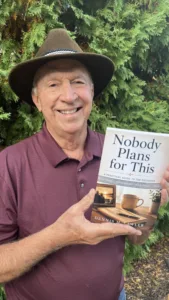
In the 242 pages of his newly released book “Nobody Plans for This”, available on Amazon both in print and Kindle versions, he presents a practical guide “to the decisions that will define your final chapter.”
"It analyzes a real problem," Lawler said, "first starting with the Baby Boomers and continuing forward. Earlier generations usually measured the span between retirement and death in years. Our generation is measuring it in decades. That’s not because we’re retiring earlier. It’s because we’re living longer, much longer, than our parents and grandparents did. That’s usually regarded as good news, but when you factor in the rising cost of elder care, lack of availability of familial care, and the realization that Medicare hardly covers any of those services, a stroke, a broken hip, or an Alzheimer’s diagnosis can quickly become a family crisis and a financial catastrophe that comes out of left field without warning or preparation."
"Longevity has been a blessing or a curse. Hope for the best, and plan for the worst."
This year, those in the Baby Boomer generation have been reaching 80 years of age and many of them lucky enough to be in good health would rather not think about the "tomorrow" that Scarlet O'Hara believes is always just around the corner. As the years pass, those tomorrows are no longer there. Reality sets in, sometimes not so kindly.
"Nobody plans for the day a parent can no longer safely live alone," Lawler said. "Nobody plans for the moment a spouse’s health changes in an instant, or for the phone call from a sibling who has finally run out of options. And yet nearly everyone will face some version of this crisis -- unprepared, overwhelmed, and forced to make consequential decisions with little time to think clearly."
Lawler, 81, who lives with his wife, Sue, in northwest Arkansas where they're on the waiting list for a retirement home there, has spent years studying the elder care landscape that most people discover only in an emergency -- from aging in place and hiring help, to the sometimes confusing, high-stakes world of continuing care retirement communities. He has toured dozens of communities across 11 states, built his own actuarial financial model comparing three real communities, and distilled what he’s learned into a guide that is equal parts compassionate and rigorous.
The book walks readers through the decisions that matter most: what Medicare will and won’t cover, the limitations of long-term care insurance, and what impact ever-increasing longevity will have on future elder care costs. Depending on the choices a family makes, the book shows readers how to run those numbers for themselves -- not someone else’s.
Lawler said the book is not intended to tell a reader what to do, but rather to provide the tools, the vocabulary and the financial clarity to make their own decisions -- while there is still time to plan. He encourages friends to visit prospective communities and get on waiting lists of those they find appealing, and to consult a retirement adviser and an attorney before making a decision.
"My advice?" said Julie Thorson, president/CEO of Friendship Haven. "Don’t wait until you have to make a decision to start thinking about one. Give yourself the gift of choices and give those who love you the peace of mind that comes from knowing what matters most to you.
"I’ve been part of the aging services field for over 25 years, and if there’s one thing I’ve learned, it’s that making decisions about how and where you want to live is much easier when you’re making them on your own terms rather than in the middle of a crisis. In my experience, waiting until something happens, often a health-related issue, rarely makes the decision easier. In fact, it usually makes an already stressful situation even more complicated. When health concerns become the primary focus, there’s often little time or energy left to thoughtfully consider where to live, what options are available, or what might be best for the future. Add the possibility of moving from a longtime home into that situation, and things can get messy pretty quickly. Not to mention the responsibility that can fall on a spouse or adult children."
Mick Flaherty moved into Friendship Haven several years ago, after the death of his wife, Alyce, and advises friends to "take the time to plan."
He said, "Talk with your spouse and children before a crisis arises. If a diagnosis such as dementia or another debilitating condition occurs, the responsibilities and decisions that come with it can place a lot of tension on your family, especially when they are also raising children of their own. Planning ahead is one of the most thoughtful gifts you can give your loved ones."
Tracy Trotter, administrator of the Marian Home and Village, agrees - and believes one of the first considerations is financial planning.
She said, "Understanding current and future expenses, evaluating available resources, and determining what is affordable over the long term are important steps. It is equally important to consider current health care needs and how those needs may change over time. Choosing a community that offers the right balance of independence, support, and access to services can provide peace of mind for both individuals and their families."
Trotter said questions to ask include:
Does the community regularly raise rates and what is the percentage of increase and how often?
Does the community offer different levels of care and what is the process in moving between levels of care?
If moving with a spouse, are there discounts?
Which is more financially smart – can I stay in my home for the same price?
How much does in-home care cost?
When unsure and if getting on waiting lists is free, get on as many as you can of places you are considering. Sometimes a wait could mean years.
Her other points of advice: ask to look at activity calendars, tour the facility without an appointment, ask about staffing and check the website Nursing Home Compare which tells of survey results, staffing and other important items.
Many seniors would prefer to age in place, in the familiarity of their own home where memories, traditions, friendships and a sense of independence abound.
"Moving to a retirement community," Thorson said, "doesn’t mean giving up your independence, your lifestyle, or the relationships that matter most to you. Those things can absolutely continue. In fact, you may discover even more opportunities to build friendships, stay active, try something new, and enjoy life without the responsibilities of home maintenance and upkeep.
"Over the years, I've reconciled myself to the fact that living in a senior living community isn't for everyone. While I personally believe in it without hesitation, I stopped trying long ago to convince people that living in a community like Friendship Haven is the right choice for everyone. But there is something I have come to believe without hesitation: connection matters greatly in how we age.
"There is an important distinction here. Living alone does not necessarily mean being lonely. Many people live alone and have wonderfully connected, full lives. But when being alone becomes isolation, and when we lose meaningful connections, it can affect us in powerful ways. And this isn't just about how many people surround us. It is about how we live. Having people who know us, places where we belong, and reasons to get up and engage with the world matter."
Lawler was born and raised in Fort Dodge, the son of George and Beatrice "Bea" Lawler. They had five children - Peg (who now lives in Kalamazoo, Michigan.) and Dennis, and three younger siblings who are now deceased: Bob, Mary and George Jr. During World War II, Lawler's father was flying reconnaissance in France when he got word in early December 1944 of Dennis' birth.
Lawler said, "I'm told that the celebration of my birth was a little over the top as my father was told to land his aircraft ASAP, because a party was about to begin."
After the war, his father returned to his former job with Swaney Oil Co. which he purchased with Harold Rice.
After graduation in 1963 from St. Edmond High School, where he excelled in football, basketball, track and baseball (and also proudly played for the Fort Dodge Demons baseball team), Lawler attended Iowa State University in Ames and earned a Bachelor's degree in electrical engineering. He served two years in the Army and later earned an MBA in Finance from the University of Wisconsin-Milwaukee.
Lawler spent nearly 40 years in the energy industry, working across the full spectrum of the business in Milwaukee, Chicago and Pittsburgh. He started in regulated utilities, moved into bulk energy marketing and trading, and spent significant time in the pipeline industry. Over the decades, he held executive positions in finance, human resources, and business development. He retired in 2005.
"Retirement gave me the time to do what many people only talk about--write the books I'd been carrying around in my head," he said.
"Canadian Reflections" (2019) was a memoir of 35 years of fishing adventures at Rowan Lake Lodge, in Ontario, Canada. Then came "Hickory" (2020), a biography of a living legend he met in Arkansas. In 2022, he turned to fiction with "Black Start," an energy industry thriller; a retirement guide, "Sorting Out Retirement Community Options" (2023), and more recently "Arbitrage," a historical novel that traces the thread from the collapse of Enron to the Russian invasion of Ukraine.
Asked how a guy with degrees in engineering and business got into self-publishing books, he replied: "It’s simple. In undergraduate school at Iowa State, I was fairly active in extracurricular activities, including being the editor of a monthly magazine called The Iowa Engineer. I didn’t write a lot of the material we published, but I read all of it and edited most of it. Most engineers have little interest or aptitude for that, and most financial number-crunchers care more about spreadsheets than syntax. But I found that sometimes being a round peg in a square hole (or is it the other way around?) can sometimes open doors, at least for me, that might otherwise have been closed."
Dennis and Sue met at Iowa State and they have been married for 58 years. They are parents of three children – David, who lives with his wife OraLee near Mt. Hood, Oregon, and Julie, who lives in Fayetteville, Arkansas., with her daughter Mariah. The Lawlers’ son Brian died in 2011 at the age of 38 and is survived by three children – Gwen, Keira and Owen who live in Indiana.