
Jerry Fitzgerald’s life a study in resilience, determination
-
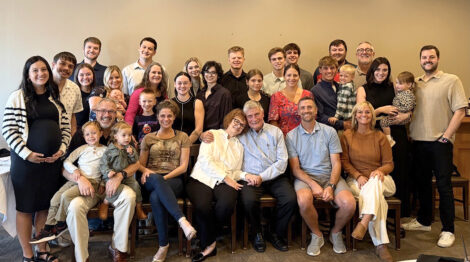
-
—Submitted photo
Family photo that was taken in 2025 at the 50th wedding anniversary of Jerry and his wife Shari.
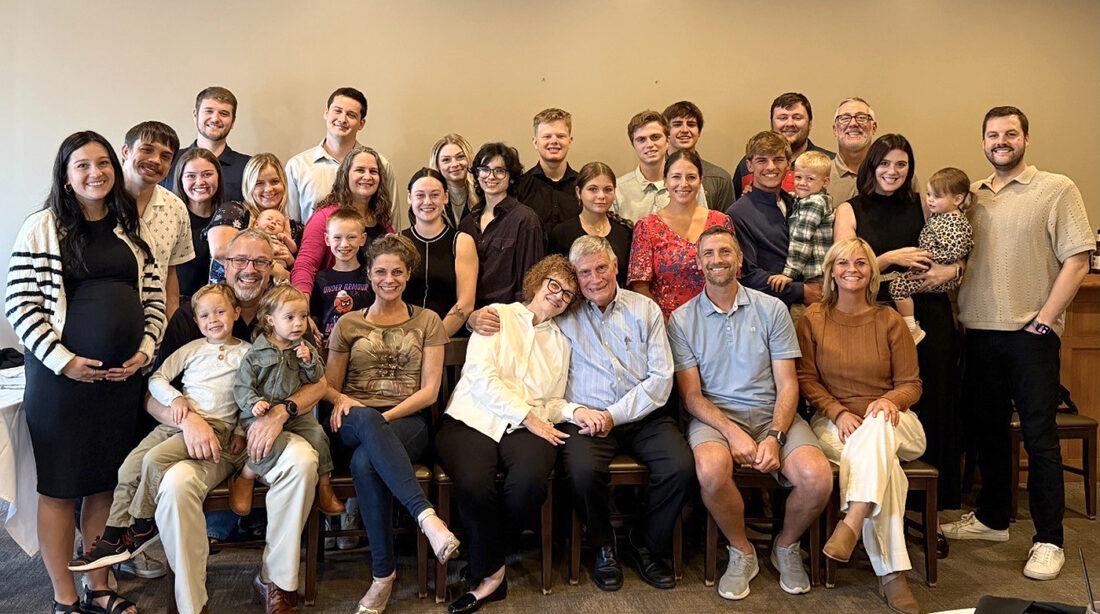
—Submitted photo
Family photo that was taken in 2025 at the 50th wedding anniversary of Jerry and his wife Shari.
Despite the passage of seven decades, Jerry Fitzgerald remembers the scene as if it were yesterday.
He was 13-years-old, an eighth grader at Corpus Christi School, and the scene was a tiny second-floor apartment above Anvers restaurant in downtown Fort Dodge where he lived with his dad and three younger brothers — Jim, Tom and Dan — and their grandmother, who was tasked with staying with the boys while their dad, Cliff Fitzgerald, was at work at the Tobin meat packing plant.
“We brothers fought a lot, not in a negative way — just four young, rambunctious boys,” he said. “The youngest three were fighting on the floor and I broke it up, and I remember telling them this:
‘We are luckier than most kids. We have had experiences most kids don’t have. Lucky, because we’ve learned things about life.'”
His memory flashed back to six years earlier, in early 1948, when their mother, Virginia (Pink) Fitzgerald, died at Mercy Hospital at the age of 32 while giving birth to a daughter, who also didn’t survive. Their dad eventually believed he had no choice but to place his four young boys — ages 7, 6, 5, 4 – in a Sioux City orphanage while he went to work at Tobin.
On the day in March 1949 when they were about to make the drive to St. Anthony’s Orphanage, a distraught Jim ran back into their house and climbed onto the roof and wouldn’t move until his dad talked him into going. What did his dad tell him to get him to come?, his brothers asked him at the time. “It’s a secret,” Jim told them, but years later he said his dad promised he would get them back. The boys were at the orphanage for four years and three months before he kept that promise and reunited with his sons in Fort Dodge.
Resilience may be the proper middle name for Jerome D. Fitzgerald.
Like his younger brothers, all now deceased, he survived and he thrived. He attained advanced college degrees, served in the Peace Corps in Bolivia, was elected to the Iowa House of Representatives and became majority leader, was the Democratic nominee for Iowa governor in 1978 and lost to incumbent Robert Ray in the general election, and served 45 years as a successful lobbyist in Des Moines, from 1985 until he retired about five years ago.
Now, he provides occasional advice and counsel to his son Matt and to his daughter Maggie and her husband Jeff Smith, who operate the lobbying firm Fitzgerald, Smith & Associates, located in Des Moines.
“I believe my dad’s success in life stems from the challenges he faced in his early family,” Maggie Fitzgerald Smith said. “He possesses a kind soul and a competitive mind, and I believe everything he has accomplished was driven by a sense of service. Even during his lobbying career, he was deeply committed to advocating for good legislation for his clients.”
Jerry Fitzgerald and his wife Shari (Bridgford), who met in January 1975 during his first year as House majority leader, celebrated their 50th anniversary last year and have lived in the same house in Fort Dodge since they were married.
They have four children — Jamie, who worked as a Senate Democratic staffer at the Capitol and later joined Mike Mauro as his deputy Polk County auditor (since 2007, Jamie has served as the Polk County auditor); Molly, who became a licensed practical nurse and works at a nursing home in Des Moines; Matt, who worked in Illinois politics while his wife was in chiropractic school and later returned to Des Moines to join the family lobbying firm, and Maggie, hired by her father for a three-month internship at the firm in 2003 and, she says with a laugh, still working there 23 years later. All four are St. Edmond High School graduates.
Fitzgerald graduated from St. Edmond in 1959 and earned an Associate of Arts degree from Fort Dodge Junior College (now Iowa Central Community College). He received a bachelor of science degree in civil engineering at Iowa State University in 1964 and joined the Peace Corps, serving in Bolivia until 1966. He then went to the University of Missouri to obtain a master’s degree in community development, working summers to pay for school by doing roofing work with two of his brothers. He left school for a year to work with Iowa Democrats on the 1968 election campaign which included Harold Hughes’ election to the U.S. Senate. He then returned to graduate school at Missouri to get his master’s.
His brothers, who also were St. Edmond graduates, also did well.
Jim graduated from Iowa State University with a bachelor’s degree in electrical engineering. He worked briefly in the Quad Cities and, with his wife Judy, moved to the Minneapolis area where he worked in the tech world with Guidant, a health care tech equipment manufacturer bought out by Medtronic. He and Judy had a daughter Susan and a son Patrick. Jim died in 2011 at the age of 68.
Tom joined the Army out of St. Edmond with his final assignment in Japan. He returned to Fort Dodge where he worked in politics including managing a gubernatorial campaign and working in a presidential campaign; he was executive director of the Polk County Democrats in 1972. In Fort Dodge he opened “Dirty Nellie’s Deli” later known as the “Stadium.” Tom operated a home remodeling business over the last 25 years, in Fort Dodge, Paton and Des Moines. He died in 2011 — a month before Jim – at the age of 66.
Dan joined the Navy after graduating from St. Edmond, where he was a standout point guard on the basketball team, and his final assignment was on an aircraft carrier in the Gulf of Tonkin. He then completed a degree in business at the University of Northern Iowa and went to work at the State Bank (First American), then at Horn Industry and was recruited to Colt Industries in Illinois. He and his wife Theresa had a son, Michael. Dan died in 1981 at the age of 36.
Jerry Fitzgerald got the politics bug when John Kennedy came to Fort Dodge in 1960 during his presidential campaign.
“I was in the crowd during his downtown parade and I was captivated,” he said.
Fitzgerald was playing football that fall and with a teammate helped out a local candidate by going door to door to get out the vote.
“I was interested enough to do that,” he said.
In his first year at community college, “I was emotionally connected with farming,” he said. When his dad started work at Tobin and then Hormel, Fitzgerald worked there for three summers on the “extra gangs” to pay for college. The work was challenging.
“This is why I am going to college, I remember thinking that,” Fitzgerald recalled.
1968 was a watershed year for Fitzgerald: The death of his father. The assassinations of the Rev. Martin Luther King Jr. and Robert F. Kennedy. Watching Kennedy’s funeral on television, he said, “I remember thinking, if he can give his life for his country, then I can volunteer to get people elected.”
He got his first opportunity with the state Democratic Party. He was a consultant in the campaign of Edward Mezvinsky for Congress in the First Iowa District in 1970, played a major role in the election of the Rev. Walter Fauntroy, worked for Rep. John Culver and then worked on the McGovern presidential campaign committee in 1972.
“People kept calling me to run or help out in campaigns,” he said. “I was hooked, I just did not know I was hooked.”
In April 1972, while still on the McGovern campaign, Fitzgerald announced he would run against Rep. Vincent Mayberry, D-Fort Dodge, in the House 46 Democratic primary. He won the primary and then won the general election and began his six-year legislative career. After only one term in the House, Fitzgerald was elected majority leader in 1974 and was re-elected to that post in 1976.
A fellow member of Fitzgerald’s freshman class in the House was Terry Branstad, a Republican, who later was elected as the 39th and 42nd governor of Iowa (1983–1999; 2011–2017) and was appointed by President Trump to be U.S. ambassador to China (2017–2020). Branstad is the longest-serving governor in U.S. history.
“I had such a good working relationship with Jerry during our service in the Iowa House of Representatives,” Branstad told The Messenger. “As House Majority Leader, Jerry was very fair to me as a member of the minority party. Jerry was always great to work with because he understood that compromise was important and vital to moving Iowa forward. It was refreshing to have someone like Jerry ready to be fair and respectful. I always appreciated that courtesy and work ethic.”
Fitzgerald’s career as a lobbyist began in 1985. And only a year later, one of his early lobbying campaigns really hit close to home. He helped lobby for passage of the law requiring use of seatbelts. Before the measure became law, Fitzgerald’s wife and son were involved in separate car accidents. They were saved from serious injury, thanks to wearing seatbelts.
“My dad played a crucial role in the success of Iowa’s community colleges,” daughter Maggie said. “He has represented several clients for years, including the Iowa Corn Growers Association, the Iowa Pork Producers Association, Broadlawns Medical Center, and the Iowa Chiropractic Society. While mom was active in the political world, she did not participate in the lobbying side of things.”
Fitzgerald’s longtime friend Richard Stark said, “Jerry has been a dedicated advocate for the city of Fort Dodge. Often working quietly behind the scenes, he has made a lasting, positive impact on the community.
“One of Jerry’s most significant contributions was his leadership in reviving the Brushy Creek State Recreation Area project and helping guide it through the state Legislature. Working alongside then–Speaker of the House Don Avenson and Janet Adams of Webster City, he played a key role in securing the funding necessary to bring the project to life – something that had stalled for years prior to his involvement. By leveraging relationships and calling in support, Jerry helped move the effort forward when it mattered most.”
Former Iowa state Sen. Jim Kersten agreed with Maggie Smith’s assessment of her dad’s contributions to Iowa community colleges.
“My time working with him while working at Iowa Central on community college issues and funding was most memorable,” he said. “He had a passion to helping former state Sen. Jack Kibbie make Iowa community colleges some of the best in the United States. He got a lot done while representing all 15 Iowa community colleges, and the system will benefit for years to come.”
Kersten added, “Jerry always supported and reached out to me, first, when I worked for Gov. Branstad, and while in the Iowa Senate and ever since. He understood the value of bipartisanship and to agree to disagree. He was one of the most detailed and thorough lobbyists I have dealt with. His attention to detail was the best and he was the easiest, but intense lobbyists to work with. He always has Fort Dodge and Iowa progress as a priority”
Another of Fitzgerald’s longtime friends, Bob Bocken, former executive with Farner-Bocken Co. of Carroll, recounts a recent lunch in which Fitzgerald told him, “I remember you were one of the first who sent me a $50 check when I first ran for office.” Said Bocken, “That shows you how humble, what kind of person he is, that he would recall that all these years later. He’s just a good solid person, he genuinely cares about people.”
Reaching back into her childhood, Maggie Smith recalled “a time when I was young, and we were not wealthy. Despite this, my dad declined a client because it did not align with his moral compass.
“While I believe his childhood experiences shaped the man he became, my mom played a significant role in helping him shine.
“Family importance has been instilled in all of us. Both of our parents were actively involved in various activities. My dad attended numerous football, basketball, and wrestling meets for my boys, serving as a silent presence in the stands. When discussing any of his grandchildren, his eyes fill with pride. He embodies the values of family first. However, I believe he and his brothers shared this mindset, stemming from their orphan experiences.
“We have a huge family – and each of us love to go support the others’ kids and grandkids. This is dad’s greatest accomplishment.”
Local Columns
Jerry Fitzgerald’s life a study in resilience, determination
Steady Leadership, Standing Apart
School districts all over Iowa are having a tough time right now. Enrollment is dropping, costs keep going up, and ...
Momentum with intention
There are years when a community stays busy, and there are years that define its trajectory. For Webster County and ...
Explaining the state’s proposed HMO tax
Regarding HF 2739, a bill which some of you have reached out about, here is the background and facts about the ...
Prop 12 is a hogwash ‘government knows best’ approach
With passage of Proposition 12 in 2018, California voters overstepped constitutional boundaries and effectively ...
Blizzard impacted paper delivery, but subscribers could still read the news
Winter wasn’t done with us yet. After we were teased with some beautiful sunny 60 degree days Mother Nature sent ...