
Supervisors approve scaled-back rezoning in split vote
Water restrictions spark heated exchanges during hearing
Trending
Webster County Supervisors approved a scaled-back version of Kevin Stumpf's rezoning request Tuesday on a 3-2 vote after a contentious meeting that pitted economic development goals against neighbors' concerns and erupted into raised voices over wells and water usage.
Supervisors Bob Thode, John Cochrane and Austin Hayek voted in favor of rezoning 63.9 acres of land surrounding Marker 126 travel center from agricultural to industrial. Supervisors Niki Conrad and Nathan Montgomery voted against the request.
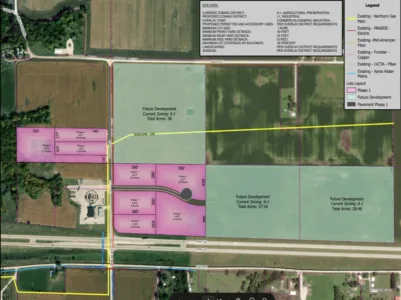
The third and final public hearing Tuesday at the Webster County Board of Supervisors meeting concerned Stumpf's request to rezone two parcels to allow for light industrial use. The Planning and Zoning Commission approved and presented to supervisors a smaller, eight-lot plan covering approximately 36 acres, with conditions governing development and emergency well usage.
Nearly three hours into the meeting, discussion became confrontational as supervisors and Kevin and Sheila Stumpf argued over whether wells should be restricted to emergencies and whether similar restrictions would apply to other current or future developments.
The Stumpfs questioned why future businesses should be required to connect to a water supplier rather than have the option of using their own wells.
Supervisors questioned the timing of those objections which took place while there was an approval motion on the floor, noting that proposed restrictions had been circulated before the meeting.
"It just seems like a frivolous thing that is added that makes our development less marketable," said Sheila Stumpf.
Conrad pointed to an Oct. 26 email in which Kevin Stumpf agreed to remain below a 25,000-gallon daily threshold and draw from the Mississippian Aquifer. She questioned why concerns about the proposed language were being raised as the board prepared to vote.
Kevin Stumpf said he would accept the daily limit, but wanted developers to retain the option of drilling wells rather than connecting to Xenia.
"We want to leave that option open for most development," he said.
Residents near the land once again voiced their concerns during the public hearing.
Resident Amy Potthoff said her son works at Marker 126 and praised the Stumpfs as employers. Her opposition, she said, centered on uncertainty about how far development would extend.
"I just don't know how far all of the development will go," said Potthoff. "I don't know how far the rezoning will go."
She asked supervisors to consider residents who moved to the country for a different way of life.
"I love Fort Dodge, and I love Webster County, and I'm very glad to be here, and I want it to continue to improve," she said. "But I'm asking that you would please take the local residents into consideration in how you vote."
A family letter presented by Michelle Holstein described increased traffic on 230th Street, concerns about children's safety and dust-control expenses. Residents also questioned whether future infrastructure costs would fall to taxpayers.
Planning and Zoning Administrator Jeff Johnson recommended the smaller development footprint, which places development closer to U.S. Highway 20 and increases separation from homes to the north.
The approved layout includes three lots west of Poplar Avenue and five to the east. The Stumpfs had sought a larger, nine-lot configuration during the discussion.
Johnson said the proposal fits the county's corridor and comprehensive plans. He cited a Greater Fort Dodge Growth Alliance analysis projecting approximately 100 direct jobs and $5 million in annual payroll at full build-out.
Johnson also noted that future development would require traffic review, documentation of utility capacity and detailed site plans addressing buildings, signage and landscaping. Johnson said the area's overlay provisions are intended for light industrial uses, such as warehouses, distribution facilities and light manufacturing.
Conrad said she had hoped to support a compromise, but could not approve the proposal as presented. She cited neighbors' concerns, the addition of wells after the Planning and Zoning Commission's consideration, changing site plans and the Planning and Zoning Commission's original recommendation of denial, among other issues.
"I really, really wanted to vote for this today," said Conrad.
Hayek emphasized that rezoning would be the first step in development, with individual projects still subject to review. He also urged better communication about conditions placed on development and their effects on surrounding residents.
"It's one thing to follow the rules," said Hayek. "It's another thing to also make sure that you're being a good neighbor at the same time."