
Bird watching, feeding on the rise
Burras shares how to help birds in the winter months
Trending
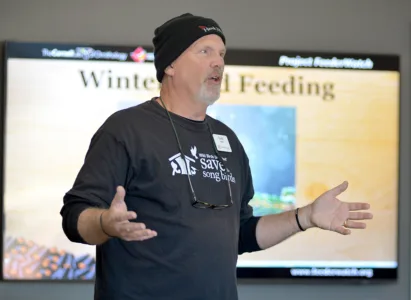
Todd Burras, with Wild Birds Unlimited, had more than just feeding advice for those attending the Saturday morning Coffee and Conversation session in the Matt Cosgrove River's Edge Discovery Center.
They might have also learned that the phrase "bird brain," while not usually a compliment to humans, is a compliment for the black capped chickadee, whose brain does something remarkable.
New cells grow and are swapped out with old ones in a process called neurogenesis. Their brains grow about 30 percent, which serves an important purpose.
"They're able to remember 100 or so caches of food for a month or so," Todd Burras said.
He said the hobby of feeding and watching wild birds took off during the COVID pandemic.
"People were looking for something to engage in," he said. "Birds are having a moment in our culture."
That interest is still being sustained, especially in the winter, when feeding the birds helps relieve the stress they're under.
"There's less time to find food during the short days with cold nights," he said. "It makes it more urgent for them to find food."
The birds don't become dependent on the feeder.
"The birds will survive without humans," he said. "They still get about 70 percent of their food from the landscape; you're just kind of supplementing them."
What might surprise some feeders is that the birds they're seeing now are not always the same birds they saw this summer. The local members of a species will migrate south, while other members of the same species living to the north will migrate to here.
While some birds might be seen here in the winter, many of the ones that stay around are what he called "a whole class of little brown birds."
"Most are house sparrows," he said.
For those who might have observed that there seem to be fewer birds, he had some bad news -- they're right.
"We've lost about 30 percent of our bird population," he said. "There's a 50-year study that backs it up, that has a lot of credibility."
What's causing the decline?
Among the reasons are loss of habitat, light pollution that confuses migrating birds, more violent storms and the use of pesticides and other chemicals that kill off insect populations the birds need.
He also said that each year, a couple of billion birds die from flying into windows, and cats, whether feral or ones allowed to roam by their owners, kill about 4 billion.
There are several things a feeder can do to help over the winter.
"Birds need to drink twice a day, at least," he said. "If you have a source of water, you'll have a lot more birds around."
Another is leaving brush piles and native vegetation. Both give birds shelter from weather and larger birds. A cleaned out bird house can also serve as a shelter from the elements.
Expect some species, like the blue jay, to eat a lot.
"They'll clean a feeder in 15 minutes," he said. "They have a sack in their throat they can stuff seeds into. One was observed to stuff 109 black oil sunflower seeds at once. They take them back to their caches."
Another way to help is to participate in the various bird counts conducted every year. There's the annual Audubon Christmas Bird Count and the Cornell Lab of Ornithology's Great Backyard Bird Count.