
A lifetime of memories
Valvick sisters helped their father on Kossuth County farm
Trending
LAKOTA -- When the Valvick families received their Century Farm award at last summer's Iowa State Fair, the certificate stated the award was to the Poppe Family Farm.
What is the connection between the Poppe family and the Valvick families?
The connection was made when the Poppe sisters, Zada and Annette, married the Valvick brothers, Marcus and Arlyn.
The Poppe Family Farm had its beginning when Adolph Poppe, Sr. and his wife Carolina bought 160 acres on March 4, 1924. The house that they moved into was built in 1920 and is still standing.
A new barn was built in 1925. However, it was damaged by strong winds and could not be repaired because of its stone foundation. Wood from the barn was salvaged and made into benches by a family member, Donald Goetz.
Adolph Poppe, Jr., father of Zada and Annette, was born in that house on March 4, 1927, exactly three years after the farm's purchase. When the senior Poppe became ill, his son, Adolph Jr., quit school in eighth grade to work on the farm.
Adolph Poppe Jr. and his wife Geneva were married in 1950 and became parents to Zada in 1959 and Annette in 1962. He was a believer in education and went back to school to receive his GED in 1969.
Upon their marriage in 1950, Adolph Jr. and Geneva moved into the farmhouse, living with his father and mother until Adolph Sr. and Carolena retired, moving into town. Adolph Jr. and Geneva retired from the farm in 1989, moving into Lakota.
The Poppe sisters grew up on a traditional farm with crops and livestock. The crops were soybeans, corn, oats, and alfalfa. Livestock was dairy for a few years, and then came beef cattle, along with pigs, sheep, chickens, ducks, geese, and rabbits.
The memories of growing up on the farm remain strong and vivid for both sisters. Zada Valvick remembers a ram that behaved like a dog around her father. The ram would follow her father all around and run up and down the rows in the field chasing the tractor.
"The ram, however, would love to head butt my sis and me," said Zada Valvick. "We would run out of the house to the big rock (looking at it now, it isn't that big) to stand on to prevent being head butted."
"Dad decided the ram had to go," she said. "He loaded him into the truck and my sister and I got in the cab with Dad. He was taking the ram to the sale barn. We cried all the way there. We were terrified of the ram but didn't want him to go."
Having two daughters and no sons to help with work on the farm meant the sisters took on the roles that usually went to the sons.
"One of my sister's and my chores was to feed the chickens and gather the eggs," said Zada Valvick.
"The chickens always pecked at us. I'm not sure of the reasoning, but we didn't want to get our shoes or boots dirty, so in the summer we gathered the eggs barefoot. We took the eggs to the basement where we washed them and then packed them into crates to be taken uptown and sold."
The sisters had a role in getting the hay in the barn.
"To put the hay into the barn, Dad would stand on the hay rack and set the fork into the hay," said Zada Valvick.
"Then my sister would back up the station wagon, which had a rope attached to it, and pull the fork into the barn. Dad would trip the fork, and the hay would fall into the haymow. I would then back the grain truck, which had a rope attached to it and pull the fork out of the haymow and the process would start over."
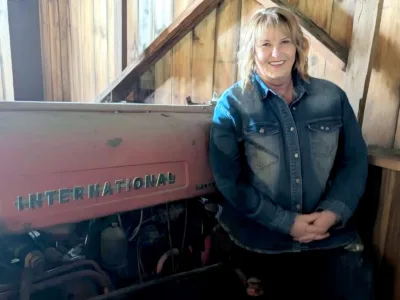
The sisters were not exempt from driving tractors, either.
"With only two girls, we were the only help dad had," said Annette Valvick. "I was driving tractor at 9-10 as I'm sure Zada was as well."
They were taught to disc, drag, and plow. The tractor had a narrow front end. Zada Valvick said they struggled with the plowing, ending up in the furrow and would sit in the tractor until their dad saw they weren't moving and came to get them straightened out.
"Dad never got mad at us for our farming antics," said Zada Valvick. "A guy with a lot of patience."
"We didn't plant or combine because we couldn't drive straight,” she added.
"Planting time meant my sister and I would be spending time in the back of the grain truck. We would fill five-gallon buckets with seed so he could fill the planter. There weren't any iPads, phones, etc. to entertain us. We would pull snake grass apart and put it back together, make crowns with braided dandelions, search for four-leaf clovers, play in the dirt and, if we got really bored, we would read."
Like many farms of that time, the Poppe farm grew and processed much of its food.
"We butchered, processed, and smoked our own meat," said Zada Valvick. "They saved all the parts of the cow when they butchered.
"Our basement looked like a butcher shop with a large industrial meat saw, tenderizer, grinder and bologna stuffer. Dad made the best ring bologna. The rings were hung onto broomsticks and then smoked in a small building outside."
Generosity was part of growing up on the Poppe farm.
"Mom and Dad freely welcomed people into their hearts and their home whether they were strangers, relatives or friends," said Zada Valvick.
"Guests never left the house without a meal," she added. "Mom was known to invite people who otherwise would have spent the holidays alone to join us for a meal. Many became lifelong treasured members of our family."
Zada Valvick asked her son Jordan what he remembers about growing up on the Poppe farm.
"As soon as Jordan learned to walk," said Zada Valvick, "he followed my dad around the farm and in the tractors. He was my dad's right-hand man. I asked Jordan if he had any memories. His reply was, 'He had a lifetime of memories.'"
Poppe Century Farm
Established: March 4, 1924
Acres: 160
Township: Lincoln
Century Farm Award: 2025
Generation: Third