
Two farms, one heritage
Calmer Farms near Manson are ‘working farms’
Trending
MANSON -- Side by side along Iowa Highway 7 in Calhoun County lie Calmer Farms -- two farms with a rich history dating back more than 150 years.
The Calmer family describes them as "working farms" -- a place where everyone pitches in to do what's needed to ensure the farms' success -- always with an eye toward the future.
Both Calmer farms can be traced back to the legacy of one man -- John P. Calmer.
One heritage
In the late 19th century, three orphan boys -- John P. Calmer, his twin Oscar and brother Olaf, immigrated from Sweden to the United States, first settling in Galesburg, Illinois, before making their way to Iowa. Two of the three, John and Oscar, put down roots in what is today's Calhoun County, while Olaf returned to Illinois.
On Sept. 24, 1875, John Calmer purchased 160 acres through the Morrill Act, which allowed states to establish public colleges with funds from the sale of federal land grants. In Iowa, those funds helped found Iowa State University. John Calmer would eventually come to own 720 acres in Calhoun County.
According to family records, he built his 1875 home "from lumber obtained from a Manson lumber yard."
His obituary stated, "While his wife and children took care of the farm, (John Calmer) operated a blacksmith shop in Manson. Each evening, summer and winter, he would walk up the track the three and one-half miles to his home, getting home as late as eight and nine o'clock at night and starting out early the next morning."
He later served as a council member and mayor for a number of years.
Eventually, he and his wife Christina passed the farm down to their son Oscar and his wife Rose. The couple built a new home in 1922. They in turn passed the farm down to their two sons, Ralph and Robert "Dan" Calmer, in the early 1950s.
"The homeplace"
Ralph Calmer, the oldest of eight children, and his wife Marie lived on what is considered the "original home place," or east farm, receiving a Century Farm Award in 1976. They had two daughters, Gail and Gwen.
On the 1976 Century Farm application, Ralph Calmer listed his farm's main crops as corn, soybeans and pasture. He also raised cattle and hogs.
About a year after graduating high school in the 1970s, Mark Calmer, Ralph's nephew, began sharecropping with his uncle and operating a farrow-to-finish hog operation together. Instead of paying rent, he kept up the buildings and made any needed improvements to the farm.
"We built our own hog sheds; we poured our own cement," he continued. "Nobody complained. You just did the work."
They quit raising hogs in 2003 when hog prices fell.
Ralph Calmer lived on the farm until age 98, and took his last combine ride on his 100th birthday in 2004.
"He was a very nice, humble guy," Mark said of his uncle. He recalled many a Saturday, sharing a cup of coffee with his aunt and uncle around the dining room table.
For the past 20 years, Ralph's daughter, Gwen (Calmer) Ewing and her husband John have lived on the home place. The couple continues to sharecrop corn and soybeans with Mark Calmer (Gwen's cousin). Named a Century Farm in 1976, the farm is now eligible for the Heritage Farm Award.
"It's a big honor to be able to hang on to (the land) for 150 years," said Mark Calmer. "When you think back, our ancestors were on this land with a horse."
The west farm
Robert "Dan" Calmer, the youngest of Oscar's eight children, and his wife Evelyn made their home on the west farm, where they raised six children -- Rozanne, Danny, Mark, Rhonda, Rebecca and Phillip.
Dan Calmer raised beef cattle, hogs, chickens, ducks -- and even milking cows for a time.
"He finally got tired of raising the hogs to pay for the cattle," said Mark Calmer, and gave up the cattle.
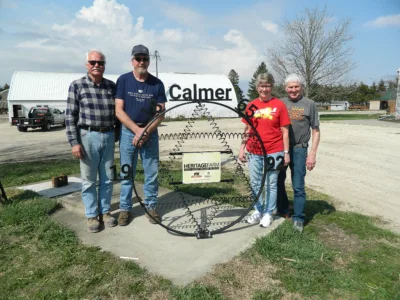
Today, 70 of the original acres are owned by Rhonda (Calmer) Hill and her husband Morey, of rural Madrid. The Hills received a Heritage Farm Award, recognizing 150 years of ownership by the Calmer family, at the Iowa State Fair last August.
"Farming runs deep with us," said Rhonda Hill. "It's an honor that it's just gotten passed down through so many generations."
Rhonda's brother, Phillip Calmer, farms the Hills' land along with his own. He began farming with his dad in the late 1970s, raising corn and soybeans and operating a farrow-to-finish operation. When he got married in 1992, his parents moved to the farm place across the road.
Phillip and his wife Jody continued to live on the farm, where they raised their children: Johnathon, Olivia, Victoria and Grant. The couple has made many improvements to the home.
Today, Phillip Calmer operates a wean-to-finish operation, raising antibiotic-free hogs for Niman Ranch. He has added several hoop barns over the years, as well as grain storage.
Inseparable memories
Sitting around the dining room table, with Mark and Phllip Calmer, Rhonda and Morey Hill and Gwen Ewing, it soon becomes clear that the stories, memories and histories of the two farms that are John P. Calmer's legacy are inseparable.
In the early days, their grandfather, Oscar, raised oats, corn and alfalfa. The oats were essential for feeding the horses used to run the farm.
"I must've been 3 or 4 when they were just about done with the horses," said Ewing, who recalled sitting atop the horses while they took a drink.
Mark Calmer recalled putting up hay bales with forks in the "big barn" and ringing sows and boars, while Ewing remembers putting up loose hay in the '50s.
Work on the farm was divided.
"The girls helped Mom; the boys helped Dad," said Rhonda Hill.
"We always had chickens," she said, adding that she "hated gathering eggs."
She still remembers the old stump with bent nails on top where the chickens' heads were laid for butchering, and the foul aroma those chickens created afterward.
Ewing said they would raise about 200 fryers at a time.
In addition, Rhonda Hill said, "Mom always had a huge garden. We had a pretty good-sized orchard too. We had lots of apple trees. A lot of canning was done."
Ewing still remembers Mark Calmer driving a tractor over to the east farm at around 5 years of age.
"He couldn't reach the clutch or the steering wheel," she laughed.
As kids, the Calmers made their own fun, whether playing in the snowbanks or pulling a sled behind a tractor.
"We worked hard, but we played hard," Phillip Calmer said.
Special guests
At least two types of guests were known to "drop in" on the farm over the years.
In the early days, Mark Calmer said, "Indians would come to the house."
A bell on the Ewing farm was once used as a warning signal for Ewing's grandmother, Christina.
"They would ring that bell if they spotted Indians while the men were working or in the field," said Gwen Ewing. "The men would come to protect them."
Growing up, Gwen and her sister Gail were instructed never to ring that bell, which still stands on the farm today, because it meant something was wrong.
In later years, hobos needing a meal were also known to visit.
"There were signs along the railroad tracks that this was a place to stop to get a warm meal," Ewing said.
Changing times
Farm equipment has changed a lot over the years. Threshing machines gave way to corn shellers and corn cribs, which eventually led to the large planters and combines of today.
Mark Calmer still recalls the two-row cultivators and planters. He said they also once had their own slaughter shed for butchering beef cattle.
One standard piece of "equipment" was the children.
"Walking beans was a family affair," said Rhonda Hill.
Unless someone managed to "weasel out" of helping, chimed in Phillip Calmer.
"Someone would always 'plant a weed' that was pulled out of their row and into mine, as if I'd missed one," said Rhonda Hill.
"I don't remember that," Mark Calmer laughed, not admitting guilt.
Phillip Calmer remembers shelling corn. "I was always in the cob wagon," he said. "I wasn't big enough, but I could be in the cob wagon."
He said shelling corn was "a neighborhood thing," where farmers helped one another by going farm to farm. "Whatever farm you were at supplied the lunch that day," he said.
All remember the rats that were attracted to the farm at corn shelling time, which they would beat with sticks or shovels. "These rats would go place to place in great big droves," Ewing said.
Looking to the future
Both Calmer Farm families plan to continue their family's legacy into the future.
Today, Mark's son, David Calmer, who lives nearby with wife Brenda, handles a large share of the farming.
His daughters Nikki Steinberg and husband Rian, and Kassandra Graeve and husband Dave, are also getting involved -- the husbands with helping farm and Kassandra with the bookkeeping. Nikki works in Rockwell City.
"I've been very blessed," said Mark Calmer. "We are truly a family farm, which is endangered."
On Phillip Calmer's farm, his oldest son Johnathon works with his hired man, while the youngest, Grant, recently took over the planting duties.
"It makes you feel a little better about the future," Phillip Calmer said, knowing the younger generation is getting involved.
All are in it for the long haul.
"My dad always said, 'Some years are good; some years are not,'" said Ewing. "You take the good with the bad."
Calmer Farms 1
Established: Sept. 24, 1875
Acres: 80
Township: Lincoln
Century Farm Award: 1976
Generation: Fourth
Calmer Farms 2
Established: Sept. 24, 1875
Acres: 70
Township: Lincoln
Heritage Farm Award: 2025
Generation: Fourth