
Rezoning hearing exposes development divide
Supervisors schedule further consideration for Oct. 20, Nov. 3
Trending
Questions about what would be built on nearly 64 acres surrounding Marker 126 divided speakers at a two-hour public hearing Tuesday, with corporate representatives urging approval of the rezoning request and neighboring residents urging the Webster County Board of Supervisors to reject it.
Supporters described opportunities for jobs, economic development and additional tax revenue. Residents questioned whether those potential benefits justified uncertainty about future businesses, increased traffic and possible effects on their homes and water supplies.
Through much of that discussion, property owner Kevin Stumpf remained seated while representatives of corporate entities and Des Moines attorney Fred Dorr spoke in favor of his request.
Stumpf addressed the board only after Supervisor Niki Conrad specifically asked him to explain his intentions for the property, noting that multiple speakers had offered several guesses about its future use, including a potential data center.
Stumpf told Conrad he "had not been approached" about a data center. He said he had spoken with Dollar General and Hy-Vee about potentially locating there, but nothing had been decided.
What industries or businesses would occupy the proposed development remained unanswered, and residents in the area told supervisors that that makes them nervous.
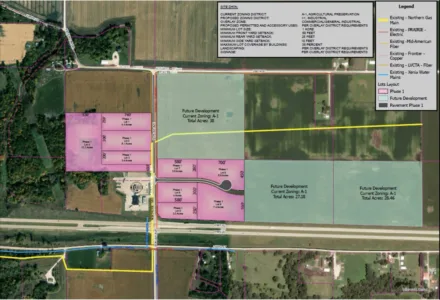
The hearing was the board's first consideration of Stumpf's request to rezone two vacant parcels totaling approximately 63.9 acres from A-1 Agricultural Preservation District to Industrial District. The property lies north of U.S. Highway 20 on both sides of Poplar Avenue.
Representatives of Cornbelt Power Co-op, Prairie Energy Co-op and Evergreen Engineering spoke positively about the proposal.
Ted DuBois, representing Evergreen Engineering, said he and Stumpf had worked with cooperative representatives over the past year to prepare the site plan. He said the development supported goals in the county's comprehensive plan, including opportunities for economic growth, additional jobs and increased tax revenue.
DuBois pointed to Marker 126 as an example of Stumpf's work and encouraged supervisors to approve the request. He also said the proposed layout had been revised in response to neighbors' concerns.
"We want to be cognizant and aware that they live in that area," said DuBois.
Residents, however, said the appearance of the existing business did not resolve their concerns about what would follow on the surrounding land.
Donna Faith praised Marker 126, but questioned what control Stumpf would have after selling the development lots.
"Kevin did a great job with the travel center," Faith said. "It's amazing. It looks great, but he's selling these lots."
Faith noted that Stumpf does not live in the area and said neighbors would be the ones living with the consequences of future development. She also questioned proceeding without knowing what industries would locate there.
Traffic was a recurring concern among opponents at Tuesday's meeting.
Faith described difficulty entering traffic near Highway 20 and trucks crossing toward the highway. She said additional development would add vehicles to a road she already considers dangerous.
"This road cannot take all that they're talking about," said Faith.
Faith also questioned whether the traffic review adequately reflected busy Friday and Saturday conditions.
Justin Patterson raised similar concerns in a letter read during the hearing, asking supervisors to consider vehicles entering and leaving U.S. Highway 20 and the effects of development on nearby families.
"It's very close to my house and I worry about the safety of my family and my neighbors," Patterson wrote.
In another letter read during the hearing, Brad Lemke asked whether Stumpf intended to put a data center on the property. He urged supervisors to reject the proposal because there were "too many negatives."
Other speakers suggested the property could be used for a truck stop or storage. No specific project was announced.
The proposal came before Supervisors after the Webster County Planning and Zoning Commission voted 4-1 on Sept. 15 to recommend denial. County planning staff, however, recommended approval with conditions.
Planning and Zoning Administrator Jeff Johnson said the commission's motion did not identify specific reasons for recommending denial.
Commission Chair Margot Knipple, speaking as a resident rather than on behalf of the commission, explained the reasons for her own opposing vote. She cited concerns about compliance with conditions of an earlier rezoning, traffic, strong neighborhood opposition and the lack of support presented during the commission's meetings.
According to Knipple, letters of support from the organizations backing the proposal were received Oct. 2, after the commission's vote.
Knipple said compliance issues associated with the earlier rezoning had been raised during the commission's deliberations. She said she understood those issues had since been addressed, but questioned how future conditions would be enforced.
"Are we going to have to continually cajole someone into following the conditions that we set?" asked Knipple.
She also described a near collision involving a truck near the travel center and urged officials to address existing traffic problems.
"These traffic concerns that these people are telling you about, these are real things," said Knipple. "These are everyday things for these people."
Water became another point of disagreement when DuBois asked supervisors to remove a proposed condition prohibiting private wells on the development lots.
The development plan calls for water service from Xenia Rural Water District. DuBois said the prohibition could leave the development without access to water if Xenia were unable to supply it.
Resident Diane Delf questioned what industrial wells could mean for neighboring households that rely on well water.
"Is it going to make our wells run dry?" asked Delf. "Are we going to have to dig deeper?"
Knipple also opposed removing the restriction, saying water supplies had been a significant concern for neighbors.
Johnson said the property's current agricultural zoning is subject to an overlay district identified for future commercial and light industrial development in the county's 2043 comprehensive plan, adopted in 2023.
An initial site plan presented in August identified 11 lots ranging from approximately three to 12 acres. Following residents' concerns, the developer agreed to remove two lots on the west side of Poplar Avenue, south of 230th Street, to increase separation from homes to the north.
Johnson recommended pulling development farther south, limiting it to the southern third of a 40-acre tract rather than its southern half.
Knipple said she had asked Stumpf during the commission's deliberations whether he would agree to reduce the development area further. He declined at that time, she said, and the commission voted on the proposal as presented.
Knipple questioned whether a development of this scope matched what she had envisioned when the overlay districts were established and suggested the county review some of those boundaries to better separate development from homes.
"We're not saying no to development," said Knipple. "We just want to make it work for everyone."
Johnson said rezoning would not automatically authorize construction. Individual projects would require additional review before building permits could be issued.
Those reviews would include confirmation that water, sewer, electrical service and roads could accommodate each proposed use. Traffic statements or studies would be reviewed by the county engineer and the Iowa Department of Transportation to determine whether roadway improvements were necessary.
Johnson said the DOT remained neutral on the rezoning decision and wanted continued involvement as development proceeded.
Proposed conditions also would require review of building appearance, signs, landscaping and the placement of loading areas and dumpsters, along with measures to address noise, dust and odors.
"We want to make sure there's quality development," said Johnson.
For neighboring residents, however, those future reviews did not settle the immediate question before the Board of what they could ultimately be living beside.
Tuesday's meeting was a public hearing only and the supervisors did not vote on the proposal.
The board scheduled the second consideration of the rezoning request for Oct. 20 and the third consideration for Nov. 3.