
A Second Chance at Life
A community of lifesavers give Jane Curtis another chapter to write
Trending
For years, Jane Curtis told the stories that shaped her community, chronicling moments of resilience, loss, hope and perseverance.
As editor of The Messenger and later editor of The Daily Freeman-Journal in Webster City, she spent decades documenting the lives of others.
When she retired in December 2025, Curtis believed the deadlines, breaking news and crises were behind her.
Instead, just four months later, she became the subject of an extraordinary story herself -- one that began with a devastating cardiac event and a fight for survival.
“We started redoing the bathroom last summer, but of course it was dragging on,” Curtis said. “The installation of a vintage sink was stalled because I decided to strip all the mastic from the original hardwood floor. That’s what I was doing on the afternoon of April 20.”
As evening approached, Curtis and her partner, Jerry, settled into the living room with a glass of wine while dinner baked in the oven.
What happened next was reconstructed later through Jerry’s recollections.
“One second I was sitting in a chair holding a glass of wine. Then the next, my head fell back and the wine glass tumbled to the floor and broke,” she said. “Jerry thought I had suffered a stroke.”
He immediately lowered her to the floor, called 911 and began CPR.
“Thank God he knows CPR,” Curtis said.
In hindsight, the warning signs had been there.
During a candidates’ forum hosted by The Daily Freeman-Journal and Kendall Young Library in October 2025, Curtis suddenly became short of breath and had to leave the room to sit down.
“I thought I was just worn out from the job,” she said.
There had been another incident months earlier.
“I fainted for a second while standing in the kitchen. Jerry caught me before I fell,” she said. “It was just a split second. That was a warning sign. I just didn’t get the hint.”
Not long afterward, Daily Freeman-Journal writer Bob Oliver became concerned enough about Curtis’ health that he contacted her brother.
“Lenny called me and, in a voice that finally got my attention, told me about Bob’s concerns and said it was time to pick a day to retire,” Curtis said. “I retired in December.”
Even after retirement, the shortness of breath continued. Curtis attributed it to years behind a desk and simply being out of shape.
Then came April 20.
As fate would have it, help was remarkably close.
“I was told a Webster City police officer was nearby when the call came in,” Curtis said. “She was there almost immediately. For that, I will forever be grateful.”
Officer Ciara Sturm of the Webster City Police Department responded first, followed by Officer Micheal Lehman. The officers assisted until not one, but two Van Diest Medical Center EMS crews arrived -- the result of a fortunate shift change. Paramedics Drew Nelleson, Anthony Haubrich and Erik Naberhaus, as well as Dixie Gable, EMT, responded to the call.
“For them, I will also be forever grateful,” Curtis said.
Having spent years reporting on emergency responders, Curtis believed she understood the importance of their work.
“I never took what our first responders do for granted,” she said. “In my professional career, I saw them in action many, many times and was always impressed. But when the perspective shifts, when it is your life they saved, the gravity of what they do every day cannot be overstated. We are so incredibly fortunate in this community to have these people who serve.”
When officers arrived, Jerry was still performing CPR. With the front door locked and his hands occupied, responders initially struggled to enter the home. Once inside, Sturm took over chest compressions until EMS personnel arrived.
“And even after we got there, the police responders stayed on and helped us,” said Nelleson.
Lehman drove the ambulance to the hospital while paramedics continued treating Curtis in the back.
Haubrich said Jerry’s immediate response gave Curtis the best possible chance of survival.
“We run into a lot of situations where dispatchers try to get family members or bystanders to start CPR, but it doesn’t always happen,” Haubrich said. “In this case, he was willing and able to start CPR until someone showed up to help.”
"Time is everything when it comes to responding to cardiac events," Haubrich said. "It's said that every minute that passes with no intervention, you lose 10 percent of survival chances."
Responders on scene included three paramedics, one EMT and two Basic Life Support instructors -- Nelleson and Lehman.
“You can’t get much better than that,” Nelleson said. “We’re really lucky in this county to have 15 paramedics, which is something many rural counties don’t have.”
CPR continued for nearly 40 minutes, during which Curtis received three defibrillation shocks.
A LUCAS device, an automated chest compression system that allows EMS crews to continue lifesaving care while monitoring vital signs, administering medications and transporting patients, was also used during the resuscitation effort. Van Diest Medical Center recently received a grant from Enhance Hamilton County Foundation to assist with the purchase of a second LUCAS device. With both ambulances now equipped with them, the likelihood that the device is available when and where it is needed has increased.
In Curtis’ case, the device helped sustain critical blood flow throughout the prolonged resuscitation, giving responders another powerful tool in the fight to save her life.
“It takes an entire team and the right equipment to have an outcome like this,” said Nelleson. “Everything came together that day.”
The lifesaving measures came at a cost. Curtis suffered multiple cracked ribs -- a common consequence of effective CPR -- along with a collapsed lung. Those injuries, however, were a small price to pay for a second chance.
She was airlifted to MercyOne Medical Center in Des Moines for advanced cardiac care.
Each day brought new answers as Curtis met with pulmonologists, cardiologists and other specialists determined to understand what had happened.
“The first significant thing I learned was that they considered it a miracle that I was alive,” she said. “Three different doctors told me I was a miracle.”
The message continued after she was transferred to the cardiac floor.
“One of the nurses came into my room and said she had just read my chart and wanted to see what a miracle looked like,” Curtis said.
The compliment came at a less-than-glamorous moment.
“A good third of my long hair was in permanent knots that would later have to be cut out,” she said. “But I was alive.”
As doctors pieced together the events that nearly claimed her life, Curtis began to understand just how extraordinary her survival had been. Immediate CPR, a rapid first-responder response, advanced cardiac care and a series of fortunate circumstances combined to give her a chance that many cardiac event victims -- particularly those in rural communities -- never receive.
As physicians continued searching for answers, Curtis learned the cardiac event was only part of the story.
“It’s probably important to say that what happened has been referred to as a cardiac event,” she said. “I say that because the underlying illness MercyOne eventually diagnosed caused it.”
Doctors diagnosed Curtis with amyloidosis.
“Yeah, I had never heard of it,” she said. “It’s a condition where proteins fold incorrectly and build up in the body. In my case, it affected my heart and caused blockages that ultimately led to the cardiac event. The blockages were treated with two stents.”
According to the Cleveland Clinic, amyloidosis occurs when proteins in the body become misshapen and form abnormal deposits in organs and tissues. Depending on the type, the disease can affect the heart, kidneys, liver, lungs and other organs. Health care providers estimate that only 1,275 to 3,200 new cases of AL amyloidosis are diagnosed in the United States each year.
For Curtis, the diagnosis answered lingering questions, but introduced a difficult new reality.
“The treatment for amyloidosis is the same treatment used for myeloma, which is cancer,” she said. “So, I’m receiving chemotherapy treatments every week. Amyloidosis is not curable.”
The diagnosis was difficult to absorb. After surviving a cardiac event doctors described as miraculous, Curtis now faced a lifelong battle with a rare disease. Yet, true to the resilience she had spent years documenting in others, she chose to focus on moving forward one day at a time.
Today, Curtis is rebuilding her strength through cardiac rehabilitation at Van Diest Medical Center while continuing weekly chemotherapy treatments for amyloidosis.
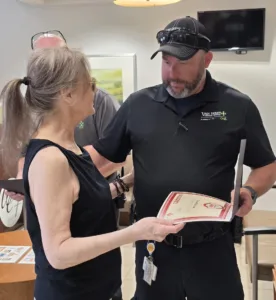
Recently, Curtis reunited with several of the first responders who helped save her life on April 20, bringing pizzas and treats to thank the men and women she now calls her personal heroes. The reunion also provided an opportunity to recognize their extraordinary efforts, as each responder received an American Heart Association Heartsaver Hero Award for the lifesaving care they provided.
For the EMS crew, reunions like this are rare.
"It's nice to see the full circle on this," Haubrich said of meeting Curtis. "We don't always get to see that."
For Curtis, words still fall short.
"Not in a million years could I express what it means to have this second chance," Curtis said. "Thank a first responder. Thank them every day for what they do.
"Believe me, it's no small thing to save a life."