
Panel of local professional women discuss views on gender equality
Women’s equality forum covers various controversial issues
Trending
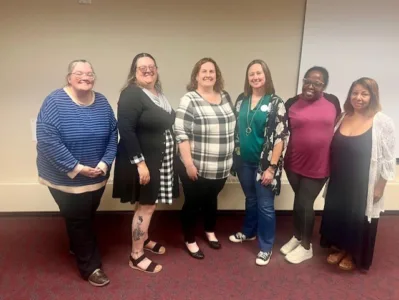
An interactive panel of six local professional women, including a political candidate, therapist, victim advocate, bookstore owner, and two educators, recently shared their experiences and viewpoints on gender equality issues and related social problems at a Fort Dodge forum.
Each of the panelists expressed their thoughts at Fort Dodge's inaugural Women’s Equality Day Forum, held at the Fort Dodge Public Library on Tuesday evening.
The panel included Rachel Burns from rural Sac County, who is a Democratic candidate for the Iowa House of Representatives, District 7. A former volunteer firefighter, she is currently employed as a speech language pathologist and medical examiner investigator.
She was joined onstage by five Fort Dodge women – Rhiannon Rippke-Koch, medical health counselor; Belinda Cardona, Domestic and Sexual Assault Outreach Center victim advocate; Cori Theroux, Green Dragon Bookshop owner; and Amber Rouse and Shameka Dillard, both of whom are educators working in the Fort Dodge Community School District.
Topics addressed by the panel included gender inequality in families, educational barriers faced by girls and women, shifting perceptions of women’s roles across generations, career-based microaggressions, workplace discrimination, health care inequities and reproductive rights, and unequal government representation.
Several of the panelists recalled their own childhood and young adult experiences of gender inequality that occurred in households and schools, with nontraditional gender roles often being stigmatized.
Theroux, for example, recalls growing up in a large family with gender segregated spaces and activities. During family get-togethers, women were almost always in the kitchen, while men would watch sports.
"There was that clear divide in the household," she said. "And even if the women weren’t cooking, they were hanging out with the women that were cooking in the kitchen. And the men, even if they didn’t watch sports, were sitting there chitchatting about sports."
As a self-identified "tomboy," however, Theroux refused to simply remain in the kitchen.
"I was always getting rowdy and into things and that they didn’t want me to do as a girl," she said. "And so, I remember I wanted to learn to shoot guns because my family were cattle ranchers. I wanted to be able to float between both the 'female' and 'male' spheres."
Similarly, Cardona recalls growing up in a very traditional patriarchal home.
"I remember that the girls had to clean the house. We had to make our brother’s beds," she said. "And that used to piss me off a lot. Yeah, I knew I was a feminist when I was 8 years old."
In contrast, Rippke-Koch remembers growing up in a home that was based on a gender role reversal - especially for that era.
"My mom was the one that went out, worked, paid the bills. My dad was the one that stayed home with us kids," she said.
But the gender role reversal of her parents led to strange reactions from her peers.
"When I said my dad stayed home with me, which is not something I ever thought was strange, everybody looked at me as if I was weird," she said.
Even popular culture played a role in the gender socialization of the panelists. Burns notes, for example, that she was raised on a lot of Disney movies.
"And I remember the 1964 Mary Poppins movie being a really obvious indicator of gender inequality, especially with the piece about the suffrage movement," she said. "But it was apparent to me at a young age that the Banks household was really being run by four women."
In Dillard's case, she grew up with mostly young male relatives, and consequently preferred to play with G.I. Joes and other toys deemed stereotypically for boys. This led to a negative reaction from many of her young female peers.
"So, I had to learn to like, to know it’s okay to be feminine. And go do girly things and play with Barbie," she said.
Several panelists recalled encountering sexist barriers in school, though such discriminatory treatment often seemed to diminish as they grew older. Rippke-Koch, for example, recalls her third-grade female teacher recommending her for the Talented and Gifted (TAG) program. She was allegedly rejected simply because of her gender.
"I remember being told, 'no, she’s a girl, we’re not going to take her,'" she said.
However, a few of her teachers eventually went to bat for her in middle school, and she was accepted into the TAG program.
"I had teachers that acknowledged my intelligence and made me believe that I could actually be something more than just a mom in the kitchen raising kids and cooking," she said.
The panelists agreed that there has been a generational shift with their daughters facing fewer gender-based educational barriers than their mothers experienced.
However, several of the panelists emphasized the importance of community leaders providing moral support for girls and women in educational institutions. In particular, single women with children often need assistance to fulfill their dreams.
"That single mom really wants to go to college in many instances," Cardona said.
Speaking from her own experience, she recalls taking a chance as a single mom and attending a community college.
She credits government programs, such as the Educational Opportunity Program (EOP) and TRIO program, for assisting her in achieving her educational goals.
"I’m really thankful for programs like EOP and TRIO that help single moms, because if it had not been for those programs, my struggle would have been insurmountable," she said.
When it comes to their careers, all of the panelists acknowledged frequent microaggressions and sexist assumptions in workplace settings.
Theroux recalls experiencing several microaggressions in former workplaces, based on gender stereotypes.
"There’s so many little tiny things like, oh, why don’t you grab the coffee, why don’t you take the notes in the meeting, why don’t you do this?" she said. "And it’s just like assumed that the woman in the room is going to take care of it, assume they’re going to order the food, that they’re going to make sure everyone has coffee, that notes are taken."
Working as a medical examiner investigator, Burns notes that she sometimes experiences surprised reactions - even from law enforcement officers - because of her gender. And as a former firefighter, she often encountered sexism and even sexual harassment, she said.
Rather than simply accepting the patriarchal status quo, however, Burns says she sought to pave the way for other women to enter the fire service.
"I was able to accomplish that to some degree in my 12 years in the fire service by welcoming, and bringing up women who joined after me," she said.
When it comes to the health care system, the panelists agreed that it suffers from major problems of systemic sexism and racism. They claimed that medical professionals often cavalierly dismiss women’s pain, for example, leading to delayed diagnoses of serious medical problems.
Rouse, for example, recalls that her mother suffered for 10 years with endometriosis without being properly diagnosed with the disease. This was because the doctors continued to dismiss her pain without running the proper tests.
"My mother was told it was all in her head," Rouse said. "And so, to me, this is a really important issue because I saw how much damage it did to my mother when she did not have the health care women should get in a timely fashion."
As another example, Dillard recalls being injured as a teenager when she fell on her tailbone. She suffered for months from recurring pain, but the local medical professionals routinely refused to perform any major medical tests on her.
As an African American woman, Dillard is convinced that her pain was not taken seriously by the local health care system due to various stereotypes related to both race and gender. Finally, her condition worsened to the point that her parents transported her to an Iowa City hospital, and were able to finally get their daughter admitted for a thorough examination.
"The doctors then discovered that I had a brain aneurysm, which came from that single fall," she recalls. "If they would have done a CT or MRI at the initial time when went to the ER, they would have seen what was happening to my brain."
Several of the panelists also expressed frustration with the lack of reproductive healthcare services in Fort Dodge and the surrounding rural Iowa region - including the lack of birthing facilities.
"Especially where I live in rural western Iowa, we are in a reproductive health care desert," Burns said. "It would be a 45-minute drive to deliver a baby."
Several panelists observed that the lack of reproductive health care in rural Iowa has been exacerbated by recent government cutbacks in funding for hospitals, Medicaid, and Planned Parenthood.
Cardona, for example, claims that women would have more affordable, convenient options, "if it wasn't for the defunding of the programs that provide reproductive care." She added, "Reproductive health care is health care. It’s a human right."
One of the biggest problems women encounter in reproductive health care is the common refusal of medical doctors to perform sterilization surgeries for women (especially young women), such as tubal ligation and hysterectomies, according to several members of the panel.
Various panel members said they even know women with serious preexisting medical problems that have been denied sterilization surgeries by physicians. They also observed that medical professionals often refuse to agree to such surgeries until they have first discussed it with their husband at home.
As Rippke-Koch recalls, "I told my doctor, who was a man, that I wanted my tubes tied after this one (her third pregnancy). And he looked at me and he said, well, what if your husband wants more children?"
Several panelists trumpeted the value of social media platforms to overcome such systemic problems.
"I will say that social media is great in this aspect because there are people that put together lists of providers that will do that for you," Theroux said. "So, if you know someone who needs reproductive services, there are lists of doctors on the Internet that will help you."
Finally, the panelists agreed that women need representation in government that reflects community diversity, not simply the presence of elderly white men in power. There was broad agreement that diversity based on gender, race, and ethnicity are important considerations when having "seats at the table."
As Burns said, "The stories that got me to run for office are from being a first responder and seeing the most horrific suffering that people can go through in a fire truck, in an ambulance, on a death investigation call. And what I would like to see moving forward is for government at all levels to look like the communities it is supposed to represent."