
Piece of firefighting history restored
Old hose reel finds new home at Fort Dodge firehouse
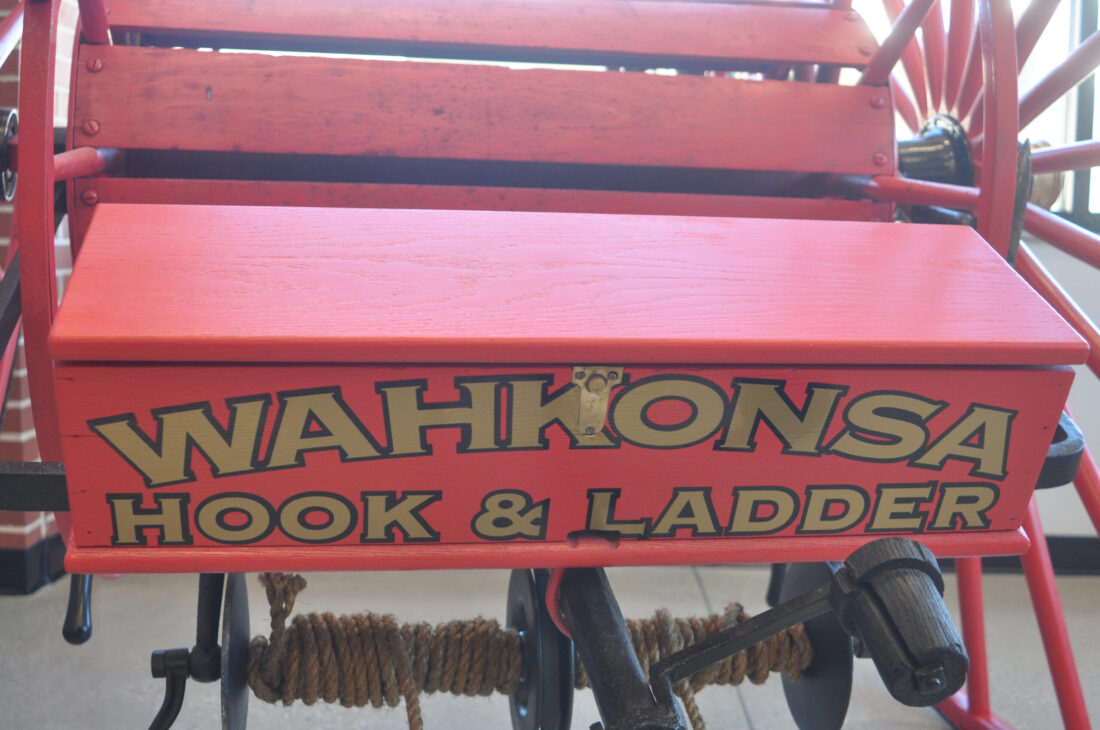
-Messenger photo by Bill Shea <br> The name Wahkonsa Hook and Ladder is painted on the restored 1800s hose reel on display at the Fort Dodge firehouse. That unit was one of the four volunteer fire companies that protected the city in the late 1800s. The others were W.A. Berry Hook and Ladder Co., Merchants Hose Co. 1 and S.T. Meservey Engine and Hose Co. 2.
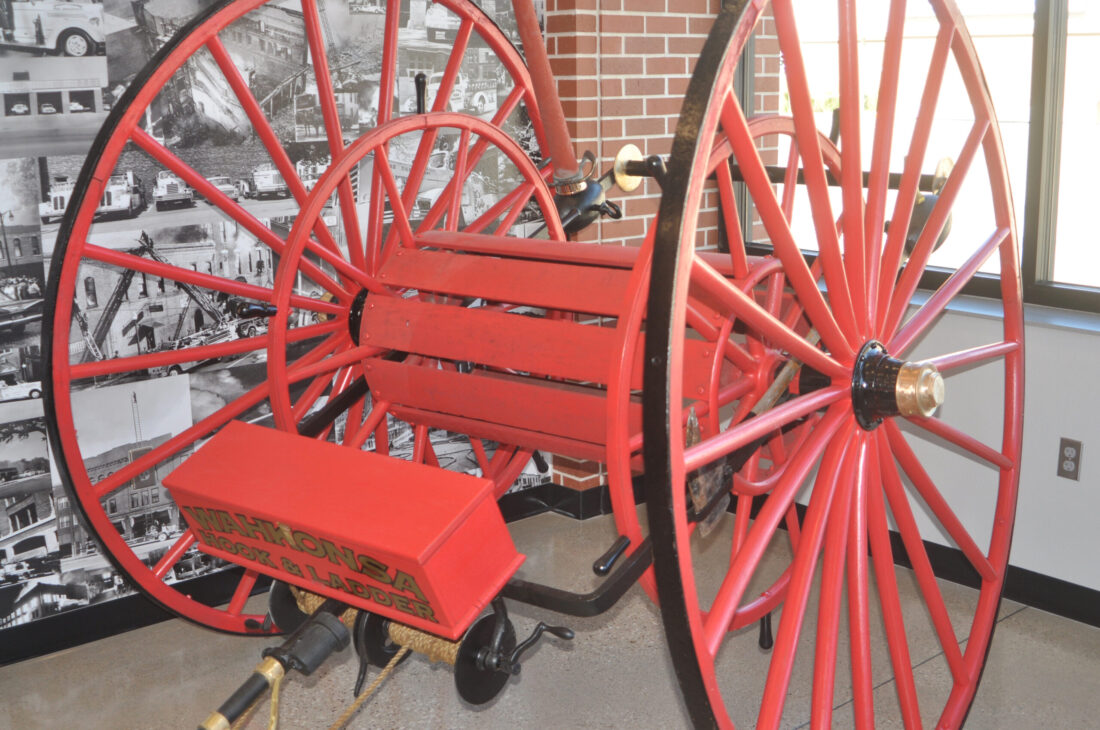
-Messenger photo by Bill Shea <br> This restored hose reel dating from the late 1800s is in the lobby of the Fort Dodge firehouse at 1515 Central Ave. It was restored by Curt Bacon Body Shop, which donated its services. The reel would have been pulled to a fire by at least four men. At the scene, the hose would be connected to a hydrant and a stream was directed onto the flames.
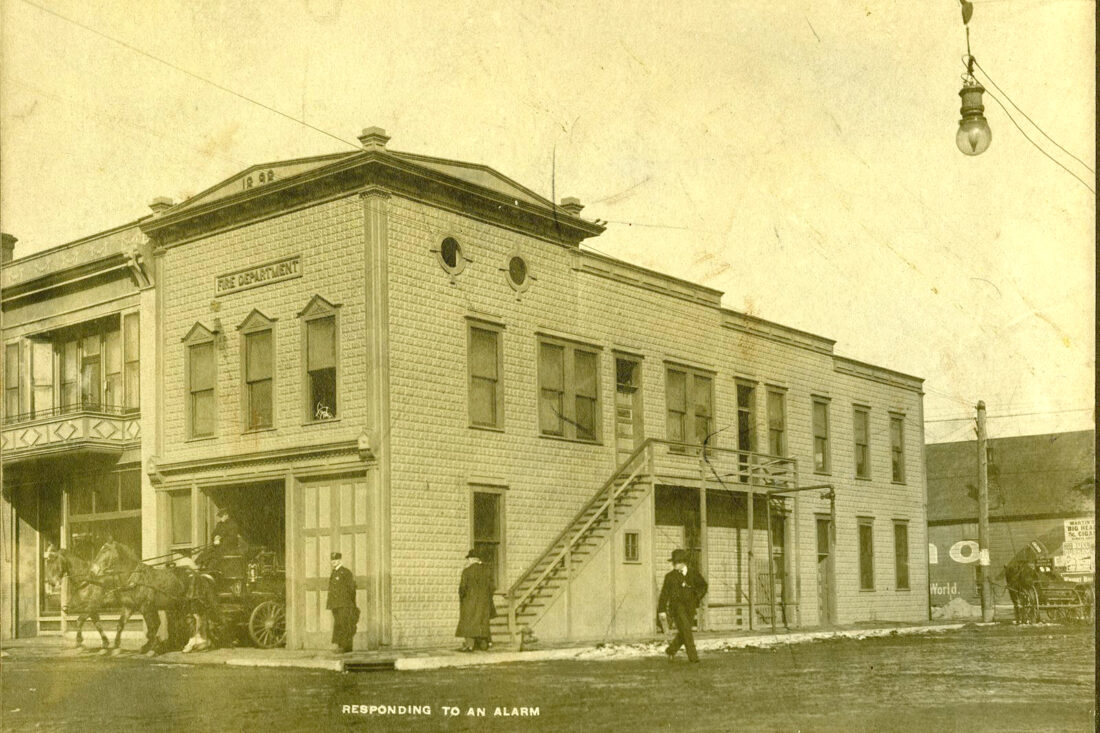
-Photo courtesy of the Webster County Historical Society <br> This building housed the Fort Dodge City Hall and the Fire Department before the current Municipal Building was built in 1915. The Fire Department also moved into that building.
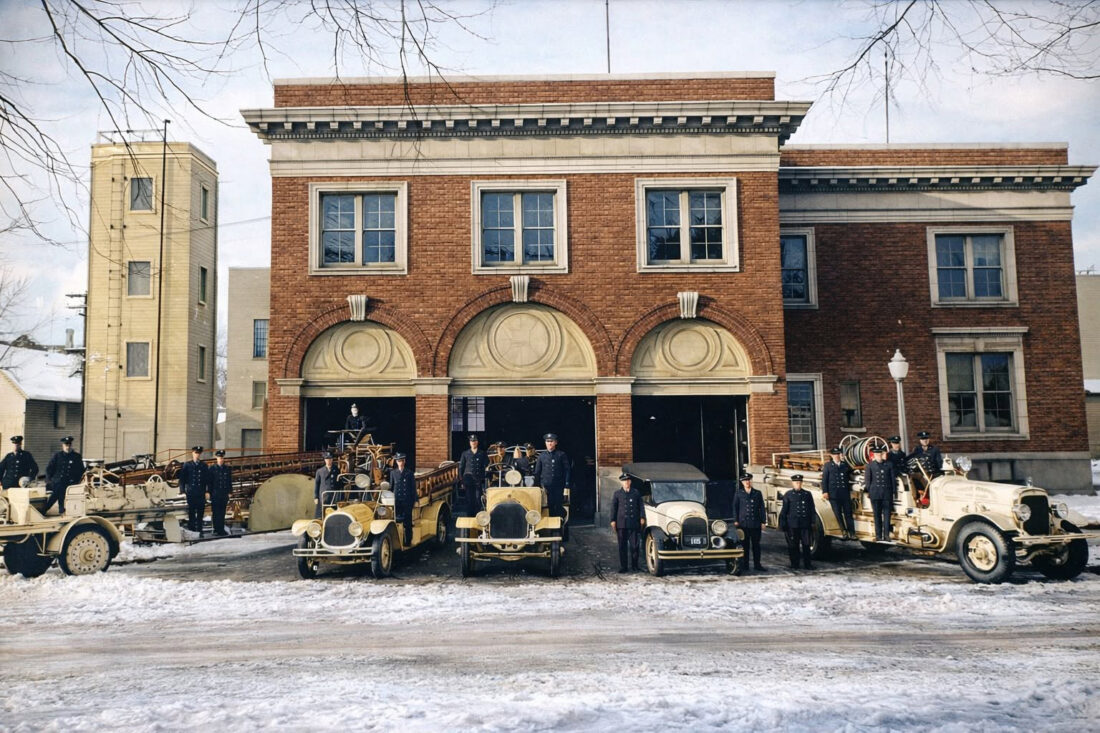
-Photo courtesy of the Webster County Historical Society <br> The Fort Dodge Fire Department moved to the Municipal Building when it was completed in 1914. The vehicles are a huge step forward from hand-drawn hose reels and horse-drawn wagons.
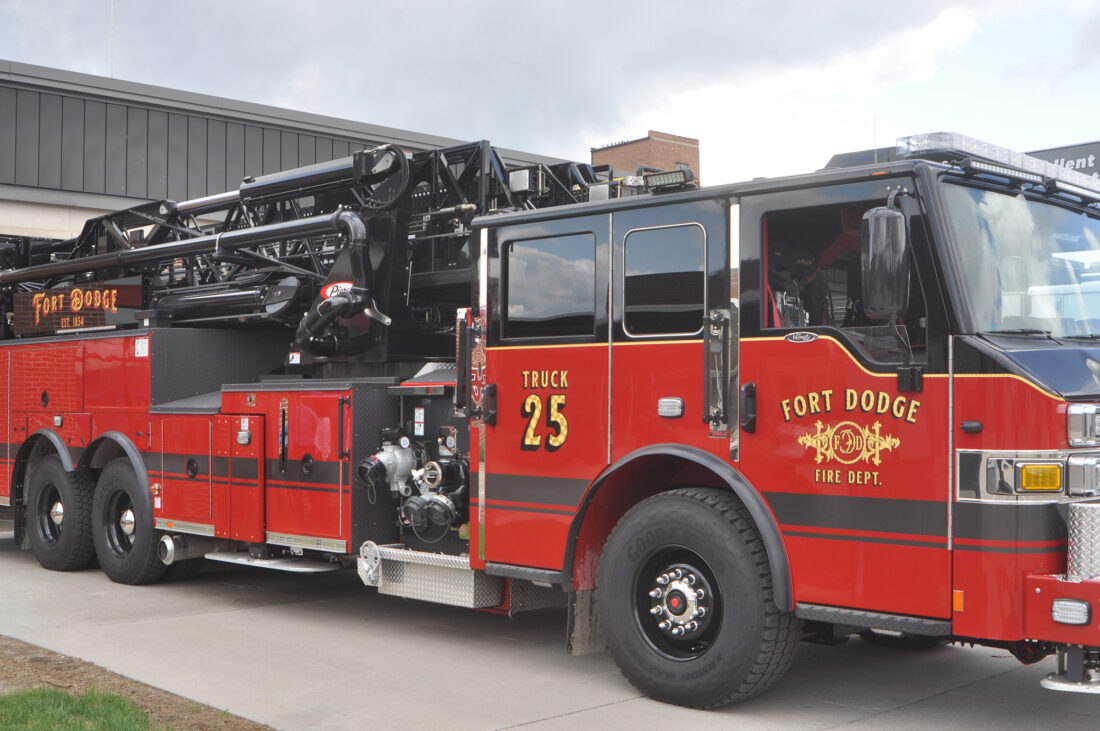
-Messenger photo by Bill Shea <br> This Pierce tower ladder was delivered to the Fort Dodge Fire Department earlier this year. It has a boom that extends 100 feet into the air. At the end of that boom is a bucket where firefighters can work to extinguish fires and make rescues. Modern firefighting equipment is much more suited to extinguishing fires.
-Messenger photo by Bill Shea <br> The name Wahkonsa Hook and Ladder is painted on the restored 1800s hose reel on display at the Fort Dodge firehouse. That unit was one of the four volunteer fire companies that protected the city in the late 1800s. The others were W.A. Berry Hook and Ladder Co., Merchants Hose Co. 1 and S.T. Meservey Engine and Hose Co. 2.
-Messenger photo by Bill Shea <br> This restored hose reel dating from the late 1800s is in the lobby of the Fort Dodge firehouse at 1515 Central Ave. It was restored by Curt Bacon Body Shop, which donated its services. The reel would have been pulled to a fire by at least four men. At the scene, the hose would be connected to a hydrant and a stream was directed onto the flames.
-Photo courtesy of the Webster County Historical Society <br> This building housed the Fort Dodge City Hall and the Fire Department before the current Municipal Building was built in 1915. The Fire Department also moved into that building.
-Photo courtesy of the Webster County Historical Society <br> The Fort Dodge Fire Department moved to the Municipal Building when it was completed in 1914. The vehicles are a huge step forward from hand-drawn hose reels and horse-drawn wagons.
-Messenger photo by Bill Shea <br> This Pierce tower ladder was delivered to the Fort Dodge Fire Department earlier this year. It has a boom that extends 100 feet into the air. At the end of that boom is a bucket where firefighters can work to extinguish fires and make rescues. Modern firefighting equipment is much more suited to extinguishing fires.
Trending
The old hose reel on its tall, spindly wheels was state-of-the-art fire equipment when it first hit the streets in about 1879.
It responded to its last fire call more than 100 years ago, and largely disappeared from view.
Now, following a full restoration job completed in 2023, it occupies a place of honor in the Fort Dodge firehouse. It is a reminder of a time when hose reels like it were key to saving lives and property when fire broke out.
Former Fire Chief Steve Hergenreter said it had been in storage at the Fort Museum and Frontier Village. He said he talked to Tim Morris, who was the museum director at the time, about it. Morris, he said, "saw value in us taking it and restoring it."
It was moved to the firehouse at 1515 Central Ave. in the spring of 2023, where it sat in the garage behind some of the modern fire trucks
Hergenreter contacted Curt Bacon, owner of Curt Bacon Body Shop in Fort Dodge, to get his input on restoring the wooden and cast iron reel. He said Bacon volunteered his services to restore it.
It was completely taken apart and the individual pieces were taken to Bacon's shop. As Bacon finished each piece of it, those individual components were brought back to the firehouse. The hose reel was put back together and was placed in the new lobby of the firehouse. Anyone walking by the north side of the building can probably see its wheels through the windows.
It consists of a reel, around which a fire hose was wrapped, mounted horizontally between two tall wheels. Those wheels may have been made in the late 1800s, but they still turn quickly and easily, as the firefighters discovered every time they had to move it. An axe and a large nozzle are mounted on its frame. A box on its front likely held spanner wrenches used to connect hose and additional nozzles.
Hergenreter said it took at least four firefighters to pull it.
There are no markings on the hose reel to show when it was built or who made it.
And while there is no truly definitive proof that the reel was used in Fort Dodge, Hergenreter found a photo from the late 1800s that apparently shows it in the city.
He said that prior to 1879, fires in Fort Dodge were put out by bucket brigades.
In 1879, he said, Fort Dodge got its first water system when a pump station was built near the Des Moines River and water mains were extended up what is now First Avenue South, Central Avenue and First Avenue North to about 12th Street. With those water mains came hydrants, he said. Firefighting could then be done with a steady stream of water under pressure through a hoseline instead of buckets.
"This was a huge, huge change in firefighting in Fort Dodge in 1879," Hergenreter said.
At about the same time, four volunteer fire companies were established to end the need for bucket brigades in Fort Dodge.
Those volunteer units were the Wahkonsa Hook and Ladder Co., W.A. Berry Hook and Ladder Co., Merchants Hose Co. 1, and S.T. Meservey Engine and Hose Co. 2. They operated from four firehouses across the city.
"Wahkonsa Hook & Ladder" is painted on the hose reel in honor of one of those old volunteer fire companies.
The arrival of the city's first motorized fire truck in 1913 signaled the end for the old hose reel.
An article in the July 23, 1907, Messenger describes firefighting at that time.
"Shortly after the alarm is rung now days, a bright red wagon with shining brass trimmings dashes up the street behind a pair of large horses. In the wagon is a group of rubber coated men. Behind a large crowd follows, intent upon seeing the fire.
"When this city was a village, all this was different. The fire house was on the southeast corner of the lot now occupied by the Webster County court house. An ancient schoolhouse had been moved to the lot and arranged as a place to keep the fire equipment. Over the door was the bell now over the door of the East End firehouse. When a fire was discovered, a man or boy went down the street crying 'Fire.' He ran as fast as possible to the firehouse and rang the bell. Close upon his heels came other men who burst into the room and dragged out the little hook and ladder wagon. Then they went rattling to the scene of the blaze.
"Here everything was in confusion, furniture was strewn over the ground and everyone was giving orders. From the nearest well to the house, the men and boys had formed a line which was passing buckets of water to be emptied upon the blaze. As soon as the ladders were taken off the wagon, a line was formed up to the roof of the burning structure and the flames were fought from overhead.
"This method of firefighting was simple in the extreme. And as often as not, the building burned before the water was put upon it. As a member of the old company said, 'We did not succeed in downing the flames as often as the flames burned down the house. The buildings were mostly of rough boards or hewn logs and these burned rapidly.'"