Fort Dodge woman battles ALS
‘You enjoy each day and hug your kids tighter’
-
-
-Submitted photo
Pictured from left are Cooper Fleming, Cheryl Fleming, Matt Fleming, Claire Madden and Nathanial Madden.
-Submitted photo
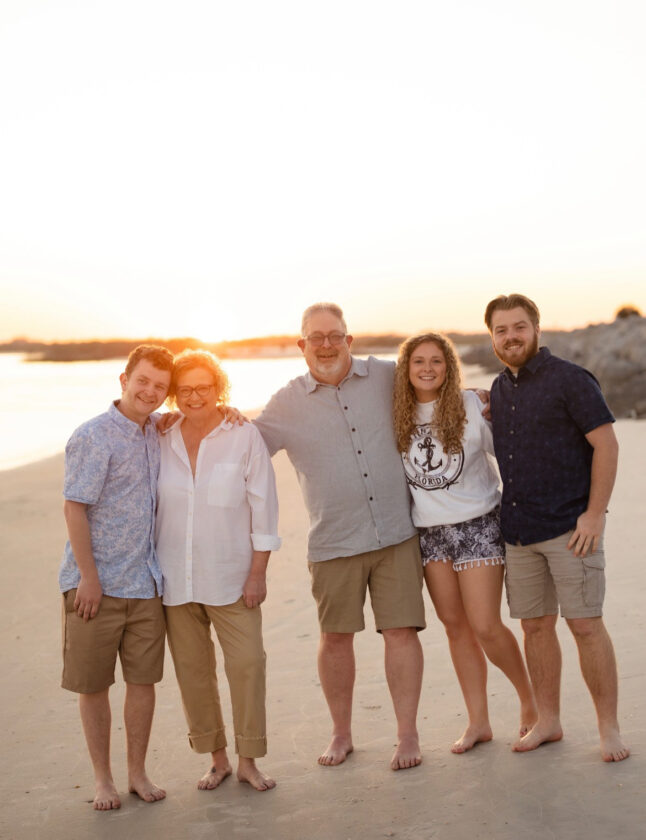
Pictured from left are Cooper Fleming, Cheryl Fleming, Matt Fleming, Claire Madden and Nathanial Madden.
Cheryl Fleming never expected to become ill with amyotrophic lateral sclerosis (ALS), also known as Lou Gehrig’s disease. After all, it’s a fairly rare malady with only around 33,000 current cases in the United States.
The 61-year-old former business owner, longtime Fort Dodge resident, and dedicated wife and mother, was both shocked and saddened when she first heard the news about her ALS diagnosis from her doctor on May Day of 2024.
“It felt like my world had shattered,” she said. “My whole life fell apart that day thinking about leaving my two kids behind at such a young age, and not being able to spend my retirement years with my husband.”
The cause of ALS remains unknown, and there is no known cure for the disease. Symptoms tend to worsen over time, and it is very costly to treat the disease. However, Fleming soon came to realize that she needs to focus on living the rest of her life to the fullest.
“It was a hard pill to swallow, but at some point, you just pick yourself up, dust yourself off, and realize that you have been given a small amount of time to let the people in your life know how you feel,” she said. “You enjoy each day and hug your kids tighter. That’s how I try to live every day.”
Fleming is currently undergoing treatment for ALS, which is a progressive neurodegenerative disease that attacks nerve cells in the brain and spinal cord, causing those cells to die. People with ALS often experience muscle weakness, paralysis, and finally, respiratory failure.
While the exact cause of ALS is unknown, it is believed to result from a combination of genetic, environmental, and immune factors. Life expectancy is typically two to four years after diagnosis, though some individuals live 10 years or more. As a progressive disease, symptoms worsen over time, leading to severe physical limitations. ALS tends to progress through three identifiable symptomatic stages.
In the earliest stage of ALS, there is a localized weakness or clumsiness, leading to such problems as tripping and dropping items. The intermediate stage includes increased paralysis in some muscles, while others are less affected. During this stage, mobility decreases, and assistance is needed for daily activities. In the final stage of the disease, muscles for breathing are severely affected, leading to respiratory failure, which is the primary cause of death. Speech and swallowing become very difficult in the final stage, often requiring a feeding tube.
“The brain loses the ability to initiate muscle movement,” Fleming said. “I am a slow progressor; my ALS started in my limbs – first in my arms with tingling sensations and then in my legs with tripping and falling. But now I can’t walk at all and can’t use my arms very well; even though I still have my voice and can swallow.”
Fleming was born in Fort Dodge, but grew up mainly in St Louis, Missouri. Her family moved back to Fort Dodge when she was a teenager. She graduated from Fort Dodge Senior High in 1983, and she married a Saint Edmond graduate, Matt Fleming, three years later. They will be celebrating their 40th anniversary this coming September. They have two young adult, fraternal twins, Cooper and Clair.
In addition to raising a family, Fleming previously owned two local businesses, Repeat Boutique and Design Two. She also worked for a wholesale company in Minneapolis, Howard’s Jewelry, as a local field agent in Fort Dodge.
“We sold everything women loved,” she said. “Twice a year I would have sample sales in my home. That was very popular here in town.”
Fleming has been very active in her church, Grace Lutheran, and related community service projects, for decades. Her church family has been integral to forming her local support network since being diagnosed with ALS. The national nonprofit organization, ALS Association, and related social media pages have helped to broaden her support network to other ALS patients across the U.S.
“I belong to Facebook groups that raise ALS awareness and help each other online,” she said. “I often find myself offering assistance to others with ALS who are going through the same symptoms that I’ve already experienced.”
The average yearly cost of ALS is around $200,000 per patient, though insurance covers some of the bill. However, the cost of treatment and accommodations for ALS patients tends to increase as the disease progresses. As physical changes occur due to the disease, costs tend to escalate dramatically.
“I started off with a walking stick, but soon moved on to a cane, and then a walker, and finally a wheelchair,” she said. “If you don’t have good insurance, it will literally bankrupt you. You are always purchasing equipment for each phase of this disease. It changes all the time as the disease progresses.”
She notes that her insurance company only pays for around 80 percent of their treatment costs; but doesn’t pay anything for home health care.
“One of the really big expenses is having nurses coming to my home three nights per week,” she said. “I’ve had friends who help me some nights, but we need nursing help. We don’t qualify for Medicaid assistance.”
A benefit event for Fleming is set for 2 to 7 p.m. Sunday at the Laramar Ballroom, 710 First Ave. North. The event will include a free-will donation meal, bake sale, silent auction, and live auction for various items. The live auction will begin at 4:30 p.m., and includes a five-day African Hunting Safari, valued at $12,500. Proceeds raised from the benefit will be used for medical expenses and the purchase of a handicap-accessible van.
Fleming explains that she initially resisted the idea of having a benefit event. However, many of her close friends and relatives kept encouraging her to have one. It is especially imperative to raise money so that they can afford to purchase a handicap-accessible van.
“All of my girlfriends have put this event together; they have been working on it for months,” she said. “I’m blessed to have a wonderful support system – my family, friends, and church. It’s much easier for me thanks to people who surround me. God has really blessed me with some wonderful people in my life.”
One of those “wonderful people” is Fleming’s longtime close friend, Laurie Wagner, of Fort Dodge. Wagner is one of the main organizers of the upcoming benefit, and has helped facilitate an unofficial committee of mutual friends who are dedicated to assisting Fleming.
“My passion to help is because my wonderful friend, Cheryl, was diagnosed with ALS, and I vowed to make her life a little bit easier in any way I can, whether it’s going with her to Mayo appointments, fixing meals, visiting together, and numerous other ways,” she explains. “We have a circle of friends who do this on a daily basis and we love to provide the support.”
Wagner says that it is “maddening” to personally witness the lack of funding for this disease or assistance available. “There is the ALS Association, which is phenomenal, but adaptation devices cost lots of money and sometimes are not readily available,” she notes.
The Sunday benefit is absolutely necessary, she says, to provide both financial and emotional support. “We want to help the Fleming family anyway that we can, and that changes on a daily basis, based on Cheryl’s needs. Everything we, as a friend “circle,” are doing is all out of love!”