
Fort Dodge began as frontier military post
-
-
-Submitted image
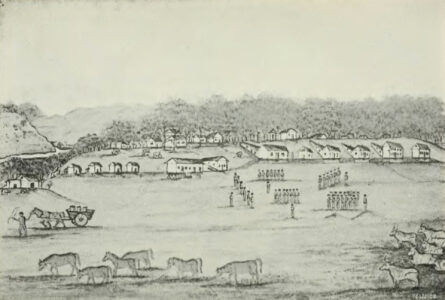
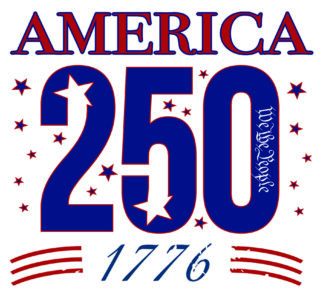
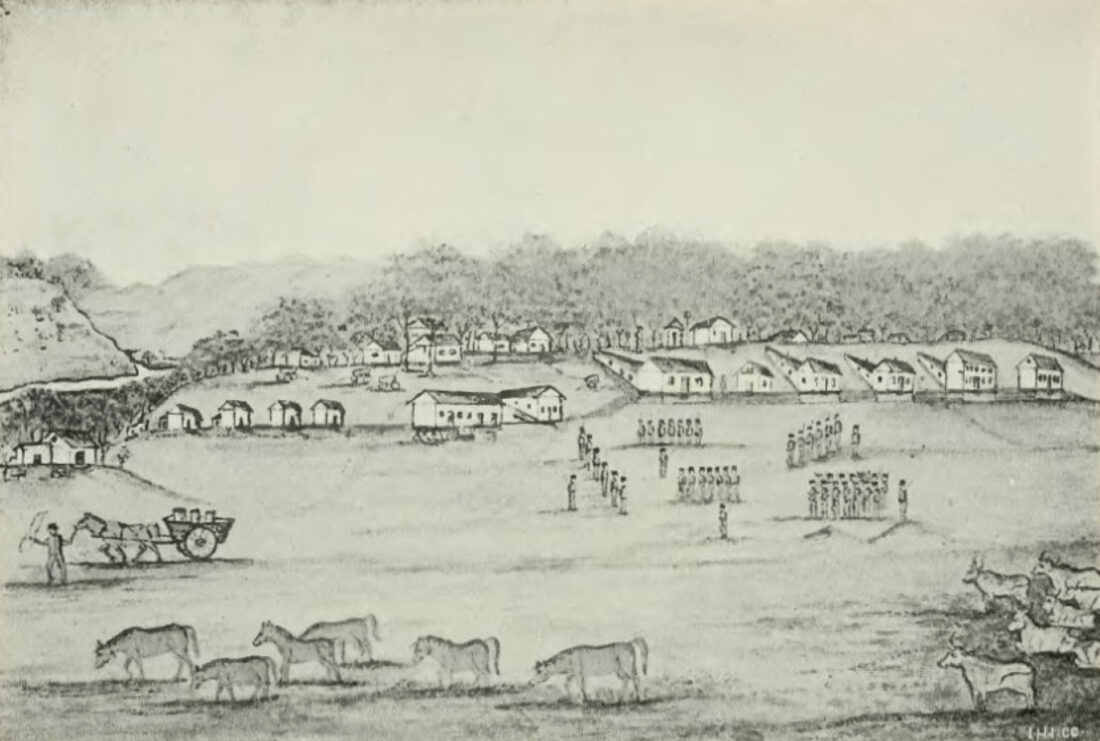
William Williams was the sutler, a civilian merchant who sold various items to the troops at the original Fort Dodge. When the troops left, he and his son James stayed behind. Williams made this drawing of the original fort.
-Submitted image
William Williams was the sutler, a civilian merchant who sold various items to the troops at the original Fort Dodge. When the troops left, he and his son James stayed behind. Williams made this drawing of the original fort.
When the American Revolution began, Fort Dodge did not exist.
In fact, Iowa did not exist. All of the land that is the state today was occupied by Native Americans and was owned by Spain in 1776. France acquired all the Spanish -owned lands in 1800.
In early 1803, President Thomas Jefferson had two American representatives approach the government of France about acquiring the port of New Orleans. French leader Napoleon Bonaparte, dealing with more pressing problems all around the world, decided he did not want to be burdened with a lot of real estate in North America. His representatives offered the Americans much more than New Orleans.
The result of those negotiations was the Louisiana Purchase of 1803, which effectively doubled the size of the United States. The United States paid France $15 million and received 828,000 square miles, including the land that is now Iowa.
Iowa was officially opened for settlement in 1833, and became a state in 1846.
Settlers moved into the general region of today’s Fort Dodge in the 1840s. There were multiple conflicts with Native Americans, and the settlers appealed to the federal government for protection.
The Army responded to those complaints by establishing a fort on the east bank of the Des Moines River, about a quarter of a mile south of where Lizard Creek empties into the river. Today, that location is the northwestern end of downtown Fort Dodge.
A document provided by the late Al Nelson, a Fort Dodge historian, provides an early account of how and why the fort was established.
The document’s author wrote:
“Situated on the Des Moines River near the junction of the Lizard Forks in what is now Webster County, Iowa.
“Established Aug. 2, 1850, by Co. E, 6th U.S. Infantry, Capt. Samuel Woods commanding two officers, 66 enlisted men and named Fort Clarke in honor of Brevet Brig. Gen. Newman S. Clark, colonel, 6th Infantry then commanding 6th Military Department. Its establishment was in accordance with a petition of the citizens of Boone County, Iowa, to Congress for military protection against incursions of the Sioux and pursuant to Orders 22, 6th Military Department, 14 July 1850.”
The post’s name was changed to Fort Dodge in 1851 in honor of the Dodge family, which was a pioneering family in Wisconsin and Iowa.
The fort was located in what is now the 300 and 400 blocks of First Avenue North, and extended south from there to the current City Square. And it was never an enclosed stockade. It was a couple rows of wooden buildings, many of which stood on the property of what is now the Human Services Building at 330 First Ave. N.
While the buildings were clustered near today’s downtown, the fort included a military reservation that extended four miles to the north and south and two miles on either side of the Des Moines River. Settlers were barred from that area.
A steam-powered saw mill was set up to cut the wood needed for the fort buildings.
The soldiers went out on regular patrols, but there were no battles. Because the area was quiet and soldiers were needed elsewhere, the fort was shut down on June 1, 1853.
The document explaining the early history of the fort provides this account:
“The post was abandoned 1 June 1853 pursuant to Orders No. 9 6th Military Department when the garrison marched to the establishment of the new position in Minnesota, Ridgeley. All movable property taken to the neighboring posts and the remainder was sold.”
Among the soldiers from the beginning was William Williams, a native of Greensburg, Pennsylvania, who had been a banker there. His role at the fort was as the sutler, a civilian merchant who sold various items to the troops. He and his son remained in Fort Dodge after the troops left.
He wrote about his experiences, and his manuscript was finally published in 1950.
Of that time after the troops departed, Williams wrote:
“After the garrison left, I and my son lived at Fort Dodge, excluded, it may be said, from the world, never having at any time more than two or three discharged soldiers with us. We lived on boiled rice, slap jacks and molasses, fish and wild fowl.”
With the fort deactivated, many land speculators were waiting for the federal government to put the property on the market. But Williams knew that the property belonged to the state of Iowa because of a federal action taken in 1846. He bought the property from the state of Iowa.
“I obtained judgement for possession and was placed in possession by an officer of the law and commenced to lay out the original plat of Fort Dodge in March 1854,” Williams wrote.
Thus, Williams was the founder and, later, first mayor of Fort Dodge.
Local News

Keeping a legacy of philanthropy alive in Fort Dodge

Iowa Central music students present Spring Showcase

America at 250: A journey through time, told through our communities
Fort Dodge began as frontier military post
Go and Do: April 3, 2026
Around the area CLARION — The Spring Coin Show will be held from 9 a.m. to 4 p.m. SATURDAY at the Heartland ...