Replanting the rural landscape
Resources available to help select trees to replace those lost by disease
-
-
-Messenger file photo by Bill Shea
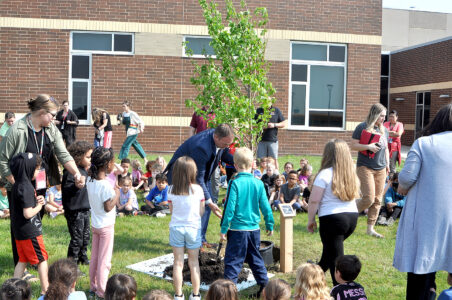
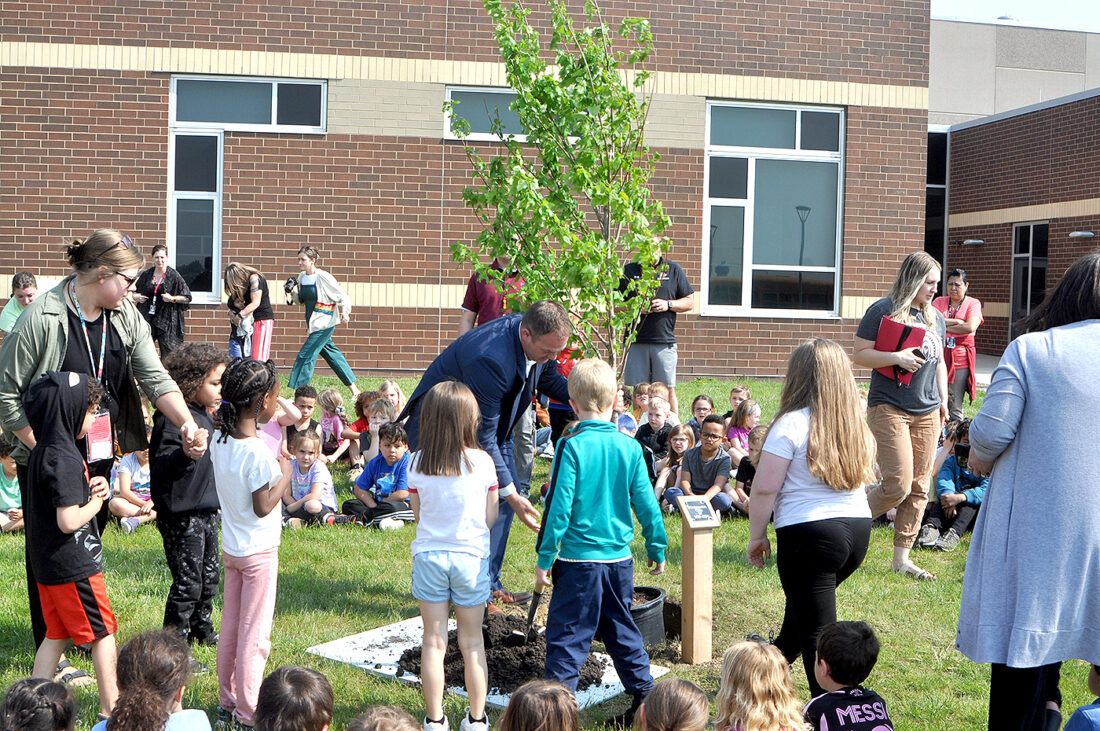
Josh Porter, superintendent of the Fort Dodge Community School District, lowers a tree into the ground as kindergarteners line up for their chance to shovel some dirt onto it. The tree was planted at Fort Dodge Middle School in May 2024.
-
-
-Messenger photo by Elizabeth Adams
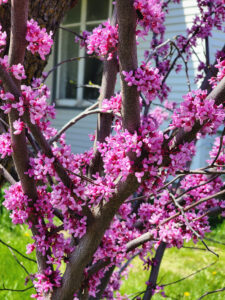
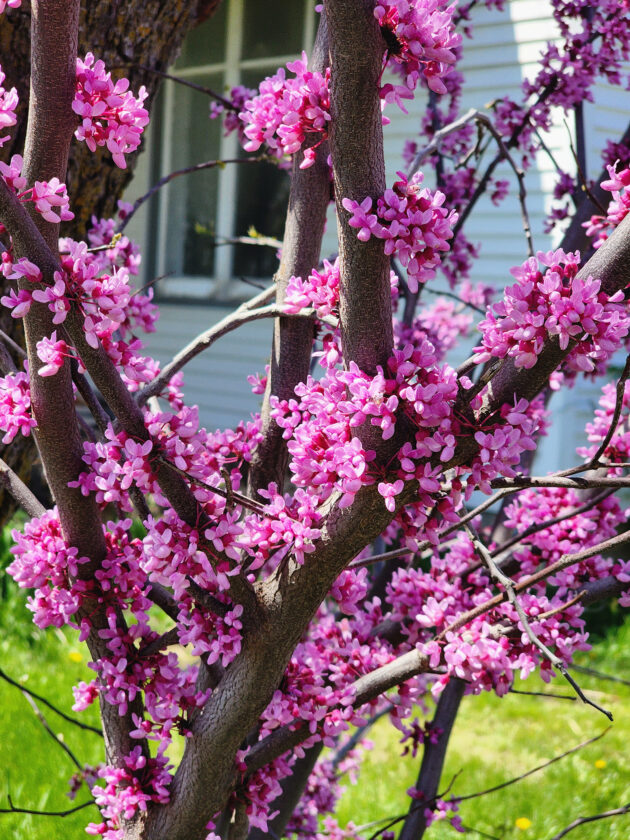
A spring redbud is pictured blooming in Bradgate.
-
- -Graphic created by Elizabeth Adams/ Information provided by Iowa Department of Natural Resources For a complete list, visit Iowa State University Forestry Extension: Trees & Shrubs Native to Iowa, https://www.iowadnr.gov/media/7589.
-Messenger file photo by Bill Shea
Josh Porter, superintendent of the Fort Dodge Community School District, lowers a tree into the ground as kindergarteners line up for their chance to shovel some dirt onto it. The tree was planted at Fort Dodge Middle School in May 2024.
Springtime will soon be making an appearance across the state of Iowa. The green is a welcome sight as trees bud out across the rural landscape.
The tree line isn’t as green as it once was, however. Over the last few years, ash trees have died back significantly. This is a direct result from the effects of the emerald ash borer. The emerald ash borer, or EAB, has contributed to an incredible amount of damage in the loss of many ash trees. To many homeowners, this may seem familiar.
Discovered in the U.S. during the 1930s, Dutch elm disease, or DED, made its way to the Midwestern states. By the early 1970s, DED had decimated an estimated 77 million elm trees in urban areas alone (USDA Forest Service DED). Iowa residents and farmers were faced with clearing mature Dutch elm trees and replanting. Groves, where the main species were elm, were sometimes replaced entirely with ash trees.
Dutch elm disease is caused by a fungus that spreads by bark beetles and through the root systems from tree to tree. The emerald ash borer is a beetle that kills a tree by burrowing and creating tunnels that essentially “girdle” the tree; thus, destroying the tissues that transport water (xylem) and sugars from photosynthesis (phloem).
According to the Iowa Department of Natural Resources, emerald ash borer damage is slated to rival or surpass any forest pest that Iowa has seen in the past.
-Messenger photo by Elizabeth Adams
A spring redbud is pictured blooming in Bradgate.
Strategic tree replanting has never been more apparent, and diversity should be at the forefront of the solution.
Iowa is native to many hardwood species of trees and shrubs. Native species are well adapted and have developed over hundreds or thousands of years in a particular ecosystem. Native trees and shrubs create habitat, provide food for wildlife and create lasting beauty in their environment. While ornamental species are nice to look at and provide aesthetic appeal, they may not be well suited and may not withstand the trials of Iowa’s unique climate.
Many resources are available on selecting the right trees for one’s home or farm. I-Tree (https://design.itreetools.org/) offers an online database where users can input specific trees they would like to plant and see their growth on a real-time map. This is particularly helpful when replanting tighter spaces for homeowners who live in residential areas.
The Iowa Department of Natural Resources state nursery offers native trees and shrub seedlings at a bulk rate. The nursery publishes a seed catalog that can be accessed at nursery.iowadnr.gov.
Lastly, Iowa State University offers publications on ash tree alternatives, promoting native wildlife and many other resources available for free download on their extension store website; https://shop.iastate.edu.
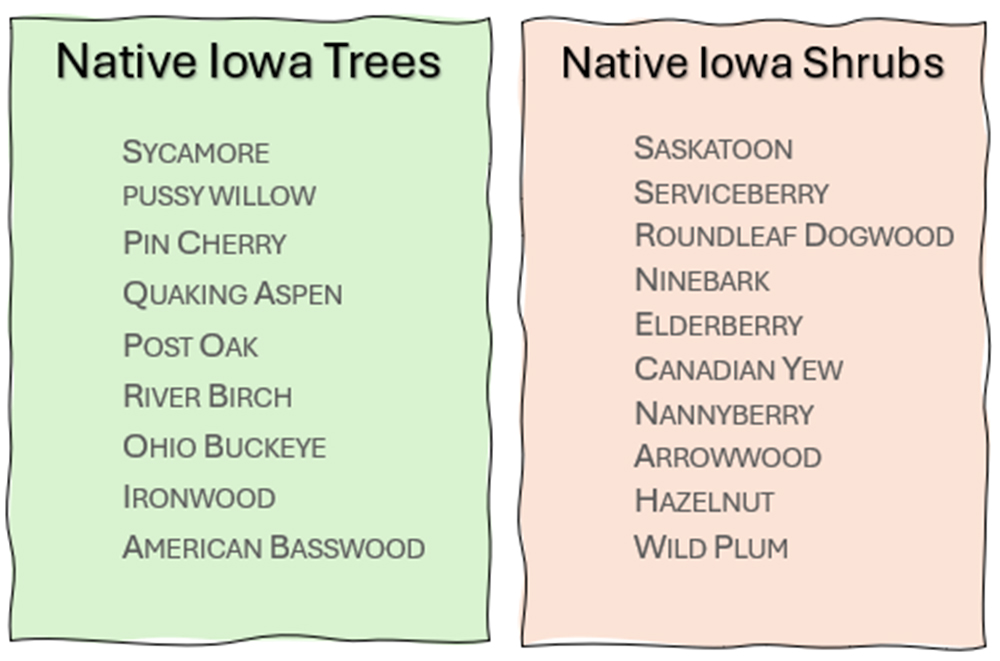
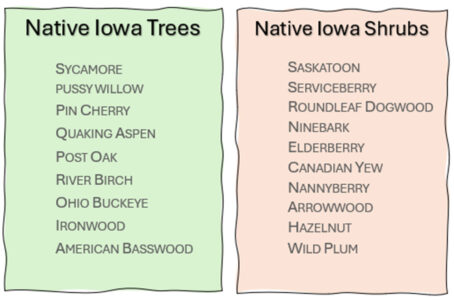
-Graphic created by Elizabeth Adams/ Information provided by Iowa Department of Natural Resources For a complete list, visit Iowa State University Forestry Extension: Trees & Shrubs Native to Iowa, https://www.iowadnr.gov/media/7589.
Also, for gardening and planting questions or tips, go to yardandgarden.extension.iastate.edu.
Local News
Replanting the rural landscape
FDCSD, Kandiland team up
‘Winter’s not over yet’
FD Police Department solves canine caper
A couple of dogs that got loose in the middle of Sunday night’s blizzard made it home safely thanks to the help ...
McCuddin charged with stabbing sister, nephew
The grim specter of homicide has touched the McCuddin family of Fort Dodge once again. On Oct. 2, 2004, Lisa ...