Property tax talk fills forum
Lawmakers also discuss education challenges
-
-
Messenger photo by Bill Shea
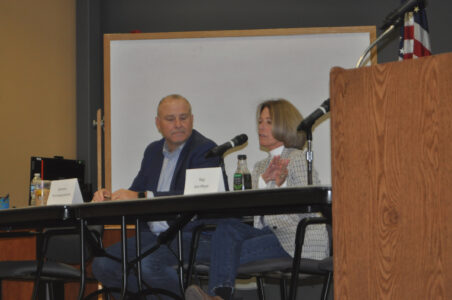
State Sen. Tim Kraayenbrink, R- Fort Dodge, and state Rep, Ann Meyer, R- Fort Dodge, participated in an Eggs and Issues forum Saturday morning at Iowa Central Community College.
-
-
Messenger photo by Bill Shea
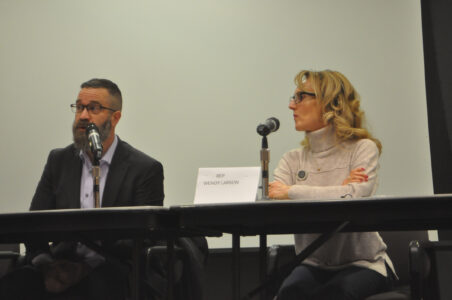
State Sen. Jesse Green, R-Boone, speaks Saturday morning at an Eggs and Issues forum while state Rep. Wendy Larson, R- Odebolt, listens.
Messenger photo by Bill Shea
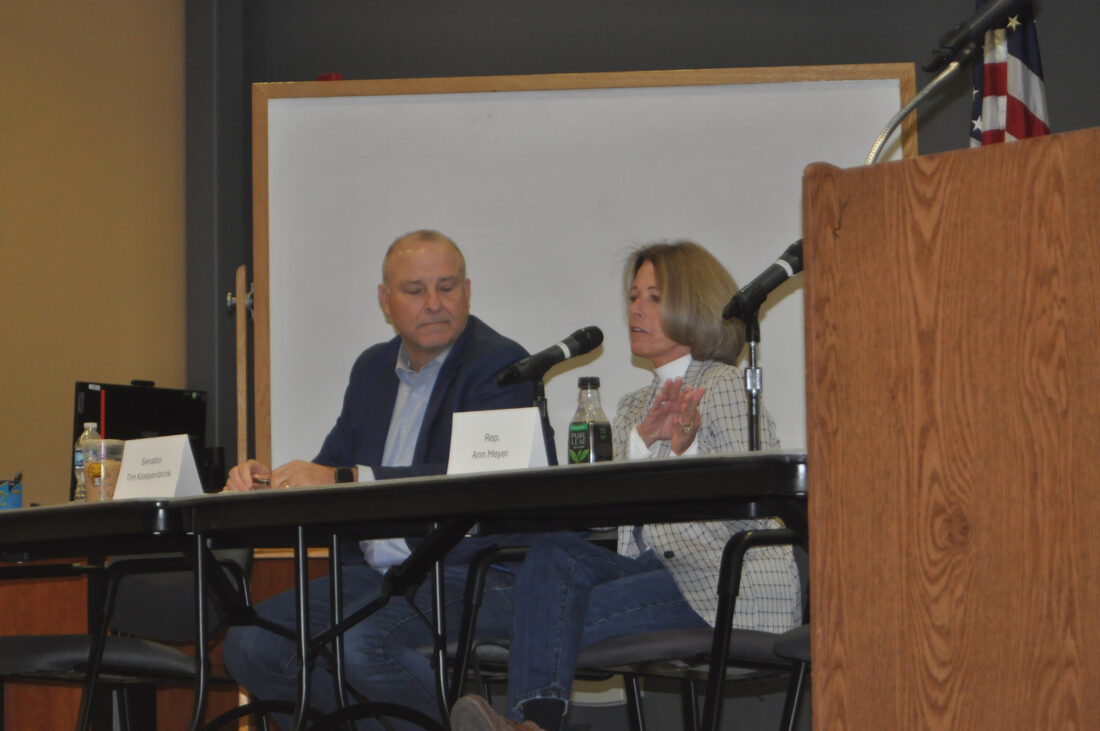
State Sen. Tim Kraayenbrink, R- Fort Dodge, and state Rep, Ann Meyer, R- Fort Dodge, participated in an Eggs and Issues forum Saturday morning at Iowa Central Community College.
Iowa lawmakers have been talking about doing something with property taxes since the legislative session began in early January. Now the state Senate is getting ready to advance a proposal.
State Sen. Tim Kraayenbrink, R-Fort Dodge, said during an Eggs and Issues forum Saturday that he expects the Senate to vote on its property tax bill within the next two weeks. But that bill won’t be the final word on property taxes this year, he said.
There are property tax plans developed by Gov. Kim Reynolds and Republicans in the Senate and the House of Representatives. What finally emerges will be a compromise, he said.
“It won’t be one or the other,” Kraayenbrink said. “It will be a combination or blended version for property taxes.”
During the forum, lawmakers also expressed some frustration with education, which consumes millions of dollars worth of state money each year, but reports still emerge of students getting to college without adequate reading skills.
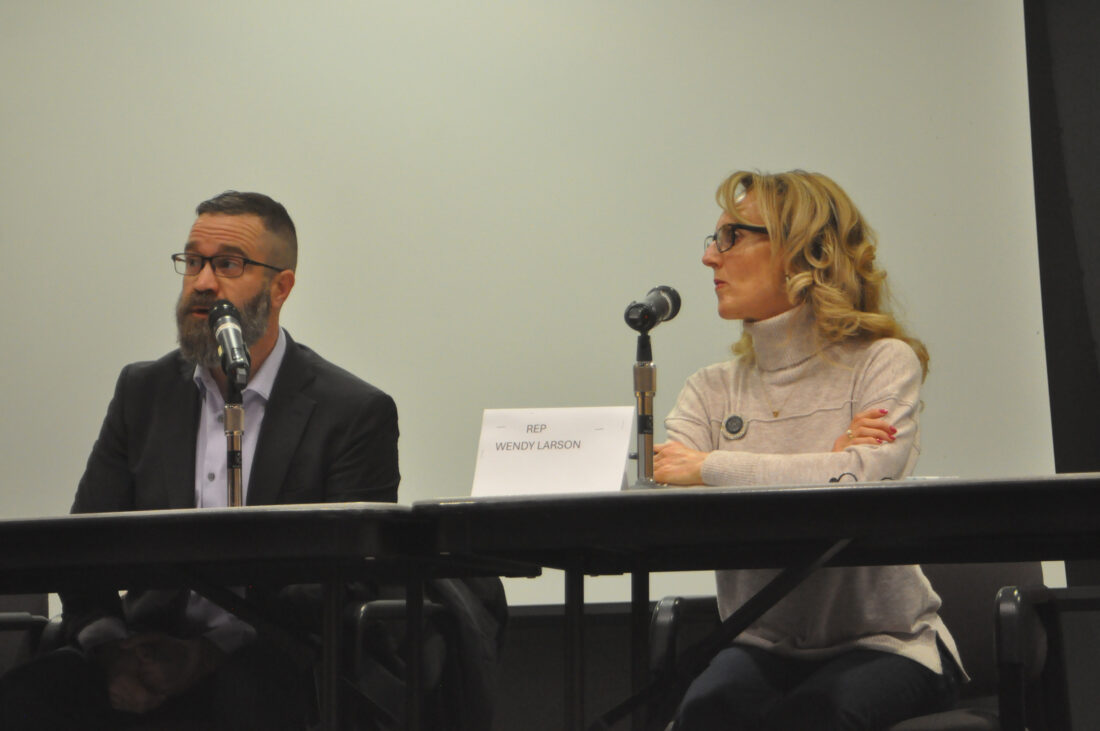
Messenger photo by Bill Shea
State Sen. Jesse Green, R-Boone, speaks Saturday morning at an Eggs and Issues forum while state Rep. Wendy Larson, R- Odebolt, listens.
State Rep. Ann Meyer, R-Fort Dodge, said the cause of some of the problems can be found outside of the classroom.
“We’ve got kids that do not have the support at home,” she said.
“I don’t think it’s a failure of our school systems,” she added. “I think it’s somewhat of a failure of our greater society.”
Kraayenbrink and Meyer were joined at the forum by state Sen. Jesse Green, R- Boone, and state Rep. Wendy Larson, R- Odebolt.
About 30 people attended the forum at Iowa Central Community College. Eggs and Issues is sponsored by the college and the Greater Fort Dodge Growth Alliance.
Property taxes
The property tax bill being drafted by Senate Republicans seems to have the most momentum right now.
Its major provisions include:
• Exempting from property taxes those who are over 60 years old and have paid off their mortgages
• Allowing local governments to implement a 1.5 cent local option sales tax with voter approval
• Eliminating many property tax credits
• Eliminating the roll back which determines what percentage of a property’s value is taxable
• Implementing a 2 percent cap on the growth of local government revenue
• Implementing a fuel tax index to help pay for road and bridge work
Kraayenbrink estimated that the fuel tax index would cost families an additional $42 a year.
He said putting a property tax freeze in place isn’t a good idea because it makes no sense to freeze something that people think is already too high.
“I think it has to be a drastic drop in property taxes and then we have to make up that revenue that is lost through other sources that are basically broader than just property taxes and continue to be on top of our elected officials so that we’re not spending money frivolously in our cities and in our counties,” he said.
Green said he believes the insurance costs of local governments, which add to the property tax bills, need to be addressed in some way. He said every year local governments see double digit increases in their insurance costs. Those costs are outside of the control of local governments, he added.
“There needs to be a discussion about this,” he said. “Sadly, I don’t think it’s going to happen this year.”
Green said he also believes tax increment financing needs to be examined as part of any property tax reform.
Tax increment financing occurs when an increase in property tax revenue from a designated area is set aside to be reinvested in that area, and thus does not go into a local government’s general fund.
Green said he thinks TIF gets used a lot because of “a loose definition of economic development.”
“I do think there has been some abuse of TIF across the state,” he said.
Education
A written question posed by an audience member asked the lawmakers “If kids in college can’t read, why are we increasing education spending?”
“It is a frustrating thing,” Larson answered.
She listed some recent statewide educational achievements, such as increases in test scores for third graders.
But she added that school district administrative costs are going up when enrollment is going down.
Kraayenbrink said he believes teacher training programs at colleges and universities are turning out graduates who aren’t up to the job.
“Teachers aren’t taught to teach,” he said.
Meyer said there has to be more “support resources” in the schools because today’s students aren’t getting the support that previous generations received at home.
She added that teachers are burdened by state mandates and by the need to do so much more for their students than previous generations of teachers had to provide.
Local News
Property tax talk fills forum
An unexpected stage
Iowa Central performs ‘Prince of Egypt’
Iranian state media say country’s supreme leader is dead
Property taxes, education discussed at forum
By BILL SHEA bshea@messengernews.net Iowa lawmakers have been talking about doing something with property taxes ...