
Lawmakers talk education, taxes
Resolution still being sought on eminent domain in Iowa
-
-
-Messenger photo by Bill Shea
Area lawmakers, from left, state Sen. Tim Kraayenbrink, R-Fort Dodge; state Rep. Wendy Larson, R-Odebolt; and state Rep. Ann Meyer, R-Fort Dodge, prepare for Saturday’s Eggs and Issues forum in the BioScience and Health Science Building at Iowa Central Community College. Forum moderator Randy Kuhlman is at right.
-Messenger photo by Bill Shea
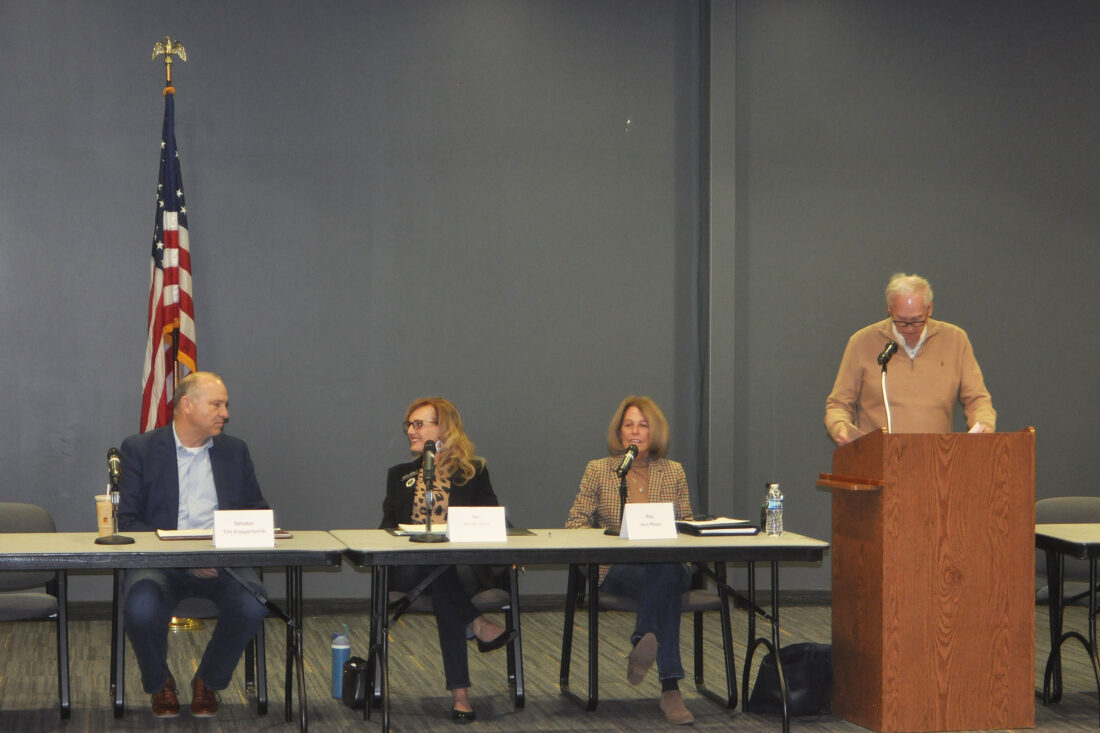
Area lawmakers, from left, state Sen. Tim Kraayenbrink, R-Fort Dodge; state Rep. Wendy Larson, R-Odebolt; and state Rep. Ann Meyer, R-Fort Dodge, prepare for Saturday’s Eggs and Issues forum in the BioScience and Health Science Building at Iowa Central Community College. Forum moderator Randy Kuhlman is at right.
Local legislators still wrestling with potential property tax and eminent domain changes were asked during a Saturday forum to explain their position on funding for education.
State Rep. Wendy Larson, R-Odebolt, said during Saturday’s Eggs and Issues forum that statewide the number of students has decreased while the number of school district administrators has gone up.
Last year the legislature raised the minimum starting pay for teachers to about $50,000, according to state Sen. Tim Kraayenbrink, R-Fort Dodge.
And while the starting pay has increased, so have the challenges teachers face in the classroom, he said.
“Overall, it is much, much harder to be a teacher,” he added.
Lawmakers meanwhile continue to work on the two dominant issues of the 2026 legislative session: property tax reform and the use of eminent domain by companies building carbon dioxide pipelines.
State Rep. Ann Meyer, R-Fort Dodge, said the House Ways and Means Committee passed a property tax bill last week.
“There are a lot of good things in it,” she said.
Meyer also said that the House passed a ban on the use of eminent domain and sent it to the Senate early in the legislative session.
About 35 people attended the forum at Iowa Central Community College. Eggs and Issues is sponsored by the college and the Greater Fort Dodge Growth Alliance.
Education
During Saturday’s forum, the lawmakers were asked what they intended to do about the fact that, in the audience member’s opinion, state funding for education has not kept up with inflation for the last six years. None of them directly answered that question. But they did comment on various elements of education funding and policy.
Larson said student enrollment is down, but the number of school district administrative employees is up 12 percent.
“We have more people managing less children,” she said.
She said education spending accounts for 54 percent of the state’s $9.2 billion budget.
Kraayenbrink said the increase in administrative personnel is in part a response to some of the challenges schools face today. He said he has heard of schools that have three or four vice principals who do nothing but deal with behavioral and discipline problems.
The senator also suggested changing the way teacher preparation programs are conducted in colleges and universities. He said young teachers graduate from college, get a job and then end up quickly going back to college to get an endorsement in reading instruction, or teaching students that have a learning disability such as dyslexia. He proposed scrapping some of the general education requirements prospective teachers have to complete while they are in college so that they can instead get their various endorsements and head to their first job fully prepared.
Property taxes
Meyer said the property tax reform proposal in the House exempts the first $25,000 of a home’s value from taxation.
She said there has been discussion about exempting people age 65 and older from property taxes altogether. She said the $25,000 exemption in the House bill is a more equitable approach because “everyone is struggling with property taxes.”
She said the House bill also puts a 2 percent limit on the growth of property tax value, but excludes the value of new growth.
Kraayenbrink said the Senate property tax bill is “pretty radical.”
Its major provisions include:
• Exempting from property taxes those who are over 60 years old and have paid off their mortgages.
• Allowing local governments to implement a maximum 1.5 cent local option sales tax with voter approval.
• Eliminating many property tax credits.
• Eliminating the roll back which determines what percentage of a property’s value is taxable.
• Implementing a 2 percent cap on the growth of local government revenue.
• Implementing a fuel tax index to help pay for road and bridge work
Kraayenbrink estimated that the fuel tax index would cost families an additional $42 a year.
He also repeated his stance that property taxes are the responsibility of local officials, not state legislators.
“You want us to fix something that we’re really not in charge of,” he said.
He said every community has different needs and tax bases.
“How can we set up a tax policy for the whole state of Iowa when these communities are so different?” he asked. “That’s what frustrates me on this.”
Any property tax reform that emerges from this year’s legislative session will be a combination of proposals from the Senate, House and Gov. Kim Reynolds, he said.
Eminent domain
In January, the House passed a bill that would prohibit the use of eminent domain for the construction of carbon dioxide pipelines.
Eminent domain is a process in which a buyer can obtain land from an unwilling seller. Once granted the power of eminent domain, the buyer gets an appraisal of the property, pays that amount to the owner and takes the land.
Summit Carbon Solutions is seeking to use eminent domain to get property for the construction of a pipeline that will carry carbon dioxide from Iowa ethanol plants to a place in North Dakota where it will be sequestered underground.
Larson and Meyer voted in favor of the bill.
“The House is very united in protecting private property,” Larson said Saturday.
The measure went to the Senate. The Senate Republican caucus favors a plan that would widen the corridor where the pipeline could be built. The general concept is that with more land to work with the need for eminent domain will be reduced and maybe eliminated.
The House and Senate must still come to an agreement on eminent domain legislation.
Local News
FD city yard waste site to reopen
The Fort Dodge Public Works Department compost site at the central garage, 3001 Eighth Ave. S., will open to ...

The hunt is on
Fort Dodge officials look to future of sewer projects
Heavy rains regularly meant trouble in Fort Dodge a decade or so ago. Many residents would have sewage backing up ...

Excellence honored
Property tax rate hearing draws little attention
A potential 14-cent increase in the property tax rate for the Fort Dodge city government received scant interest ...