Barn with a purpose
Farming and family go together for Kamrar couple
-
-
-Messenger file photo by Lori Berglund
Wayne and Barb Blue stand in front of their barn on the home place where Wayne has lived most of his life north of Kamrar.
-Messenger file photo by Lori Berglund
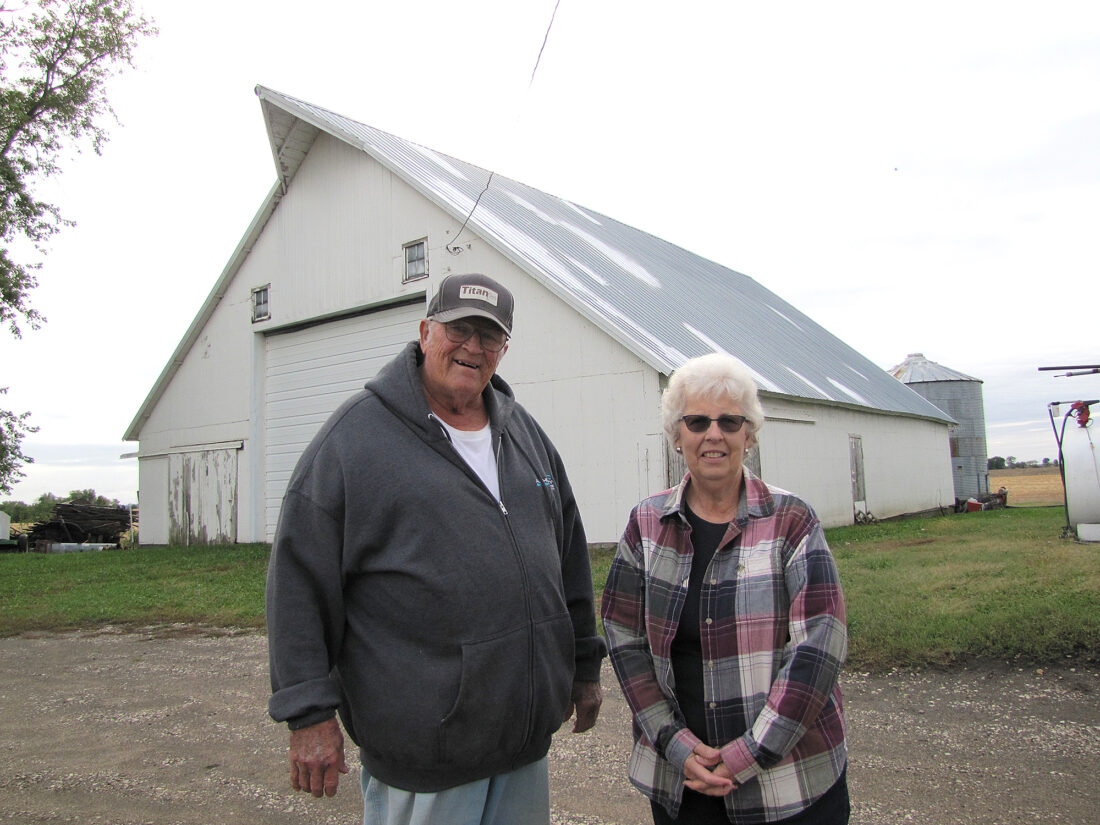
Wayne and Barb Blue stand in front of their barn on the home place where Wayne has lived most of his life north of Kamrar.
Editor’s note: This feature first ran in a special Farm News publication called Barns of Iowa, published Nov. 28, 2025.
KAMRAR — “I wish this old barn could talk,” said Wayne Blue of the barn on the home farm where he has lived most of his life.
That old barn would indeed have some good stories to tell from more than a century of farming. There were good years, bad years, drought years, and times when it seemed to rain without ceasing — it even dodged a tornado that ripped across the neighborhood back in the 1970s.
When it was built, farmers picked corn by hand. Now it houses combines that do in one operation the tasks of picking and shelling that used to require days, weeks, and help from the neighbors when it was time to shell-out a crib.
“It was built, I guess, in the early 1900s,” Blue said. “It had an old rock foundation all the way around it. I’m sure they had cows, horses, and all whatnot. There was a milking parlor on the north side of the barn with several cow stanchions.”
Blue was about 9 years old when his parents, the late Anthony and Jennie (Koop) Blue, moved their young family on to the place. The farmstead had originally been part of the Mamminga family, another common name in this part of Hamilton County.
“I’d hate to guess how many hours as a kid I spent in that barn shooting BB guns,” he recalled.
There were also plenty of hot summer days when it was time to put up hay to feed the cattle for cold winter days ahead.
“We sweated up there putting up bales in the summer,” Blue said. “It had to be the hottest place in the world up there in the haymow.”
Every farm had milk cows in those days, and it was usually his brother’s job to get those chores done first thing in the morning. “I never got to do any milking, but my brother Gary did,” Blue recalled. “He had to milk three cows before he went to school.”
By the time his parents bought the farm, the stone foundation was already starting to show its age.
“He hired a crew and put a new foundation under it and new steel all around it,” Blue said of his father.
The family originally lived nearby on another farm and had calves in a lot on this site. When his dad arrived one evening to check the calves and found evidence of someone trying to rustle calves, it was time to move onto the place.
“We had a gate to this place so that nobody could get in,” Blue said. “He came over and the gate was open, and he thought maybe he had forgotten to close it. When he got close, he could see some filings where someone had cut the padlock off and they were getting ready to possibly rustle some calves out of there. After that, we moved over here.”
Blue would eventually raise his own family here with wife, Barb. The two met while she was working at the legendary M & M Cafe at Blairsburg. They have two grown children, Tony and Michelle.
As the years went by, farming changed. The family no longer raised cattle, but did raise hogs for many years. They had 15 farrowing stalls on the north side of the barn and 14 stalls on the east, all with pits underneath. Eventually they got out of the hog business to concentrate on grain farming. Again, the barn started to show its age.
“The barn was just standing here and the roof was starting to deteriorate,” Blue said. “I thought, ‘It’s either going in a pile or I’m going to put a roof on it.’ So it got a new steel roof.”
But the barn also needed to be useful, and its unique design allowed it to adapt to yet another new use. While many barns have beams and structures that can’t be readily moved, Blue was able to redesign it just enough to be able to drive a combine through it.
“We put a roller door on the front and cut through the haymow,” he said. “The beams were high enough so that we didn’t have to worry about combine clearance. Now the barn serves a purpose again and it keeps machinery dry.”
At 72 feet long, the Blues can actually fit three combines inside, nose to back. There is no thought of retiring. He’s having too much fun getting to farm now with three generations of his family, including his son, Tony, and Tony’s son, Tanner Blue.
“It kind of gives you a nice feeling,” he said. “When we’ve the three combines running, with Tony and Tanner running in front of me and I’m coming from behind, I just look at them and it really makes you feel good.”
Local News
River Valley Rockhounds hold 61st Rock, Gem, Mineral, Jewelry and Fossil Show
From our files: March 2011
FD council to consider second EMS agreement
The Fort Dodge City Council will consider a second agreement with Webster County for receipt of money from the ...

St. Edmond hires new vocal music director
Barn with a purpose