
Growing leaders
Young farmers urged to get involved in Iowa Corn Growers Association
-
-
-Photo courtesy of Jerry Maier
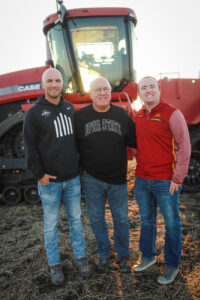
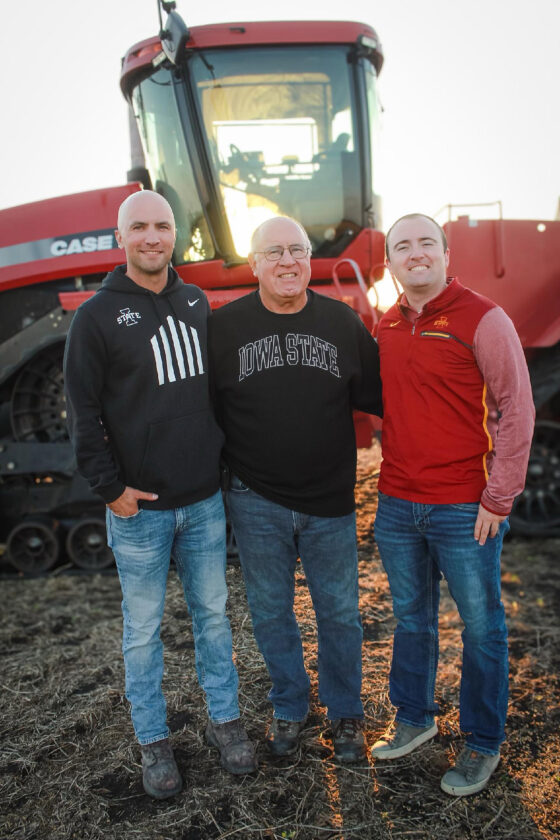
Iowa Corn Promotion Board member Jerry Maier enjoys spending time in the field with sons Brandon, left, and Brett, right.
-Photo courtesy of Jerry Maier
Iowa Corn Promotion Board member Jerry Maier enjoys spending time in the field with sons Brandon, left, and Brett, right.
Growing corn? That’s big business in Iowa.
Growing leaders? That can be a lot harder on this land between two rivers that produces more corn than any other state in the nation.
“I grow it, so I want to help move it and protect it,” said Jerry Maier, a long-time activist with the Iowa Corn Growers Association and member of the Iowa Corn Promotion Board.
A 1977 graduate of Eagle Grove High School, Maier grew up helping on his family’s Wright County farm. After high school, he headed off to Iowa State University, earning a degree in agriculture in 1981.
“I started driving a tractor when I was probably 8 or 9 years old,” he recalled. “I just enjoyed working the ground and growing crops. Farming is something new every year.”
But the early 1980s was a tough time to return to the family farm. His parents would actually leave Iowa for Tennessee before the decade of the Farm Crisis was over.
“The ’80s were really hard on my mom and dad’s operation,” Maier said. “I shared some equipment with my folks when I was in college, but I never really did farm any of the ground that they did.”
Like many small farmers, Maier found that the only way he could make it was to find an off-farm job — sometimes working two or three jobs at the same time as farming. Slowly, he was able to build his own successful operation. It is perhaps because of these struggles that he sees the value in becoming involved in an organization such as the Iowa Corn Growers.
“My dad always thought that if you are going to be involved, then do something; you need to put something back into it,” he said. “The Corn Growers was a good organization to do that.”
His dad also set a strong example of taking an active role in one’s community.
“Dad was on the fair board for a lot of years; he was on the co-op board, and that’s just the way we were brought up,” Maier said. “You give back to your community.”
Maier’s own involvement with the Iowa Corn Growers Association began in 1981, but in those early years he chose to only do things at the local level.
“When I started, I stayed local for a long time because of the amount of time it takes,” he recalled. “It’s only three meetings a year, but if you really want to be involved, it’s a lot more than that.”
For young farmers, especially those with a family, Maier encouraged that getting involved at the local level is a great way to start. The time commitment is what you make it, and it can be a way to start learning more about the organization and how it works on behalf of corn producers.
“My big thing is that I would like to see the young guys get involved, even just getting our newsletter,” he said. “Start receiving the information and learn what we do, even just in the legislative area.”
Representing District 2 in north central Iowa on the Iowa Corn Promotion Board, Maier is part of a 12-member board that oversees the use of checkoff dollars. As noted by the Iowa Corn Growers Association, the checkoff dollars are focused on “market development, education and research.”
Board members are elected annually from each of the nine crop districts in Iowa. The board also includes four ex-officio members.
While even some farmers often struggle with the checkoff program, Maier is a ready defender of its purpose and value to grow the market for corn producers.
“If you’re not willing to step up and promote your product, who do you expect to do it?” he asked. “The end-users, or someone like that, they have their own interests involved. The Corn Growers, we step up and represent you and your products, legislative-wise, and much more.”
Maier noted checkoff dollars have been used to improve research and genetics for such things as finding ways to develop varieties that will better tolerate drought.
“I always try to explain to people that the checkoff is a very good thing, doing a lot of things to help make farming more sustainable, more profitable,” he said.
During tough economic times, Maier said the value of the checkoff dollars only grows.
“Right now, we’re in a tough time, but even when you do everything right, you can still be in a tough time.”
In his part of Iowa, yields have suffered in recent years due to a variety of weather concerns, according to Maier.
“We’ve had too much rain, too much hail, and our yields have not been real good for the last four years, but I’m an optimist,” he said. “Every farmer is an optimist.”
High input costs are yet another factor making it tough on farmers in the current economy, Maier noted.
“It makes it tough because we do rely on fertilizer to grow these crops, and if we can’t feed the livestock for the cattle industry, that impacts the price people have to pay for meat in town,” he added.
From corn to calves, it’s all connected, and the Iowa Corn Growers Association helps connect those dots into the fabric of American agriculture. Maier sees great value in getting involved, and working to protect and grow the corn market for the long-term future.
During his own years with the Iowa Corn Growers Association, Maier has served on numerous committees and focus groups. He has served as vice chair of the Iowa Corn Research and Business Development Committee, chair of the Iowa Corn Usage and Production Committee and a member of the Animal Ag and Environmental Committee. He has served on the National Corn, Food, Feed and Industrial Committee, U.S. Grains Council Innovation and Sustainability, and Asia Advisory Teams, as well as many more gropus at the local, state and national level.
But don’t be daunted by his long resume. For Maier, it all started at the local level in Wright County.
And, for most farmers, that local involvement can make all the difference. Getting involved beyond that is always a personal choice.
“I would just like to see more young farmers get involved,” he emphasized. “Start learning about what we do.”
Local News
Growing leaders
School funding bill to help with transport costs
Farnhamville, Stratford sharing agreements approved
The Webster County Supervisors approved sharing agreements with the Reading-Cedar fire and ambulance service in ...
Ag in the Classroom presents ‘Right This Very Minute’
CALHOUN COUNTY — “You need a farmer” was the message that came through clearly when Kalene Berte, Ag in ...
Council launches multiple projects
Death of cartel leader makes travel unsafe
When news broke this weekend about the death of Oseguera Cervantes in Mexico—'El Mencho’, it seemed like a ...