
Lee Bailey — U.S. Army
Bailey survived blast in South Vietnam
-
-
-Messenger file photo by David Borer
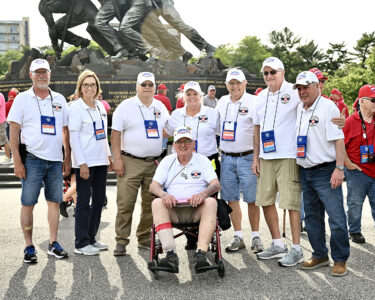
The Brushy Creek Area Honor Flight staff at the US Marine Corps War Memorial in May 2025, from left, Darron Baker, Peggy Dettmann, Lee Bailey, Orene Cressler, Mel Schroeder, Craig Malloy, and Russ Naden, with Ron Newsum seated in front.
-Messenger file photo by David Borer
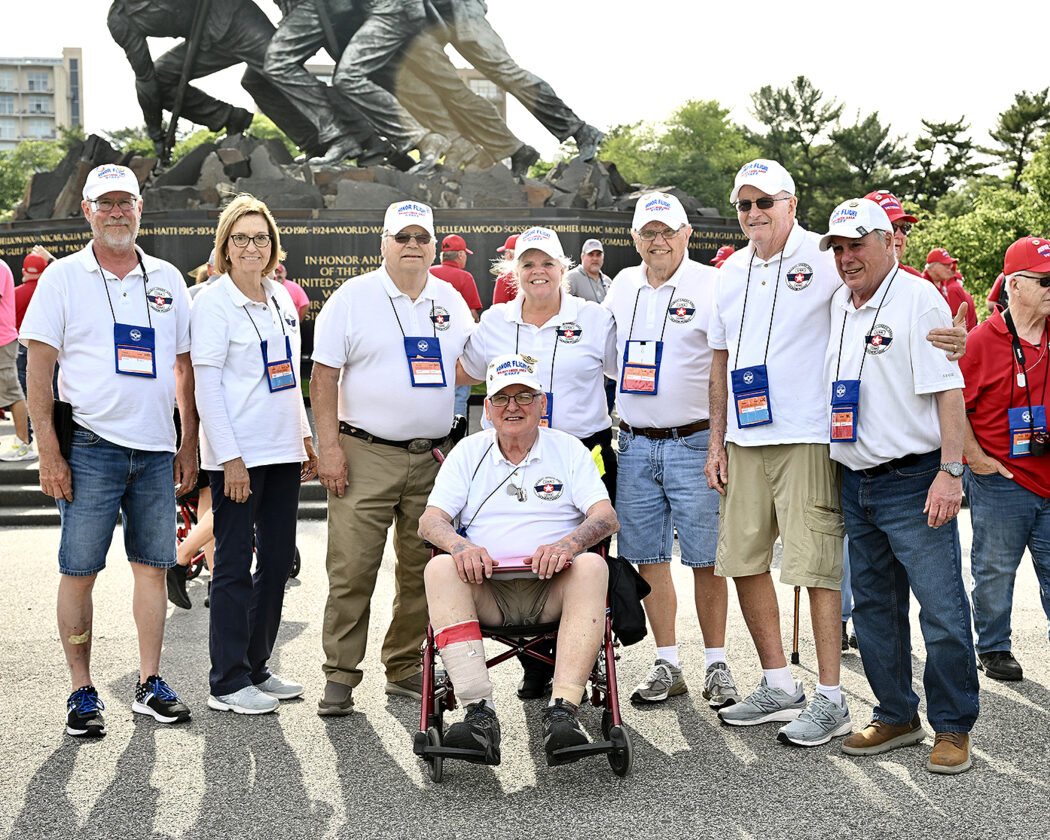
The Brushy Creek Area Honor Flight staff at the US Marine Corps War Memorial in May 2025, from left, Darron Baker, Peggy Dettmann, Lee Bailey, Orene Cressler, Mel Schroeder, Craig Malloy, and Russ Naden, with Ron Newsum seated in front.
LAURENS — It was a hot, steamy night in South Vietnam when Lee Bailey settled down atop his armored personnel carrier to rest.
The next thing he remembers is being in a military hospital with burns covering 51 percent of his body.
He suffered those burns when an armor-piercing round hit his armored personnel carrier, causing an explosion and fire. His doctors didn’t think he was going to make it back to the United States. He defied their expectations, and was back on a tractor soon after returning to Pocahontas County.
Bailey is a native of Pocahontas who graduated from Pocahontas High School. He was drafted into the Army in February 1968.
He was sent to basic training at Fort Bliss, Texas. That fort, he said, is right next to the White Sands Missile Range, which is across the border in New Mexico. He recalled that as part of basic training the soldiers would camp in ankle deep sand at the missile range.
After he completed basic training, Bailey was sent to Fort Knox, Kentucky, to learn how to work with tanks and armored personnel carriers. He was assigned to an armored personnel carrier, a tracked vehicle that carries troops, but doesn’t have the big guns of a tank.
He was taught to drive an armored personnel carrier. To steer the carrier,he said, the driver used two sticks. To go straight ahead the driver pushed both sticks forward. To turn right,the driver moved the stick on the right. To turn left, the driver moved the stick on the left.
Bailey did not drive the armored behemoth much because he was assigned as a gunner, firing one of the machine guns that were the carrier’s weapons.
He was sent to South Vietnam and was assigned to the 23rd Infantry Regiment.
That unit was based on the coast near Chu Lai. Bailey said there was a beautiful beach near the base.
“It didn’t look like a war zone until they sent you out into the boonies for a patrol,” he said.
The explosion that badly wounded Bailey happened on a high point the Army called Hill 29. His armored personnel carrier had been sent to hold a position there.
The four soldiers who made up the crew of the armored personnel carrier got on top of it to rest because it was too hot to sleep inside of it, Bailey said.
While they were on top of the carrier, an armor-piercing round hit the side of the machine and blew up some C4 explosive in it, Bailey said. The resulting blast threw all four soldiers off of the carrier. Two of them were killed, Bailey and another man were wounded.
He was taken to an Army field hospital in South Vietnam, then to a hospital in Japan. Then he was taken to a hospital at Fort Sam Houston in San Antonio, Texas. He was in that hospital for two months receiving treatment that included skin grafts.
He said after those two months, he was sent home for 30 days. He was told to just rest.
He did not follow the doctor’s orders.
“I was a farm kid,” he said. “It was harvest. I jumped on a tractor.”
He said after his first day on the tractor the legs of his pants were soaked in blood.
His skin grafts held secure, however. He learned that other burn patients from that Army hospital who just rested lost their skin grafts and had to have the procedure done again.
“Maybe I did it right,” he said.
The Army was not done with him, however. After his 30-day leave he returned and was assigned as a clerk. He said in that role he “wrote my own early out,” completing the paperwork that resulted in his discharge from the Army.
Bailey returned to Pocahontas County and farmed until his retirement in 2010.
He joined the board of the Brushy Creek Area Honor Flight and worked on 23 of the first 27 flights.
Local News
Reward increased again in shooting case
Sick days continue
FD man arrested after chase ends in crash
A driver who led police on a pursuit through Fort Dodge at speeds of up to 80 miles per hour early Friday morning ...
Former county official joins Growth Alliance staff
Former Webster County Recorder Lindsay Laufersweiler has been named the new community engagement director of the ...
FDSH students to build She Sheds
The SkillsUSA club at Fort Dodge Senior High School is holding a unique fundraiser this spring The club, led by ...
Go and Do: Feb. 13, 2026
In Fort Dodge FORT DODGE — The Iowa Central Community College Band will perform a Valentine concert at 7 p.m. ...